
Unit 8 - Advanced Calculus (HL only)
Required Prior Knowledge
Questions
Consider the binomial expansion of \(\sqrt[3]{1+3x}\)
a) Determine the first five terms of the expansion
b) State the interval of convergence for the complete expansion
c) Using a suitable value of \(x\), estimate the value of \(\sqrt[3]{1.3}\)
d) Calculate the percentage error of your estimation
Solutions
Get Ready
Questions
Consider the two functions$$P(x)=a_{0}+a_{1}x+a_{2}x^{2}+a_{3}x^{3}+a_{4}x^{4}+a_{5}x^{5}$$and$$f(x)=\ln \left(1+x\right)$$You are going to examine the behaviour of both functions at \(x=0\):
a) If \(f\left(0\right)=P\left(0\right)\), find \(a_{0}\).
b) Find the derivatives \(f’\left(x\right)\) and \(P’\left(x\right)\).
c) Use these to solve \(f’\left(0\right)=P’\left(0\right)\), and find \(a_{1}\).
d) Use a similar method to find the derivatives \(f^{\left(n\right)}\left(x\right)\) and \(P^{\left(n\right)}\left(x\right)\) for \(n=2,3,4,5\), then solve the equation \(f^{\left(n\right)}\left(0\right)=P^{\left(n\right)}\left(0\right)\), to find the value of \(a_{n}\). Do NOT simplify the fractions you get as an answer.
e) Find an expression for the coefficient \(a_{n}\) of the polynomial in terms of \(f^{\left(n\right)}(0)\) and \(n\).
f) Write out the full polynomial \(P\left(x\right)\), simplifying the coefficients.
g) Draw the graphs of \(f\left(x\right)\) and \(P\left(x\right)\) on the same set of axes, and describe the behaviour of both functions around \(x=0\).
f) use the applet below to investigate what happens as you increase the number of derivatives evaluated, and hence the number of terms in the Polynomial \(P\left(x\right)\) shown in blue. The red function is \(f\left(x\right)\).
Solutions
Notes
If \(f\left(x\right)\) has \(n\) derivatives at \(x=0\), then \(P\left(x\right)\), the Maclaurin Polynomial of degree \(n\) for \(f\left(x\right)\) centred at \(x=0\), is the unique polynomial of degree \(n\) which satisfies the following conditions:
\(f\left(0\right)=P\left(0\right)\)
\(f^{\left(n\right)}\left(0\right)=P^{\left(n\right)}\left(0\right)\)
\(a_{1}=\frac{f’\left(0\right)}{1!}\); \(a_{2}=\frac{f’’\left(0\right)}{2!}\); \(a_{3}=\frac{f’’’\left(0\right)}{3!}\); \(a_{4}=\frac{f^{\left(n\right)}\left(0\right)}{4!}\); …
Hence$$P\left(x\right)=f\left(0\right)+\frac{f’\left(0\right)}{1!}x+\frac{f’’\left(0\right)}{2!}x^{2}+\frac{f’’’\left(0\right)}{3!}x^{3}+…+\frac{f^{\left(n\right)}\left(0\right)}{n!}x^{n}$$
Examples and Your Turns
Example
Compute the 6th order Maclaurin Polynomial of $$f\left(x\right)=e^{x}$$
Your Turn
Compute the 6th order Maclaurin Polynomial of $$f\left(x\right)=\cos x$$
Your Turn
Compute the 6th order Maclaurin Polynomial of $$f\left(x\right)=\sin x$$
Your Turn
Compute the 6th order Maclaurin Polynomial of $$f\left(x\right)=\sqrt[3]{1+3x}$$
Your Turn
Compute the 6th order Maclaurin Polynomial of $$f\left(x\right)=\frac{1}{1-x}$$
Your Turn
Compute the 6th order Maclaurin Polynomial of $$f\left(x\right)=\left(1+x\right)^{n}$$Hence deduce the result seen in 1-18 Binomial Theorem for Rational Powers.
Your Turn
Consider the function \(f\left(x\right)=\frac{1}{1-x}\) for \(\left|x\right|<1\).
a) Prove by mathematical induction that$$\frac{d^{n}}{dx^{n}}\left(\frac{1}{1-x}\right)=\frac{n!}{\left(1-x\right)^{n+1}}$$for all \(n\in\mathbb{Z}^{+}\).
b) Hence, show that the Maclaurin series representation for \(f\left(x\right)\) is$$\sum_{n=0}^{\infty} x^{n}$$
Your Turn
Consider the function \(f\left(x\right)=xe^{x}\).
a) Prove by mathematical induction that$$f^{\left(n\right)}\left(x\right)=\left(x+n\right)e^{x}$$for all \(n\in\mathbb{Z}^{+}\).
b) Hence, show that the Maclaurin series representation for \(f\left(x\right)\) is$$\sum_{n=1}^{\infty} \frac{x^{n}}{\left(n-1\right)!}$$
Notes
When a Maclaurin Polynomial is derived with infinite terms, it is known as the Maclaurin Series for the original function.
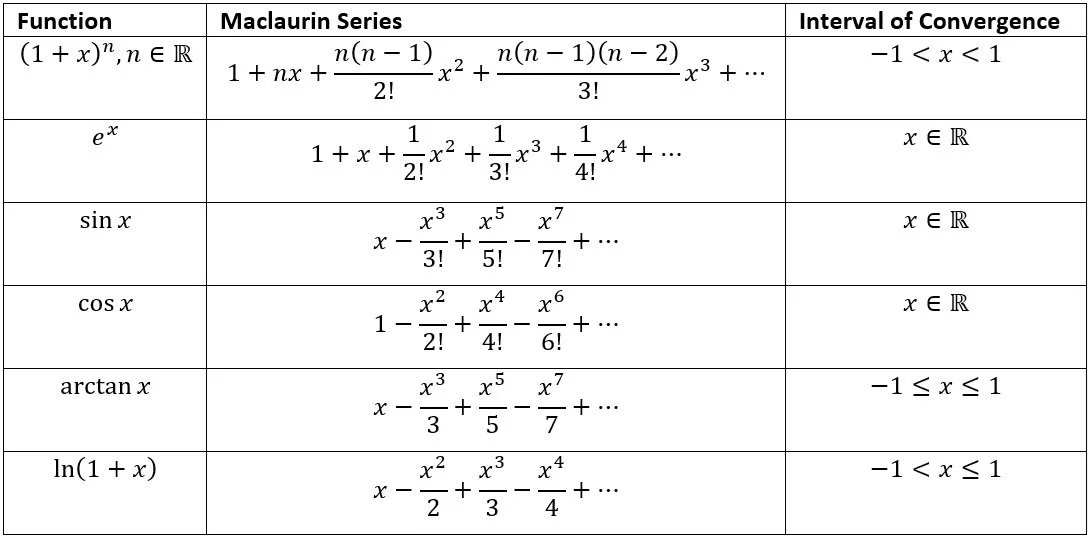
For any infinite Maclaurin Series, there is an interval of convergence. This is the values of \(x\) for which the Maclaurin Series converges to the function.
That is, the values of \(x\) such that$$\lim_{n\to \infty}P\left(x\right)=f\left(x\right)$$In 1-18 Binomial Theorem for Rational Powers we saw that the interval of convergence for \(\frac{1}{1-x}\) was \(-1<x<1\).
Below is a table of some common Maclaurin Series and their intervals of convergence.
The series are given in the Formula Booklet, but the intervals are not.
Key Facts
Use this applet to generate a prompt for a Key Fact that you need to know for the course. The idea is that you should KNOW these key facts in order to be able to solve problems.
Taking it Deeper
Conceptual Questions to Consider
Why do we divide by \(n!\)?
What is the interval of convergence, any why does it matter?
Common Mistakes / Misconceptions
Don’t forget the factorial in the denominator of each fraction.
The most common mistake is to not understand the importance of the interval of convergence, and what this means as we get further from \(x=0\).
Connecting This to Other Skills
The Binomial Theorem for Rational Powers (1.18) is just a specific case of a Maclaurin Series, and was the first infinite series representation we saw.
We have used the idea of from Differential Calculus (Unit 4) to calculate derivatives when computing Maclaurin Series.
We need to understand and be able to comfortably use Factorials (1.13) and Sigma Notation (1.3).
We will build upon this idea in the Manipulation of Maclaurin Series (8.3) and also in Maclaurin Series from Differential Equations (8.9).
Self-Reflection
What was the most challenging part of this skill for you?
What are you still unsure about that you need to review?