
Unit 2 - Functions
Required Prior Knowledge
Questions
Solve the following equations:
a) \(3x-7=5x+1 \)
b) \(x^{2}-5x+6=0\)
Given that \(x^{3}-x^{2}-10x-8=\left(ax^{2}+bx+c\right)\left(x+2\right)\), determine the values of \(a\), \(b\) and \(c\).
In how many different ways can you do this?
Solutions
Get Ready
Questions
Use you Graphical Calculator to sketch the following functions, labelling any axis intercepts, asymptotes and turning points.
a) \(y=x^{3}+2x^{2}-5x+1\)
b) \(y=\frac{x^{2}+e^{x}}{x}\)
Solutions
Notes
It is possible to solve many types of equations analytically, such as linear and quadratic equations, and some cubic, exponential and trigonometric equations.
But some types of equations are either very difficult or impossible to solve analytically.
We can solve these equations using technology (before graphical calculators, this was done by tedious trial and error, or using some advanced numerical methods to get solutions to a required number of decimal places).
Suppose we have an equation. Then each side of the equation is a function. In general, any equation is of the form$$f\left(x\right)=g\left(x\right)$$There are two methods to solve this. Both involve graphing functions in the calculator.
-
Graph the function $$Y1=f\left(x\right)$$ and $$Y2=g\left(x\right)$$Then we find the intersections of these two functions.
-
Rearrange the equation into the form$$f\left(x\right)-g\left(x\right)=0$$and graph this function.
Then find the roots of this function.
In either method we are only interested in the \(x\) values of the coordinates found.
Examples and Your Turns
Example
Solve the equation \(2x^{2}=3x+2\) using technology.
Your Turn
Use both methods to solve the equation$$x^{3}+2x^{2}-5x+1=\frac{x^{2}+e^{x}}{x}$$
Your Turn
Use both methods to solve the equation$$2^{x}=4-x$$
Your Turn
Consider the function \(f\left(x\right)=x^{3}-x^{2}-7x-1\) with domain \(-2\le x\le 3\).
a) Sketch the graph of \(y=f\left(x\right)\).
b) Find the coordinates of:
i) the root(s);
ii) the local maximum;
iii) the local minimum;
iv) the \(y\)-intercept.
c) Find the range of \(f\left(x\right)\).
d) Solve the equation$$x^{3}-x^{2}-7x-1=x^{2}+2x+4$$
Notes (HL)
We can solve quadratic equations by factorising the quadratic function equal to \(0\), and then using the null factor law.
The same is true for any polynomial function.
All cubic function can be factorised into one of four forms.
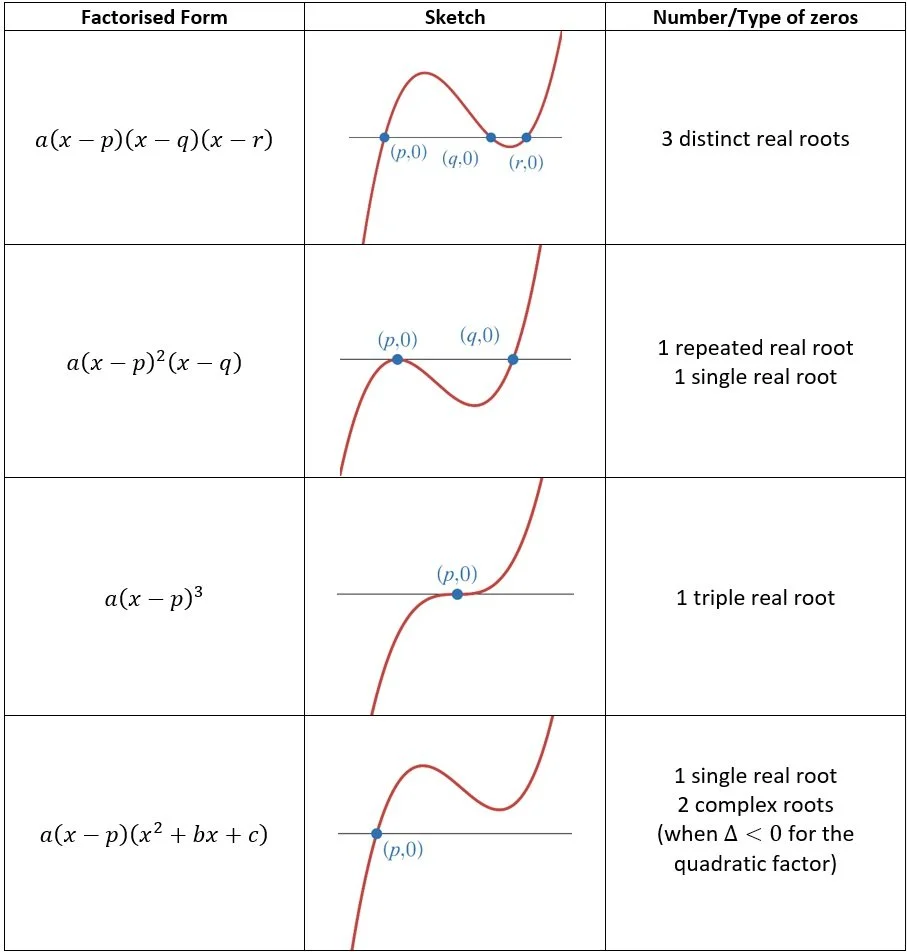
Note that some zeros might be repeated or complex.
We know from the Conjugate Root Theorem that complex roots must come in pairs, so there must be either 1 real root or 3 real roots.
Examples and Your Turns (HL)
Example
Sketch the graph of $$y=\left(x-1\right)\left(x+2\right)\left(x+5\right)$$
Your Turn
Sketch the graph of $$y=x\left(x-3\right)\left(x+2\right)$$
Your Turn
Sketch the graph of $$y=\left(x-1\right)^{2}\left(x+2\right)$$
Your Turn
Sketch the graph of $$y=x\left(x-3\right)^{2}$$
Your Turn
Sketch the graph of $$y=\left(x-1\right)^{3}$$
Your Turn
Sketch the graph of $$y=\left(x+1\right)\left(x^{2}+4x+5\right)$$
Your Turn
Sketch the graph of $$y=\left(x-3\right)\left(x-1\right)\left(x+2\right)\left(x+6\right)$$
Your Turn
Sketch the graph of $$y=x\left(x-1\right)^{2}\left(x+2\right)$$
Notes (HL)
Factorising cubic functions is more difficult than quadratic functions.
The best approach is to use the Factor Theorem to find a first factor, then fully factorise from there. You can use polynomial division or equating coefficients to do this.
If you have access to technology, then you can use that to find the first zero. You can then find the others (even if they are complex).
Examples and Your Turns
Example
Solve$$x^{3}-2x^{2}-5x+6=0$$
Your Turn
Solve$$x^{3}+x^{2}-5x-2=0$$
Your Turn
Solve$$x^{3}-x^{2}-x+1=0$$
Your Turn
Solve$$x^{3}-4x^{2}+5x+10=0$$
Your Turn
Solve $$x^{4}-1=0$$
Your Turn
Solve $$x^{5}-1=0$$
Practice (HL)
Solve each equation analytically. Use your GDC to sketch and check your answers.
(a) \(x^{3}+2x^{2}-x-2=0\)
-
Let \(f\left(x\right)=x^{3}+2x^{2}-x-2\).
Attempt to find first factor using Factor Theorem.
Try \(x=1\) → \(f\left(1\right)=1+2-1-2=0\implies \left(x-1\right)\) is a factor of \(f\left(x\right)\).
So $$\begin{align}f\left(x\right)&=\left(x-1\right)\left(x^{2}+3x+2\right)\\&=\left(x-1\right)\left(x+1\right)\left(x+2\right)\end{align}$$Thus the solutions to the equation are \(1\), \(-1\) and \(-2\).
(b) \(x^{3}-3x^{2}-10x+24=0\)
-
Let \(f\left(x\right)=x^{3}-3x^{2}-10x+24\).
Attempt to find first factor using Factor Theorem.
Try \(x=1\) → \(f\left(1\right)=1-3-10+24\ne 0\).
Try \(x=2\) → \(f\left(2\right)=8-12-20+24= 0\implies \left(x-2\right)\) is a factor of \(f\left(x\right)\).
So $$\begin{align}f\left(x\right)&=\left(x-2\right)\left(x^{2}-x-12\right)\\&=\left(x-2\right)\left(x-4\right)\left(x+3\right)\end{align}$$Thus the solutions to the equation are \(2\), \(3\) and \(-4\).
(c) \(x^{3}+10=2x^{2}+5x\)
-
Let \(f\left(x\right)=x^{3}-2x^{2}-5x+10\).
Attempt to find first factor using Factor Theorem.
Try \(x=1\) → \(f\left(1\right)=1-2-5+10\ne 0\).
Try \(x=2\) → \(f\left(2\right)=8-8-10+10= 0\implies \left(x-2\right)\) is a factor of \(f\left(x\right)\).
So $$\begin{align}f\left(x\right)&=\left(x-2\right)\left(x^{2}-5\right)\\&=\left(x-2\right)\left(x-\sqrt{5}\right)\left(x+\sqrt{5}\right)\end{align}$$Thus the solutions to the equation are \(2\), \(\sqrt{5}\) and \(-\sqrt{5}\).
(d) \(x^{3}+1=-x\left(x+1\right)\)
-
Let \(f\left(x\right)=x^{3}+x^{2}+x+1\).
Attempt to find first factor using Factor Theorem.
Try \(x=1\) → \(f\left(1\right)=1+1+1+1\ne 0\).
Try \(x=-1\) → \(f\left(-1\right)=-1+1-1+1= 0\implies \left(x+1\right)\) is a factor of \(f\left(x\right)\).
So $$f\left(x\right)=\left(x+1\right)\left(x^{2}+1\right)$$The quadratic \(x^{2}+1\) has no solutions in the real numbers.
Thus the solutions to the equation are \(-1\), \(i\) and \(-i\).
(e) \(2x^{3}+7x^{2}+2x-3=0\)
-
Let \(f\left(x\right)=2x^{3}+7x^{2}+2x-3\).
Attempt to find first factor using Factor Theorem.
Try \(x=1\) → \(f\left(1\right)=2+7+2-3\ne 0\).
Try \(x=-1\) → \(f\left(-1\right)=-2+7-2-3= 0\implies \left(x+1\right)\) is a factor of \(f\left(x\right)\).
So $$\begin{align}f\left(x\right)&=\left(x+1\right)\left(2x^{2}+5x-3\right)\\&=\left(x+1\right)\left(2x-1\right)\left(x+3\right)\end{align}$$Thus the solutions to the equation are \(-1\), \(-3\) and \(\frac{1}{2}\).
(f) \(2x^{3}-x^{2}-4x+2=0\)
-
Let \(f\left(x\right)=2x^{3}-x^{2}-4x+2\).
Attempt to find first factor using Factor Theorem.
Try \(x=1\) → \(f\left(1\right)=2-1-5+10\ne 0\).
Try \(x=-1\) → \(f\left(-1\right)=-2-1+4+2\ne 0\).
The \(2x^{3}\) suggests that maybe \(\left(2x+k\right)\) might be a factor, so we use this clue to look for factors.
Try \(x=\frac{1}{2}\) → \(f\left(\frac{1}{2}\right)=\frac{2}{8}-\frac{1}{4}-2+2= 0\implies \left(2x-1\right)\) is a factor of \(f\left(x\right)\).
So $$\begin{align}f\left(x\right)&=\left(2x-1\right)\left(x^{2}-2\right)\\&=\left(2x-1\right)\left(x-\sqrt{2}\right)\left(x+\sqrt{2}\right)\end{align}$$Thus the solutions to the equation are \(\frac{1}{2}\), \(\sqrt{2}\) and \(-\sqrt{2}\).
(g) \(x^{2}\left(3x+1\right)=2\left(3x+1\right)\)
-
Let \(f\left(x\right)=3x^{3}+7x^{2}-4x-2\).
Attempt to find first factor using Factor Theorem.
Try \(x=1\) → \(f\left(1\right)=3+7-4-2\ne 0\).
Try \(x=-1\) → \(f\left(-1\right)=-3+7+4-2\ne 0\).
The \(3x^{3}\) suggests that maybe \(\left(3x+k\right)\) might be a factor, so we use this clue to look for factors.
Try \(x=\frac{1}{3}\) → \(f\left(\frac{1}{3}\right)=\frac{3}{27}+\frac{7}{9}-\frac{4}{3}-2\ne 0\).
Try \(x=-\frac{1}{3}\) → \(f\left(-\frac{1}{3}\right)=-\frac{3}{27}+\frac{7}{9}+\frac{4}{3}-2= 0\implies \left(3x+1\right)\) is a factor of \(f\left(x\right)\).
So $$f\left(x\right)=\left(3x+1\right)\left(x^{2}+2x-2\right)$$The quadratic factor does not factorise, so we need to use the quadratic formula to find the solutions for this factor.$$\begin{align}x&=\frac{-2\pm\sqrt{2^{2}-4\left(1\right)\left(-2\right)}}{2}\\&=\frac{-2\pm\sqrt{12}}{2}\\&=-1\pm\sqrt{3}\end{align}$$
Thus the solutions to the equation are \(-\frac{1}{3}\), \(-1+\sqrt{3}\) and \(-1-\sqrt{3}\).
(h) \(x^{4}-x^{3}-7x^{2}+x+6=0\)
-
Let \(f\left(x\right)=x^{4}-x^{3}-7x^{2}+x+6\).
Attempt to find first factor using Factor Theorem.
Try \(x=1\) → \(f\left(1\right)=1-1-7+1+6= 0\implies \left(x-1\right)\) is a factor of \(f\left(x\right)\).
So $$f\left(x\right)=\left(x-1\right)\left(x^{3}-7x-6\right)$$We now need to factorise the cubic factor.
Let \(g\left(x\right)=x^{3}-7x-6\).
Attempt to find a factor using Factor Theorem.
Try \(x=1\) → \(g\left(1\right)=1-7-6\ne 0\)
Try \(x=-1\) → \(g\left(-1\right)=-1+7-6= 0\implies \left(x+1\right)\) is a factor of \(g\left(x\right)\), and thus also of \(f\left(x\right)\).
So $$\begin{align}f\left(x\right)&=\left(x-1\right)\left(x+1\right)\left(x^{2}-x-6\right)\\&=\left(x-1\right)\left(x+1\right)\left(x-3\right)\left(x+2\right)\end{align}$$
Thus the solutions to the equation are \(1\), \(-1\), \(3\) and \(-2\).
(i) \(x^{5}-2x^{4}-15x^{3}+20x^{2}+44x-48=0\)
-
Let \(f\left(x\right)=x^{5}-2x^{4}-15x^{3}+20x^{2}+44x-48\).
Attempt to find first factor using Factor Theorem.
Try \(x=1\) → \(f\left(1\right)=1-2-15+20+44-48= 0\implies \left(x-1\right)\) is a factor of \(f\left(x\right)\).
So $$f\left(x\right)=\left(x-1\right)\left(x^{4}-x^{3}-16x^{2}+4x+48\right)$$We now need to factorise the quartic factor.
Let \(g\left(x\right)=x^{4}-x^{3}-16x^{2}+4x+48\).
Attempt to find a factor using Factor Theorem. We already know \(g\left(1\right)\ne 0\) since \(f\left(1\right)\ne 0\), so no need to check again
Try \(x=-1\) → \(g\left(1\right)=1+1-16-4+48\ne 0\)
Try \(x=2\) → \(g\left(2\right)=16-8-64+8+48=0\implies \left(x-2\right)\) is a factor of \(g\left(x\right)\), and thus also of \(f\left(x\right)\).
So $$f\left(x\right)=\left(x-1\right)\left(x-2\right)\left(x^{3}+x^{2}-14x-24\right)$$We now need to factorise the cubic factor.
Let \(h\left(x\right)=x^{3}+x^{2}-14x-24\).
Attempt to find a factor using Factor Theorem. We already know \(h\left(1\right)\ne 0\) since \(f\left(1\right)\ne 0\), and similarly \(h\left(-1\right)\ne 0\) since \(g\left(-1\right)\ne 0\) so no need to check these again.
Try \(x=2\) → \(h\left(-1\right)=8+4-28-24\ne 0\)
Try \(x=-2\) → \(h\left(-2\right)=-8+4+28-24=0\implies \left(x+2\right)\) is a factor of \(h\left(x\right)\), and thus also of \(f\left(x\right)\).
So $$\begin{align}f\left(x\right)&=\left(x-1\right)\left(x-2\right)\left(x+2\right)\left(x^{2}-x-12\right)\\&=\left(x-1\right)\left(x-2\right)\left(x+2\right)\left(x-4\right)\left(x+3\right)\end{align}$$
Thus the solutions to the equation are \(1\), \(2\), \(-2\), \(4\) and \(-3\).
Your Turn
How many sets of three consecutive integers are there in which the sum of the three integers equals their product?
Find these sets of integers
Notes (HL)
It is often best to draw a sketch of the graph when dealing with equations involving Modulus Functions (look back at Function Transformations).
We can also use the following properties:$$\left|x\right|^{2}=x^{2}\\ \left|-x\right|=x\\ \left|xy\right|=\left|x\right|\left|y\right|\\ \left|\frac{x}{y}\right|=\frac{\left|x\right|}{\left|y\right|}\\ \left|x-y\right|=\left|y-x\right|\\ \left|x-y\right|=0\iff x=y\\ \left|x\right|=\left|y\right|\iff x=y\text{ or }x=-y$$
Examples and Your Turns (HL)
Example
Solve$$\left|2x+3\right|=2$$
Your Turn
Solve$$\left|3-2x\right|=1$$
Your Turn
Solve$$\left|\frac{3x+2}{1-x}\right|=4$$
Your Turn
Solve$$\left|x+1\right|=\left|2x-3\right|$$
Your Turn
Solve$$\left|x+1\right|=2x-5$$
Your Turn
Solve$$\left|3x-1\right|=\left|x+5\right|$$
Key Facts
Use this applet to generate a prompt for a Key Fact that you need to know for the course. The idea is that you should KNOW these key facts in order to be able to solve problems.
Taking it Deeper
Conceptual Questions to Consider
When using the GDC to solve equations by graphing, what is the relationship between the \(x\) intercepts and the solutions to the equation? Explain why.
Why are we not interested in the \(y\)-coordinates of the points of intersection when solving an equation graphically?
Describe the general method for solving polynomial equations.
Why is it very helpful to consider the graph when solving an equation involving absolute values?
Common Mistakes / Misconceptions
Using the equation solver in the GDC, and not the graph. Whilst the equation solver is a useful tool, it can often miss solutions if there are multiple solutions. The built in polynomial solvers are good, but be wary for other equations. Graphing allows you to quickly see ALL the solutions.
Not using the GDC in Paper 2 and Paper 3. Whenever there is an equation in a calculator paper, they EXPECT you to use technology to solve it. Don’t waste time trying to do it analytically when you can quickly use the GDC.
Using an inappropriate View Window when solving the equation graphically. Make sure you can ‘see’ the shape of both functions.
For polynomials with leading coefficient NOT equal to 1, not trying factors that are rational non-integers in the factor theorem.
Not using the Conjugate Root Theorem when appropriate to help narrow down roots.
For absolute value functions, not checking solutions actually work in the original equation, as redundant solutions can be introduced by squaring both sides.
For absolute value functions, not checking both cases e.g. \(\left|2x+1\right|=3\) means we need to solve BOTH \(2x+1=3\) AND \(2x+1=-3\).
Connecting This to Other Skills
This is an absolutely fundamental skill throughout the course. You will often have to solve equations as part of other problems, especially in Paper 2 and 3, where GDC use is essential for time management.
It builds on the ideas of Polynomials (2.19), The Factor Theorem (2.20) and the Fundamental Theorem of Algebra (2.21). For polynomial equations, you will normally need to solve Quadratic Equations (PK3) including those with complex roots (2.14).
Other types of equations require a knowledge of the basics of various function types, including Exponential Functions (2.8), Rational Functions (2.9) and Absolute Value Functions (2.10). It also needs an understanding of Graphing Function (2.4) and the Points of Interest (2.5).
In the next skill, Inequalities (2.24) we will build on these ideas further to look at inequalities instead of equations.
Self-Reflection
What was the most challenging part of this skill for you?
What are you still unsure about that you need to review?