
Unit 2 - Functions
Required Prior Knowledge
Questions
Solve the equations
a) \(4x+5=0 \)
b) \(5=8+x\)
Solutions
Get Ready
Questions
Sketch the graphs of the following lines on a set of axes
a) \(y=3x-1\)
b) \(y=-\frac{1}{2}x+2\)
Solutions
Notes
The gradient of a line is a measure of the steepness / slope of the line.
The gradient if the line passing through the points \(\left(x_{1},y_{1}\right)\) and \(\left(x_{2},y_{2}\right)\) is given by$$\frac{y_{2}-y_{1}}{x_{2}-x_{1}}$$
Examples and Your Turns
Your Turn
Find the gradient of each line segment below.
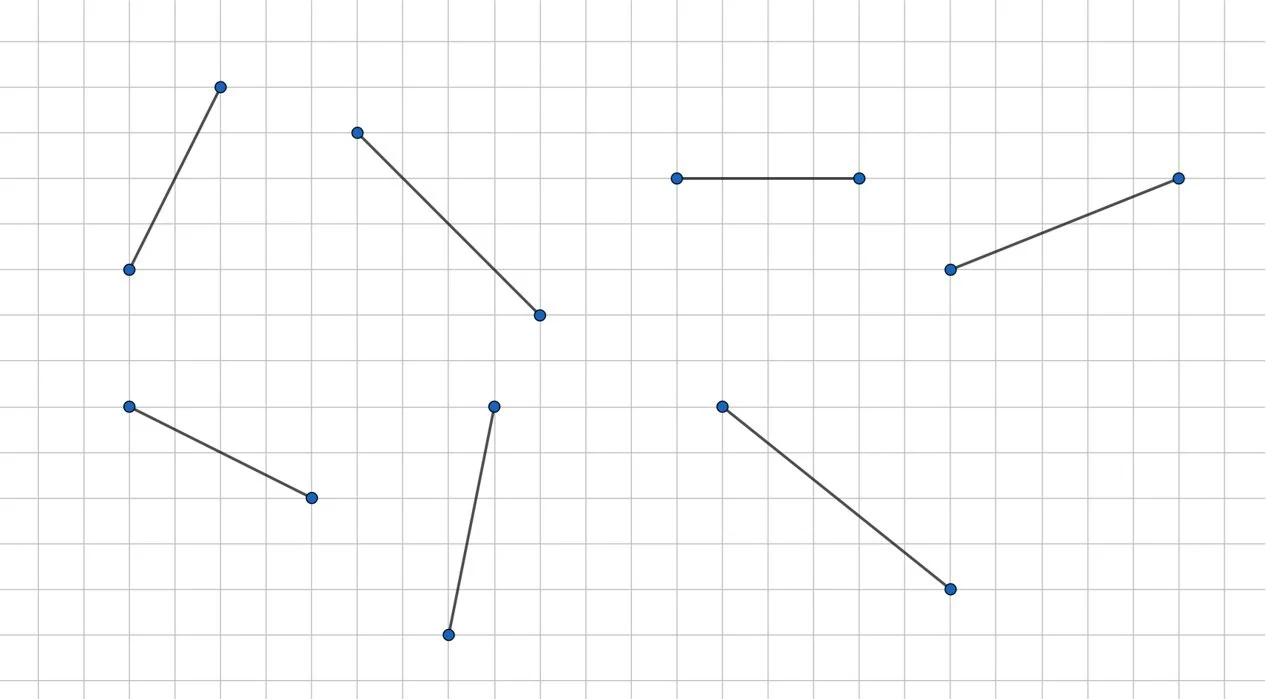
Your Turn
Find the gradient of the line through \(\left(-2,1\right)\) and \(\left(2,9\right)\).
Your Turn
Find the gradient of the line through \(\left(1,-\frac{1}{2}\right)\) and \(\left(4,1\right)\).
Your Turn
Find \(a\) given the line joining \(\left(a,-4\right)\) and \(\left(1,8\right)\) has gradient \(3\).
Your Turn
Find \(a\) given the line joining \(\left(-2,3\right)\) and \(\left(1,a\right)\) has gradient \(2\).
Notes
The equation of a straight line is a linear equation in two variables (usually \(x\) and \(y\).
All points on the line satisfy the equation. That is, if we substitute the \(x\) and \(y\) values into the equation, then the result works.
There are two common forms of equations of straight lines:
Slope-intercept form$$y=mx+c$$where \(m\) is the gradient of the line and \(c\) is the \(y\)-intercept.
General form$$ax+by=d$$
-
$$y=2x-1\\2y+5x=7\\2y+5x+7=0\\2t+5v+7=0\\\frac{1}{2}t+\frac{v}{5}+\frac{1}{7}=0$$
-
Knowing the gradient is \(m\), substitute this into \(y=mx+c\).
Substitute the coordinates of a point on the line for \(x\) and \(y\)
Solve the equation to find \(c\)
Rewrite the equation in the form \(y=mx+c\) with both \(m\) and \(c\) now known.
-
$$y=x^{2}+3x+2\\2x+3\\t^{2}=3v-2\\\frac{1}{y}+\frac{3}{x}=4$$
To find the \(y\)-intercept of a straight line, you set \(x=0\) and solve the resulting equation.
To find the \(x\)-intercept of a straight line, you set \(y=0\) and solve the resulting equation.
To find the equation of a straight line we have two possible methods. In both cases we need to know and/or calculate the gradient first.
-
Knowing the gradient is \(m\), substitute this into \(y-y_{1}=m\left(x-x_{1}\right)\).
Substitute the coordinates of a point on the line for \(x_{1}\) and \(y_{1}\)
Rearrange the equation into the required form.
Two lines are parallel if they have the same gradient.
For two lines with gradients \(m_{1}\) and \(m_{2}\), they are parallel if and only if $$m_{1}=m_{2}$$
Two lines are perpendicular if they are at \(90°\) to each other.
For two lines with gradients \(m_{1}\) and \(m_{2}\), they are perpendicular if and only if $$m_{1}=-\frac{1}{m_{2}}\text{ OR }m_{1}\times m_{2}=-1$$That is, \(m_{1}\) and \(m_{2}\) are negative reciprocals.
Examples and Your Turns
Your Turn
Find the equation of the line with gradient \(3\) that passes through \(\left(-10,-8\right)\).
Your Turn
Find the equation of the line with gradient \(\frac{9}{7}\) that passes through \(\left(2,4\right)\).
Your Turn
Find the equation of the straight line through the two points \(\left(-8,10\right)\) and \(\left(-5,4\right)\).
Your Turn
Find the equation of the straight line through the two points \(\left(-9,4\right)\) and \(\left(7,8\right)\).
Your Turn
Find the equation of the straight line parallel to \(y=4x-1\) which passes through \(\left(4,17\right)\).
Your Turn
Find the equation of the straight line parallel to \(y=8x+5\) which passes through \(\left(16,26\right)\).
Your Turn
Find the equation of the straight line perpendicular to \(y=4x-1\) which passes through \(\left(4,17\right)\).
Your Turn
Find the equation of the straight line perpendicular to \(y=8x+5\) which passes through \(\left(16,26\right)\).
Notes
The perpendicular bisector of a line segment (or of two given points) is the equation of the straight line which is perpendicular to the given line, and passes through the midpoint.
Recall that the midpoint of two points \(\left(x_{1},y_{1}\right)\) and \(\left(x_{2},y_{2}\right)\) is given by$$\left(\frac{x_{1}+x_{2}}{2},\frac{y_{1}+y_{2}}{2}\right)$$
Examples and Your Turns
Your Turn
Given \(A\left(4,-3\right)\) and \(B\left(-2,7\right)\), find the equation of the perpendicular bisector of \(AB\).
Your Turn
The line \(4y=3x+1\) intersects the curve \(xy=28x-27y\) at the point \(P\left(1,1\right)\) and at the point \(Q\).
The perpendicular bisector of \(PQ\) intersects the line \(y=4x\) at the point \(R\).
Calculate the area of the triangle \(PQR\).
Key Facts
Use this applet to generate a prompt for a Key Fact that you need to know for the course. The idea is that you should KNOW these key facts in order to be able to solve problems.