
Unit 3 - Trigonometry
Required Prior Knowledge
Questions
Without using a calculator, fill in the table.
| Radians | \(0\) | \(\frac{\pi}{6}\) | \(\frac{\pi}{4}\) | \(\frac{\pi}{3}\) | \(\frac{\pi}{2}\) | \(\frac{2\pi}{3}\) | \(\frac{3\pi}{4}\) | \(\frac{5\pi}{6}\) | \(\pi\) |
|---|---|---|---|---|---|---|---|---|---|
| \(\sin x\) | \(0\) ? |
\(\frac{1}{2}\) ? |
\(\frac{\sqrt{2}}{2}\) ? |
\(\frac{\sqrt{3}}{2}\) ? |
\(1\) ? |
\(\frac{\sqrt{3}}{2}\) ? |
\(\frac{\sqrt{2}}{2}\) ? |
\(\frac{1}{2}\) ? |
\(0\) ? |
| \(\cos x\) | \(1\) ? |
\(\frac{\sqrt{3}}{2}\) ? |
\(\frac{\sqrt{2}}{2}\) ? |
\(\frac{1}{2}\) ? |
\(0\) ? |
\(-\frac{1}{2}\) ? |
\(-\frac{\sqrt{2}}{2}\) ? |
\(-\frac{\sqrt{3}}{2}\) ? |
\(-1\) ? |
| \(\tan x\) | \(0\) ? |
\(\frac{\sqrt{3}}{3}\) ? |
\(1\) ? |
\(\sqrt{3}\) ? |
Undef. ? |
\(-\sqrt{3}\) ? |
\(-1\) ? |
\(-\frac{\sqrt{3}}{3}\) ? |
\(0\) ? |
| Degrees | \(0^{\circ}\) ? |
\(30^{\circ}\) ? |
\(45^{\circ}\) ? |
\(60^{\circ}\) ? |
\(90^{\circ}\) ? |
\(120^{\circ}\) ? |
\(135^{\circ}\) ? |
\(150^{\circ}\) ? |
\(180^{\circ}\) ? |
| Radians | \(\frac{7\pi}{6}\) | \(\frac{5\pi}{4}\) | \(\frac{4\pi}{3}\) | \(\frac{3\pi}{2}\) | \(\frac{5\pi}{3}\) | \(\frac{7\pi}{4}\) | \(\frac{11\pi}{6}\) | \(2\pi\) | \(\frac{13\pi}{6}\) |
| \(\sin x\) | \(-\frac{1}{2}\) ? |
\(-\frac{\sqrt{2}}{2}\) ? |
\(-\frac{\sqrt{3}}{2}\) ? |
\(-1\) ? |
\(-\frac{\sqrt{3}}{2}\) ? |
\(-\frac{\sqrt{2}}{2}\) ? |
\(-\frac{1}{2}\) ? |
\(0\) ? |
\(\frac{1}{2}\) ? |
| \(\cos x\) | \(-\frac{\sqrt{3}}{2}\) ? |
\(-\frac{\sqrt{2}}{2}\) ? |
\(-\frac{1}{2}\) ? |
\(0\) ? |
\(\frac{1}{2}\) ? |
\(\frac{\sqrt{2}}{2}\) ? |
\(\frac{\sqrt{3}}{2}\) ? |
\(1\) ? |
\(\frac{\sqrt{3}}{2}\) ? |
| \(\tan x\) | \(\frac{\sqrt{3}}{3}\) ? |
\(1\) ? |
\(\sqrt{3}\) ? |
Undef. ? |
\(-\sqrt{3}\) ? |
\(-1\) ? |
\(-\frac{\sqrt{3}}{3}\) ? |
\(0\) ? |
\(\frac{\sqrt{3}}{3}\) ? |
| Degrees | \(210^{\circ}\) ? |
\(225^{\circ}\) ? |
\(240^{\circ}\) ? |
\(270^{\circ}\) ? |
\(300^{\circ}\) ? |
\(315^{\circ}\) ? |
\(330^{\circ}\) ? |
\(360^{\circ}\) ? |
\(390^{\circ}\) ? |
Get Ready
Questions
Hence draw the graphs of \(y=\sin x\), \(y=\cos x\) and \(y=\tan x\) on the following axes.
Notes
Recall that the \(y\) coordinate of any point on the unit circle is given by \(\sin\theta\) where \(\theta\) is the angle from the positive \(x\)-axis to the line.
Grab the green square in the applet below, and move it around the unit circle. Notice that the red line represents the \(y\) coordinate. Can you see what happens and how the graph that is formed is linked to the unit circle?
Now consider the applet below, and how it shows how we get the graph of \(y=\cos x\).
The period of a trigonometric function is how long (how many degrees / radians) it takes to complete one full cycle.
The principal axis of a trigonometric function is the horizontal line running exactly halfway between the maximums and minimums.
The amplitude of a wave function is the distance between the principal axis and the maximum.
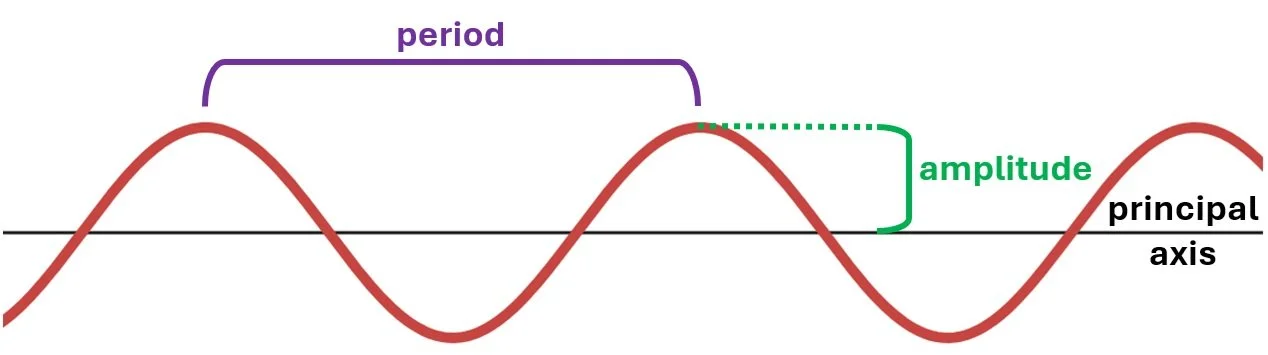
The maximums of \(y=\sin x\) occur at \(90^{\circ}+360^{\circ}k\).
The minimums of \(y=\sin x\) occur at \(270^{\circ}+360^{\circ}k\).
The period of \(y=\sin x\) is \(360^{\circ}\) or \(2\pi\).
The principal axis of \(y=\sin x\) is \(y=0\).
The amplitude of \(y=\sin x\) is \(1\).
The maximums of \(y=\cos x\) occur at \(360^{\circ}k\).
The minimums of \(y=\cos x\) occur at \(180^{\circ}+360^{\circ}k\).
The period of \(y=\cos x\) is \(360^{\circ}\) or \(2\pi\).
The principal axis of \(y=\cos x\) is \(y=0\).
The amplitude of \(y=\cos x\) is \(1\).
The period of \(y=\tan x\) is \(180^{\circ}\) or \(\pi\).
The asymptotes of \(y=\tan x\) occur at \(\pm 90^{\circ}\), \(\pm 270^{\circ}\), …
Investigation
Use the activity below to fill in the following notes.
-
$$\left|a\right|$$
-
$$y=d$$
-
$$d-\left|a\right|\le y\le d+\left|a\right|$$
-
$$d+\left|a\right|$$
-
$$d-\left|a\right|$$
Your Turn
Complete the table below. Click on the missing cells to reveal the answers.
| Function | Amplitude | Principal axis | Range | y-coord. of max. | y-coord. of min. |
|---|---|---|---|---|---|
| \(y = 2 \sin x\) |
\(2\)
?
|
\(y = 0\)
?
|
\([-2, 2]\)
?
|
\(2\)
?
|
\(-2\) |
|
\(y = 2 \cos x + 1\)
?
|
\(2\) | \(y = 1\) |
\([-1, 3]\)
?
|
\(3\)
?
|
\(-1\)
?
|
|
\(y = 2 \sin x - 1\)
?
|
\(3\) | \(y = -1\) | \([-3, 1]\) |
\(1\)
?
|
\(-4\) |
| \(y = -2 \sin x - 1\) |
\(2\)
?
|
\(y = -1\)
?
|
\([-3, 1]\)
?
|
\(1\)
?
|
\(-3\)
?
|
|
\(y = -1 \cos x + 20\)
?
|
\(1\)
?
|
\(y = 20\)
?
|
\([19, 21]\)
?
|
\(19\) | \(21\) |
|
\(y = 20 \sin x - 10\)
?
|
\(20\) |
\(y = -10\)
?
|
\([-30, 10]\)
?
|
\(10\)
?
|
\(-10\) |
| \(y = -20 \cos x + 10\) |
\(20\)
?
|
\(y = 10\)
?
|
\([-10, 30]\)
?
|
\(30\)
?
|
\(-10\)
?
|
|
\(y = 4.5 \sin x + 1.5\)
?
|
\(4.5\) | \(y = 1.5\) |
\([-3, 6]\)
?
|
\(6\)
?
|
\(-3\)
?
|
|
\(y = 1.7 \cos x + 12.1\)
?
|
\(1.7\)
?
|
\(y = 12.1\)
?
|
\([10.4, 13.8]\) |
\(13.8\)
?
|
\(10.4\)
?
|
|
\(y = 3.1 \sin x - 8.6\)
?
|
\(3.1\)
?
|
\(y = -8.6\) |
\([-11.7, -5.5]\)
?
|
\(-5.5\) |
\(-11.7\)
?
|
Notes
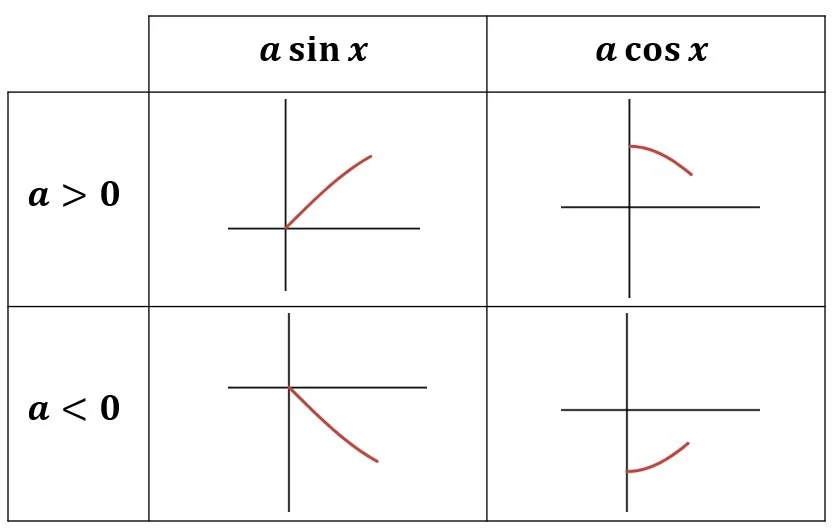
Th sign of \(a\) also affects how the graph starts, as shown below.
Your Turns
Your Turn
Sketch the graph of$$y=4\sin x -5$$
Your Turn
Sketch the graph of$$y=-3\cos x +1$$
Your Turn
Sketch the graph of$$y=15.5\cos x - 3.5$$
Your Turn
Sketch the graph of$$y=12-2\sinx$$
Your Turn
Give an equation for this graph.
Your Turn
Give an equation for this graph.
Your Turn
Give an equation for this graph.
Your Turn
Give an equation for this graph.
Investigation
For this investigation use the activity below.
Look at the graph of \(y=\sin x\). Write down the period of the function.
Look at the graph of \(y=\sin 3x\). Write down the period of the function.
How many complete cycles are there in the domain \(0^{\circ}\le x\le 360^{\circ}\)?
Look at the graph of \(y=\sin 2x\). Write down the period of the function.
How many complete cycles are there in the domain \(0^{\circ}\le x\le 360^{\circ}\)?
Look at the graph of \(y=\sin \left(-2x\right)\). Write down the period of the function.
How many complete cycles are there in the domain \(0^{\circ}\le x\le 360^{\circ}\)?
Look at the graph of \(y=\sin \left(-\frac{1}{2}x\right)\). Write down the period of the function.
How many complete cycles are there in the domain \(0^{\circ}\le x\le 360^{\circ}\)?
Look at the graph of \(y=\cos \left(-\frac{1}{2}x\right)\). Write down the period of the function.
How many complete cycles are there in the domain \(0^{\circ}\le x\le 360^{\circ}\)?
Consider the function \(y=\cos 6x\). Write down the period of the function.
How many complete cycles are there in the domain \(0^{\circ}\le x\le 360^{\circ}\)?
Check in the activity.
Consider the function \(y=\sin \left(\frac{1}{3}x\right)\). Write down the period of the function.
How many complete cycles are there in the domain \(0^{\circ}\le x\le 360^{\circ}\)?
Check in the activity.
Notes
\(y=\sin \left(bx\right)\) has period that is equal to \(\frac{360^{\circ}}{b}\) or \(\frac{2\pi}{b}\).
That is, there are \(b\) waves in each \(360^{\circ}\) or \(2\pi\).
Your Turn
Give an equation for this graph.
Your Turn
Give an equation for this graph.
Your Turn
Give an equation for this graph.
Your Turn
Give an equation for this graph.
Notes
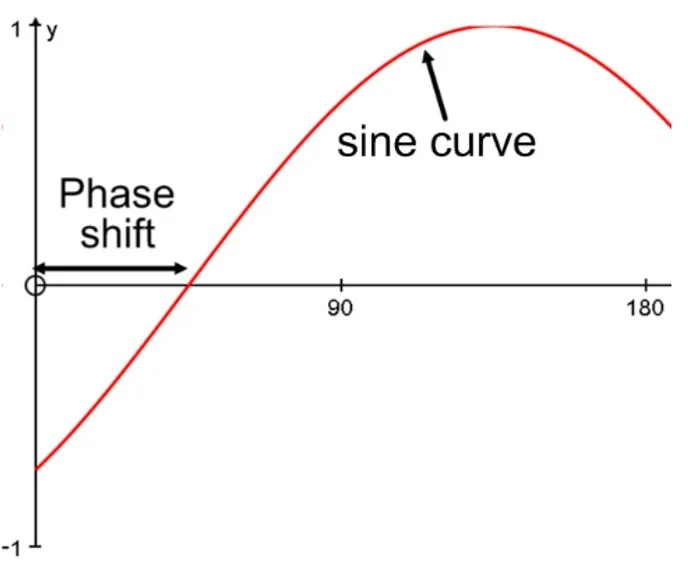
The phase shift is how far the function has been moved left or right when compared to a ‘normal’ sine of cosine graph.
Investigation
For this investigation you can use the activity below.
Look at the graph of \(y=\sin\left(x+90^{\circ}\right)\). Write down the phase shift of the function.
Look at the graph of \(y=\sin\left(x-90^{\circ}\right)\). Write down the phase shift of the function.
Look at the graph of \(y=\sin\left(x-180^{\circ}\right)\). Write down the phase shift of the function.
Look at the graph of \(y=\cos\left(x-180^{\circ}\right)\). Write down the phase shift of the function.
Look at the graph of \(y=\sin\left(x-60^{\circ}\right)\). Write down the phase shift of the function.
Look at the graph of \(y=\sin\left(2x-60^{\circ}\right)\). Write down the phase shift of the function.
Look at the graph of \(y=\sin\left(2\left(x-30^{\circ}\right)\right)\). Write down the phase shift of the function.
Notes
\(y=\sin\left(x-c\right)\) has a phase shift of \(c\).
That is, the graph is translated by \(\begin{pmatrix}-c\\0\end{pmatrix}\).
\(y=\sin\left(b\left(x-c\right)\right)\) has a phase shift of \(c\).
\(y=\sin\left(bx-c\right)\) has a phase shift of \(\frac{c}{b}\).
Putting it all together we get:$$y=a\sin\left(b\left(x-c\right)\right)+d$$where
\(\left|a\right|\) is the amplitude and $$a=\frac{\text{max}-\text{min}}{2}$$
\(b\) is the frequency and so$$\text{period}=\frac{2\pi}{b}=\frac{360^{\circ}}{b}$$
\(c\) is the phase shift
\(y=d\) is the principal axis where$$d=\frac{\text{max}+\text{min}}{2}$$
Your Turn
Find an equation in the form \(y=a\sin\left(b\left(x-c\right)\right)+d\) for the graph below. Also find a cosine function.
Your Turn
Find an equation in the form \(y=a\sin\left(b\left(x-c\right)\right)+d\) for the graph below. Also find a cosine function.
Your Turn
Find an equation in the form \(y=a\sin\left(b\left(x-c\right)\right)+d\) for the graph below. Also find a cosine function.
Your Turn
Find an equation in the form \(y=a\sin\left(b\left(x-c\right)\right)+d\) for the graph below. Also find a cosine function.
Your Turn
Complete the table for these SINE functions.
| Function | Amplitude | Period | Principal Axis | Phase Shift |
|---|---|---|---|---|
| \(y = \sin(3x)\) |
\(1\)
?
|
\(120^{\circ} \text{ or } \frac{2\pi}{3}\)
?
|
\(y = 0\)
?
|
\(0\)
?
|
| \(y = 2\sin(x - 30^{\circ})\) |
\(2\)
?
|
\(360^{\circ}\)
?
|
\(y = 0\)
?
|
\(30^{\circ}\)
?
|
| \(y = 2 \sin(x - \frac{\pi}{6})\) |
\(2\)
?
|
\(2\pi\)
?
|
\(y = 0\)
?
|
\(\frac{\pi}{6}\)
?
|
| \(y = \sin(2(x - \frac{\pi}{6}))\) |
\(1\)
?
|
\(\pi\)
?
|
\(y = 0\)
?
|
\(\frac{\pi}{6}\)
?
|
| \(y = \sin(2x - \frac{\pi}{6})\) |
\(1\)
?
|
\(\pi\)
?
|
\(y = 0\)
?
|
\(\frac{\pi}{12}\)
?
|
| \(y = \sin(2x - \frac{\pi}{3})\) |
\(1\)
?
|
\(\pi\)
?
|
\(y = 0\)
?
|
\(\frac{\pi}{6}\)
?
|
| \(y = 5 \sin(\frac{1}{2}(x - \frac{\pi}{6})) + 1\) |
\(5\)
?
|
\(4\pi\)
?
|
\(y = 1\)
?
|
\(\frac{\pi}{6}\)
?
|
| \(y = -6.5 \sin(3x - 120^{\circ}) + 2.5\) |
\(6.5\)
?
|
\(120^{\circ}\)
?
|
\(y = 2.5\)
?
|
\(40^{\circ}\)
?
|
|
\(y = 5 \sin(5\left(x-50^{\circ}\right)) - 2\)
?
|
\(5\) | \(72^{\circ}\) | \(y = -2\) | \(50^{\circ}\) |
|
\(y = 35 \sin(\frac{1}{3}x) + 50\)
?
|
\(35\) | \(6\pi\) | \(y = 50\) | \(0\) |
|
e.g.\(y = 3 \sin(2x) + 10\)
?
|
\(3\) |
\(180^{\circ}\)
?
|
\(y = 10\)
?
|
\(0\)
?
|
|
e.g.\(y = 10 \sin(2x)\)
?
|
\(10\)
?
|
\(180^{\circ}\) |
\(y = 0\)
?
|
\(0\)
?
|
|
e.g.\(y = \sin(2\left(x - 30^{\circ}\right))\)
?
|
\(1\)
?
|
\(180^{\circ}\) |
\(y = 0\)
?
|
\(30^{\circ}\) |
|
e.g.\(y = \sin(2\left(x - \frac{\pi}{3}\right))\)
?
|
\(1\)
?
|
\(\pi\)
?
|
\(y = 0\)
?
|
\(\frac{\pi}{3}\) |
|
e.g.\(y = 12.5 \sin(2\left(x - \frac{\pi}{3}\right)) + 1\)
?
|
\(12.5\) |
\(\pi\)
?
|
\(y = 1\)
?
|
\(\frac{\pi}{3}\) |
|
e.g.\(y = 10 \sin(24x) - 5\)
?
|
\(10\)
?
|
\(\frac{\pi}{12}\) |
\(y = -5\)
?
|
\(0\)
?
|
|
\(e.g.y = \sin(\frac{\pi}{6}x)\)
?
|
\(1\)
?
|
\(12\) |
\(y = 0\)
?
|
\(0\)
?
|
Your Turn
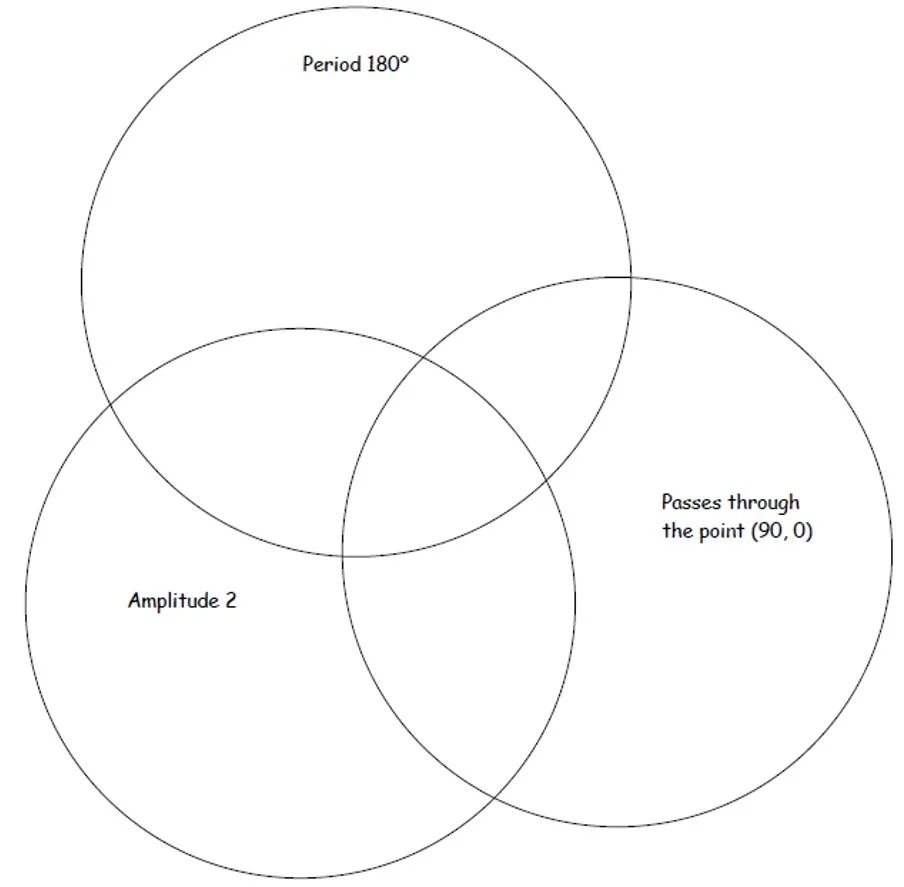
Add a function of the form \(y=a\cos\left(b\left(x-c\right)\right)+d\) to each section of the below Venn Diagram.
Your Turn
Sketch the graph of $$y=2\sin\left(3x-\frac{3\pi}{4}\right)+1$$
Your Turn
Sketch the graph of $$y=-3\cos\left(4x+\pi\right)-1$$
Key Facts
Use this applet to generate a prompt for a Key Fact that you need to know for the course. The idea is that you should KNOW these key facts in order to be able to solve problems.
Taking it Deeper
Conceptual Questions to Consider
Explain why the amplitude is given by \(\left|a\right|\) and not \(a\).
What is the connection between period and frequency?
How can you represent the same graph with a sine function and a cosine function? Which constants would change in the formula? By what?
Common Mistakes / Misconceptions
A common mistake is to think that \(b\) is equal to the period, rather than the using the calculation \(b=\frac{2\pi}{\text{period}}\).
The most difficult part of the process is determining the phase shift.
Forgetting to factorise \(b\) if necessary to find the phase shift.
Connecting This to Other Skills
This skill uses the ideas from Function Transformations (2.18) and applies them directly to trigonometric functions.
In the next skill we will Model with Trig Functions (3.10) which applies these ideas to real world phenomena.
It can be helpful to use the graph of trigonometric function when solving trigonometric equations (3.16).
Self-Reflection
What was the most challenging part of this skill for you?
What are you still unsure about that you need to review?