
Unit 2 - Functions
Required Prior Knowledge
Questions
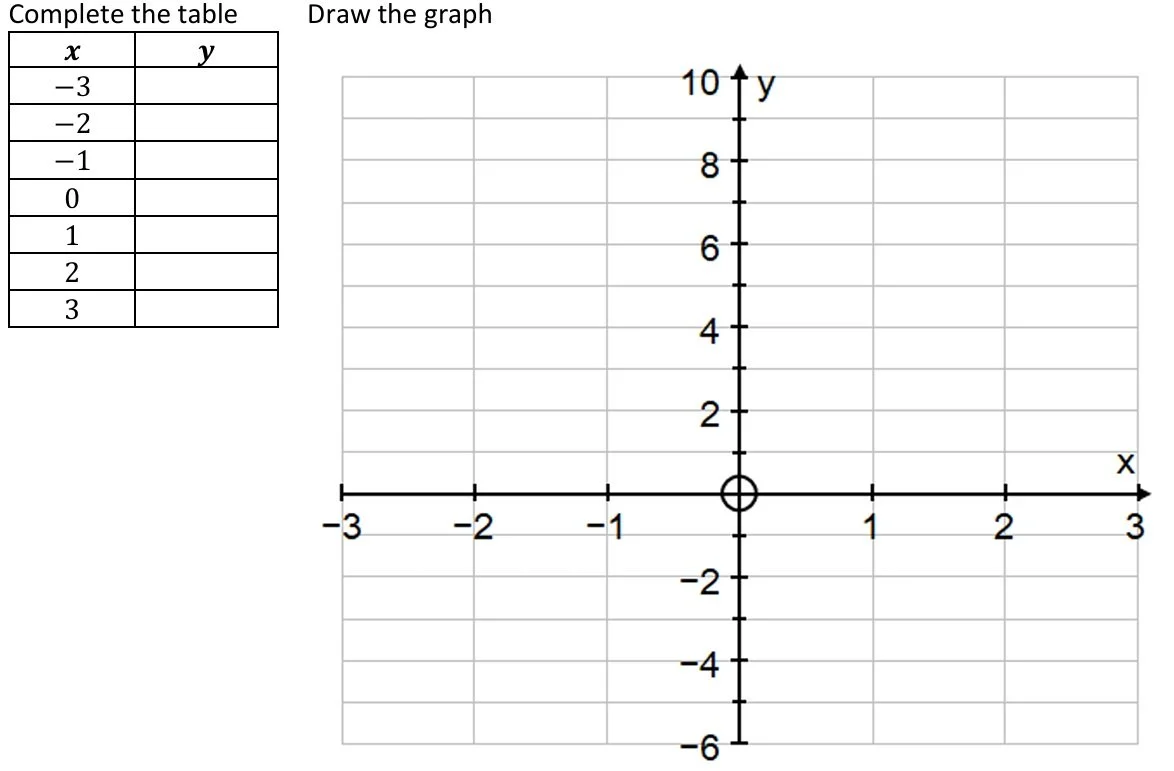
Calculate The function \(f\left(x\right)=x^{3}+3x^{2}-4\) is defined over all real numbers. Complete the table of values and draw the graph on the axes provided.
Solutions
Get Ready
Questions
:Using the graph of \(f\left(x\right)=x^{3}+3x^{2}-4\) that you drew in the Required Prior Knowledge, determine:
a) when \(f\left(x\right)<0\)
b) when \(f\left(x\right)=0\)
c) when the sign of \(f\left(x\right)\) changes
Solutions
Notes
There are several points of interest on the graph of a function that we can find using the GDC.
A zero (or root of the corresponding equation) is a point where \(y=0\).
It is a value of the domain that maps to \(0\) in the range.
Graphically, it is a point where the graph crosses the \(x\)-axis.
The \(y\)-intercept is the point where \(x=0\).
It is the value of \(\f\left(0\right)\).
Graphically, it is the point where the graph crosses the \(y\)-axis.
A turning point is any point where the graph changes direction.
That is, it changes from going upwards to downwards (or vice versa).
Turning points are either a local maxima or a local minima.
A local maxima is when the graph changes from going upwards to going downwards.
A local minima is when the graph changes from going downwards to going upwards.
We use the word local as they are the maximum / minimum point in the local vicinity. There may be other values that are greater or smaller elsewhere in the function.
We can also use our GDC to evaluate statements like \(f\left(2\right)\) or even solve \(f\left(x\right)=2\).
Examples and Your Turns
Example
For the function$$f\left(x\right)=x^{3}+3x^{2}-4$$find the coordinates of the:
a) roots
b) \(y\)-intercept
c) local maximum
d) local minimum
e) point where \(x=2\)
f) points where \(y=-2\)
Your Turn
For the function$$f\left(x\right)=-x^{4}+3x^{2}+4$$find the coordinates of the:
a) roots
b) \(y\)-intercept
c) local maximum
d) local minimum
e) point where \(x=1\)
f) points where \(y=5\)
Notes
An asymptote is a line that a graph approaches as it tends to infinity.
These commonly occur in graphs with a \(x\) in the denominator of a fraction.
When drawing asymptotes on graphs we use a dashed line.
Vertical Asymptotes occur when the denominator of a fraction is equal to \(0\).
The graph of a function will never cross a vertical asymptote.
Horizontal Asymptotes occur when a function tends to a finite value as the value of \(x\) gets bigger.
The graph of a function might cross a horizontal asymptote ‘near’ the origin.
Examples and Your Turns
Example
For the function $$f\left(x\right)=\frac{3x-9}{x^{2}-x-2}$$find the equations of the asymptotes of the graph of \(y=f\left(x\right)\).
Your Turn
For the function $$f\left(x\right)=\frac{x^{2}-3}{x^{2}+5x+6}$$find the equations of the asymptotes of the graph of \(y=f\left(x\right)\).
Your Turn
For the function$$f\left(x\right)=\frac{4}{x-2}$$
a) Use your GDC to sketch a graph of the function
b) Label the sketch with all axes intercepts
c) Label the sketch with the coordinates of all turning points, stating whether they are local maxima or minima
d) State the equation of any asymptotes
To see the answer, click on the grey circle to the left of the word Function below.
Your Turn
For the function$$f\left(x\right)=2-\frac{3}{x+1}$$
a) Use your GDC to sketch a graph of the function
b) Label the sketch with all axes intercepts
c) Label the sketch with the coordinates of all turning points, stating whether they are local maxima or minima
d) State the equation of any asymptotes
To see the answer, click on the grey circle to the left of the word Function below.
Your Turn
For the function$$f\left(x\right)=2^{x}-3$$
a) Use your GDC to sketch a graph of the function
b) Label the sketch with all axes intercepts
c) Label the sketch with the coordinates of all turning points, stating whether they are local maxima or minima
d) State the equation of any asymptotes
To see the answer, click on the grey circle to the left of the word Function below.
Your Turn
For the function$$f\left(x\right)=2x+\frac{1}{x}$$
a) Use your GDC to sketch a graph of the function
b) Label the sketch with all axes intercepts
c) Label the sketch with the coordinates of all turning points, stating whether they are local maxima or minima
d) State the equation of any asymptotes
To see the answer, click on the grey circle to the left of the word Function below.
Your Turn
For the function$$f\left(x\right)=\frac{4x}{x^{2}-4x-5}$$
a) Use your GDC to sketch a graph of the function
b) Label the sketch with all axes intercepts
c) Label the sketch with the coordinates of all turning points, stating whether they are local maxima or minima
d) State the equation of any asymptotes
To see the answer, click on the grey circle to the left of the word Function below.
Your Turn
For the function$$f\left(x\right)=3^{-x}+2$$
a) Use your GDC to sketch a graph of the function
b) Label the sketch with all axes intercepts
c) Label the sketch with the coordinates of all turning points, stating whether they are local maxima or minima
d) State the equation of any asymptotes
To see the answer, click on the grey circle to the left of the word Function below.
Your Turn
For the function$$f\left(x\right)=\frac{x^{2}-1}{x^{2}+1}$$
a) Use your GDC to sketch a graph of the function
b) Label the sketch with all axes intercepts
c) Label the sketch with the coordinates of all turning points, stating whether they are local maxima or minima
d) State the equation of any asymptotes
To see the answer, click on the grey circle to the left of the word Function below.
Your Turn
For the function$$f\left(x\right)=\frac{x^{2}+1}{x^{2}-1}$$
a) Use your GDC to sketch a graph of the function
b) Label the sketch with all axes intercepts
c) Label the sketch with the coordinates of all turning points, stating whether they are local maxima or minima
d) State the equation of any asymptotes
To see the answer, click on the grey circle to the left of the word Function below.
Your Turn
For the function$$f\left(x\right)=\frac{2^{x}+3}{2^{x}+1}$$
a) Use your GDC to sketch a graph of the function
b) Label the sketch with all axes intercepts
c) Label the sketch with the coordinates of all turning points, stating whether they are local maxima or minima
d) State the equation of any asymptotes
To see the answer, click on the grey circle to the left of the word Function below.
Your Turn
For the function$$f\left(x\right)=2^{-x}x^{2}$$
a) Use your GDC to sketch a graph of the function
b) Label the sketch with all axes intercepts
c) Label the sketch with the coordinates of all turning points, stating whether they are local maxima or minima
d) State the equation of any asymptotes
To see the answer, click on the grey circle to the left of the word Function below.
Key Facts
Use this applet to generate a prompt for a Key Fact that you need to know for the course. The idea is that you should KNOW these key facts in order to be able to solve problems.
Taking it Deeper
Conceptual Questions to Consider
Why can a function only have one \(y\)-intercept but multiple zeros?
Why does setting \(y=0\) allow us to find the zeros?
What is the difference between a local maximum and a global maximum?
Why do vertical asymptotes occur when the denominator of a fraction is equal to \(0\)?
Common Mistakes / Misconceptions
Confusing the domain and range of a relation.
Thinking that all equations represent a function (e.g. \(x^{2}+y^{2}=1\)).
Misunderstanding the vertical line test.
Connecting This to Other Skills
This skill is fundamentally important for the development of all other function-related skills covered in Unit 2.
A clear understanding of relations and functions is absolutely essential for success in calculus, which is explored in greater detail in Units 4 and 5.
Self-Reflection
What was the most challenging part of this skill for you?
What are you still unsure about that you need to review?