
Unit 2 - Functions
Required Prior Knowledge
Questions
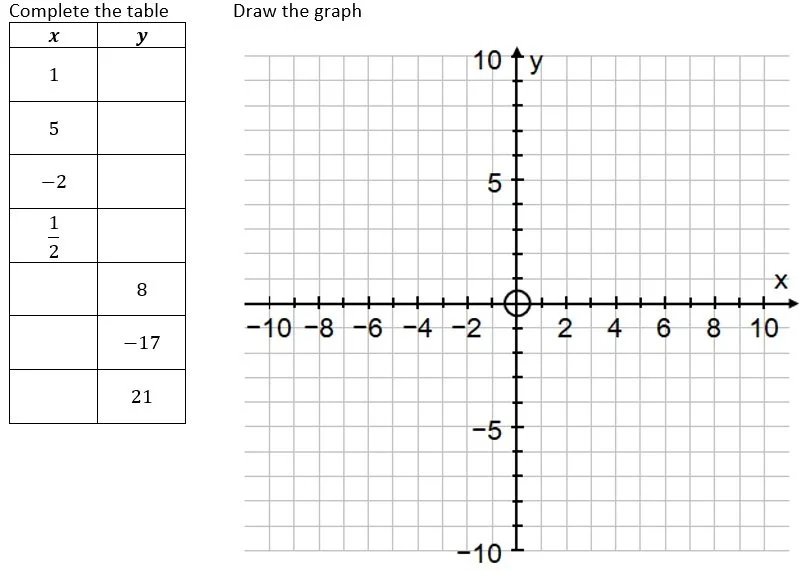
The equation of a graph is given by \(y=x^{2}\).
a) Complete the table of values below
b) Draw the graph on the axes below
Solutions
Get Ready
Questions
A function is given by the following table $$\begin{array}{c|c|c|c|c|c|c}x&0&1&2&3&4&5\\ \hline f\left(x\right)&7&2&9&-1&4&0\end{array}$$Using this function, write down:
a) \(f\left(1\right)\)
b) \(f\left(4\right)\)
c) The value of \(a\) if \(f\left(a\right)=7\)
Solutions
Notes
All functions can be represented by a graph.
We need to know the domain when drawing the graph of a function, as this affects how much of the graph we draw.
We can also list points on the graph of a function in a table of values.
We can use our GDC to draw the graph of a function and to generate the table of values.
When asked to sketch a graph we must
ensure it has the right shape
label important points
When asked to draw a graph we must
be accurate
label axes
If you are given a set of axes on which to draw the graph, make sure you match the graph to those axes. If using your GDC, set the View Window to match the axes.
Examples and Your Turns
Example
A function is defined as$$f\left(x\right)=x^{3}+\frac{1}{2}x^{2}-2x+1$$over the domain \(\left\{x:-3\le x \le 3,x\in\mathbb{R}\right\}\).
Draw a sketch of the graph of \(y=f\left(x\right)\) and give the table of values for the integers \(-3\le x \le 3\).
Your Turn
A function is defined as$$f\left(x\right)=\frac{x^{3}-12x+18}{4}$$over the domain \(\left\{x:-5\le x \le 3,x\in\mathbb{R}\right\}\).
Draw a sketch of the graph of \(y=f\left(x\right)\) and give the table of values for the integers \(-5\le x \le 3\).
Your Turn
Use your GDC to draw a sketch of the function$$f\left(x\right)=\frac{2}{\sqrt{4x-12}}$$Once done, you can reveal the graph below by clicking on the greyed out circle to the left of the word Function.
Your Turn
Use your GDC to draw a sketch of the function$$f\left(x\right)=2x^{3}-5$$Once done, you can reveal the graph below by clicking on the greyed out circle to the left of the word Function.
Your Turn
Use your GDC to draw a sketch of the function$$f\left(x\right)=-\left|3x-7\right|$$Once done, you can reveal the graph below by clicking on the greyed out circle to the left of the word Function.
Your Turn
Use your GDC to draw a sketch of the function$$f\left(x\right)=\frac{x^{2}}{x^{2}+6}$$Once done, you can reveal the graph below by clicking on the greyed out circle to the left of the word Function.
Your Turn
Use your GDC to draw a sketch of the function$$f\left(x\right)=\sqrt{x-8}+3$$Once done, you can reveal the graph below by clicking on the greyed out circle to the left of the word Function.
Your Turn
Use your GDC to draw a sketch of the function$$f\left(x\right)=\frac{4}{x+1}$$Once done, you can reveal the graph below by clicking on the greyed out circle to the left of the word Function.
Your Turn
Use your GDC to draw a sketch of the function$$f\left(x\right)=-\frac{3}{3x-6}$$Once done, you can reveal the graph below by clicking on the greyed out circle to the left of the word Function.
Your Turn
Use your GDC to draw a sketch of the function$$f\left(x\right)=4+x$$Once done, you can reveal the graph below by clicking on the greyed out circle to the left of the word Function.
Your Turn
Use your GDC to draw a sketch of the function$$f\left(x\right)=2+\sqrt{x^{2}-9}$$Once done, you can reveal the graph below by clicking on the greyed out circle to the left of the word Function.
Your Turn
Use your GDC to draw a sketch of the function$$f\left(x\right)=\left|\frac{x-1}{x+5}\right|$$Once done, you can reveal the graph below by clicking on the greyed out circle to the left of the word Function.
Your Turn
Use your GDC to draw a sketch of the function$$f\left(x\right)=-x^{3}+8$$Once done, you can reveal the graph below by clicking on the greyed out circle to the left of the word Function.
Your Turn
Use your GDC to draw a sketch of the function$$f\left(x\right)=\frac{7}{\sqrt{2x-5}}$$Once done, you can reveal the graph below by clicking on the greyed out circle to the left of the word Function.
Key Facts
Use this applet to generate a prompt for a Key Fact that you need to know for the course. The idea is that you should KNOW these key facts in order to be able to solve problems.
Taking it Deeper
Conceptual Questions to Consider
What are the limitations of relying on a GDC when sketching a function?
Why is it important to understand the basic features of graphs of key functions, even when you have a GDC?
How does \(f\left(2\right)=7\) relate to the graph of the function of \(y=f\left(x\right)\)?
Common Mistakes / Misconceptions
Not setting the view window appropriately in the GDC.
Accidently setting the Maximum and Minimum values for the x and/or y axis to be the same, causing an error.
Forgetting to label axes or points.
Connecting This to Other Skills
This skill is a pre-cursor to the next skill on finding key points on graphs of functions (2.5). It is also fundamental to when we look at specific functions (2.7, 2.8, 2.9 and 2.10).
Without being able to draw graphs in the GDC, you will not be able to find points of intersection of two functions (2.17), and graphing transformations of functions will be impossible (2.18).
Understanding the graphs of polynomials will be essential to the Fundamental Theorem of Algebra (2.21).
In Unit 3 we will graph the trigonometric functions (3.9).
In Units 4 and 5, when studying calculus, we will work with the graphs of functions extensively to understand these concepts.
Self-Reflection
What was the most challenging part of this skill for you?
What are you still unsure about that you need to review?