
Unit 3 - Trigonometry
Required Prior Knowledge
Questions
Label the size of the angles in these two triangles in both degrees and radians.
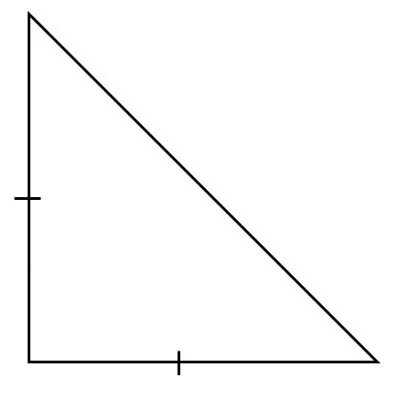
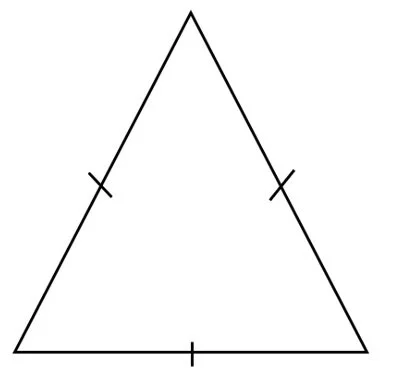
Solutions
Get Ready
Questions
Using the two triangles above and the unit circle, fill in the table below.
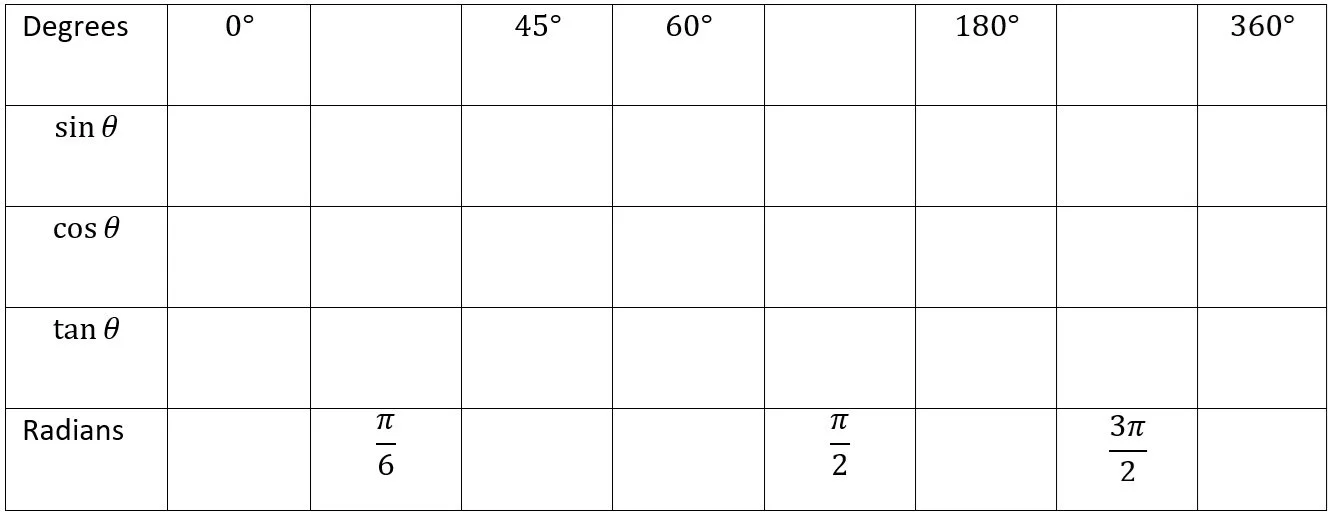
Solutions
Your Turn
Without looking at the table above, fill in the gaps so that all cells in a row have the same value.
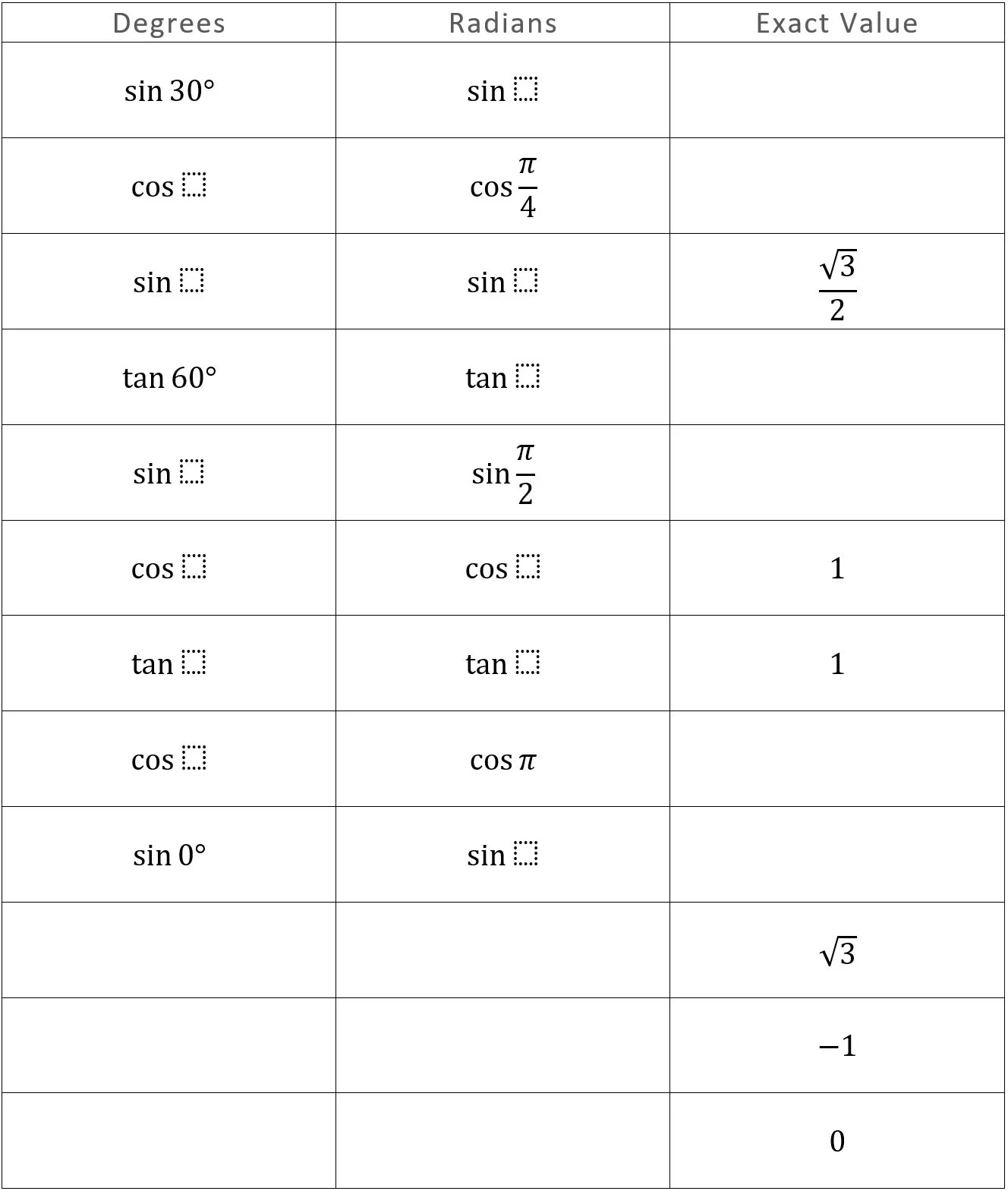
Examples and Your Turns
Example
Find the exact values of \(\sin\alpha\), \(\cos\alpha\) and \(\tan\alpha\) for \(\alpha =\frac{3\pi}{4}\).
Your Turn
Find the exact values of \(\sin\alpha\), \(\cos\alpha\) and \(\tan\alpha\) for \(\alpha =\frac{4\pi}{3}\).
Your Turn
Find the exact values of \(\sin\alpha\), \(\cos\alpha\) and \(\tan\alpha\) for \(\alpha =225^{\circ}\).
Your Turn
Find the exact values of \(\sin\alpha\), \(\cos\alpha\) and \(\tan\alpha\) for \(\alpha =\frac{5\pi}{3}\).
Your Turn
Find the exact values of \(\sin\alpha\), \(\cos\alpha\) and \(\tan\alpha\) for \(\alpha =\frac{11\pi}{6}\).
Your Turn
Find the exact values of \(\sin\alpha\), \(\cos\alpha\) and \(\tan\alpha\) for \(\alpha =510^{\circ}\).
Your Turn
Find the exact value for each of these.
|
|
|
||||||
|
|
|
||||||
|
|
|
||||||
|
|
|
||||||
|
|
|
||||||
|
|
|
Your Turn
Without using a calculator, evaluate$$8\sin\left(\frac{\pi}{3}\right)\cos\left(\frac{5\pi}{6}\right)$$
Your Turn
Find all angles \(0\le\theta\le 2\pi\) with a cosine of \(\frac{1}{2}\).
Key Facts
Use this applet to generate a prompt for a Key Fact that you need to know for the course. The idea is that you should KNOW these key facts in order to be able to solve problems.
Taking it Deeper
Conceptual Questions to Consider
Describe how you can use the unit circle and the two special triangles to work with the exact values.
Explain how the values of \(\sin \frac{\pi}{3}\) and \(\cos \frac{\pi}{6}\) are related, based on the unit circle.
Common Mistakes / Misconceptions
The biggest mistake is working out the correct exact value, but then forgetting to use the unit circle to determine the sign of the answer.
Another common mistake is to mix up the sine and cosine exact values. They are opposites when in order, sine from smallest to largest.
Connecting This to Other Skills
We are using the ideas from the Unit Circle and Periodicity (3.5) in this skill.
When we start Solving Simple Equations (3.8) and Solving Equations (3.16) we will often do this in non-calculator papers where knowledge of the exact values is crucial.
We will see in working with Compound Angle Formulae (3.10) that exact values can be helpful to determine other values of the trigonometric functions.
Self-Reflection
What was the most challenging part of this skill for you?
What are you still unsure about that you need to review?