
Unit 3 - Trigonometry
Required Prior Knowledge
Questions
What do \(a\), \(b\), \(c\) and \(d\) affect in the function$$f\left(x\right)=a\sin\left(b\left(x+c\right)\right)+d$$
Solutions
Notes
We can use trigonometric functions to model periodic data.
Steps for fitting data to a trigonometric function:
Find the amplitude$$a=\frac{\text{max}-\text{min}}{2}$$
Find the Principal Axis$$d=\frac{\text{max}+\text{min}}{2}$$
Find the Period$$b=\frac{2\pi}{\text{period}}$$
Find the Phase Shift by thinking about horizontal translations.
Your Turns
Your Turn (NON-CALCULATOR)
The average daytime temperature for a city is given by the function $$D\left(t\right)=5\cos\left(\frac{\pi}{6}t\right)+20$$where \(t\) is the time in months after January and \(D\) is measured in \(^{\circ}\)C.
a) Sketch the graph of \(D\) against \(t\) for \(0\le t\le 24\)
b) Find the average daytime temperature during May.
c) Find the minimum average daytime temperature, and the month in which it occurs.
Your Turn
The height of a seat on a Ferris Wheel is modelled by $$H\left(t\right)=-15\cos\left(\frac{\pi}{20}t\right)+17$$
a) What is the maximum height of the seat?
b) How long does one full revolution take?
c) What is the height of the seat when the ride starts?
Your Turn
The depth of water in the harbour is modelled by the function$$D\left(t\right)=a\cos\left(b\left(t-c\right)\right)+d$$where \(t\) is the time in hours after midnight. The depth is 16 m at high tide at 3am, and at 9am it is low tide and the depth is 10 m.
(a) Find the equation for depth of water in terms of time.
(b) Find how long the water is below 12 m high in a single day.
Your Turn
The number of hours of daylight in a city can be modelled by the function$$L\left(t\right)=a\cos\left(b\left(t-c\right)\right)+d$$On January 1st (\(t=1\)), there are \(9\) hours of daylight. The maximum daylight is \(15\) hours on July 1st (\(t=182\)).
a) Find the function, assuming a year is \(365\) days.
b) Use your model to predict the number of hours of daylight on October 25th (\(t=298\)).
Your Turn
The table below shows the mean monthly temperature in Cape Town.
| Month | Jan | Feb | Mar | Apr | May | Jun | Jul | Aug | Sep | Oct | Nov | Dec |
|---|---|---|---|---|---|---|---|---|---|---|---|---|
| Temp. \(T\) (\(^{\circ}\text{C}\)) | 28 | 27 | \(25\frac{1}{2}\) | 22 | \(18\frac{1}{2}\) | 16 | 15 | 16 | 18 | \(21\frac{1}{2}\) | 24 | 26 |
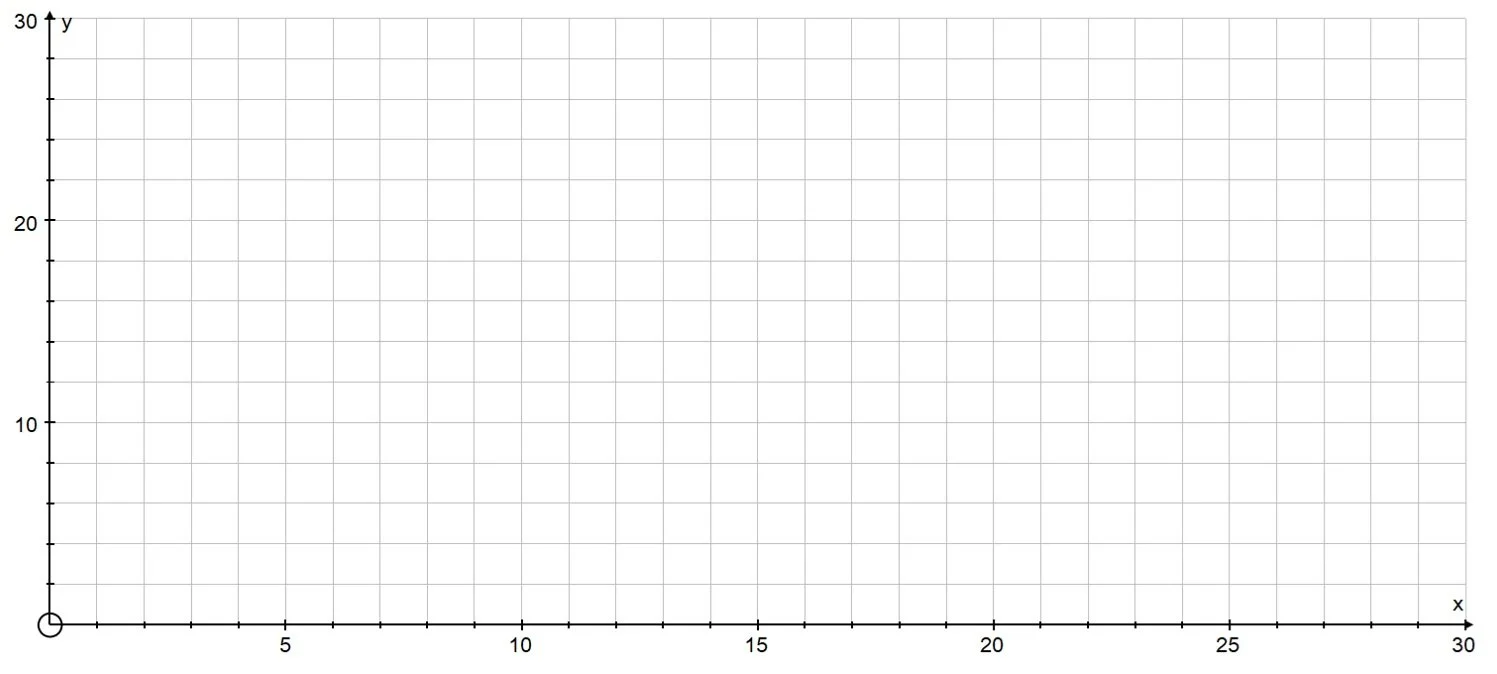
By plotting the date over a two-year period, find a model for the temperature over time.
Your Turn
A buoy is floating in the sea. The distance from the sea floor to the buoy’s base is modelled by the function$$d\left(t\right)=A\sin\left(Bt\right)+C$$. At high tide, the distance is \(15\) metres. At low tide, \(6\) hours later, the distance is \(9\) metres.
a) Find the values of \(A\) and \(C\).
b) Find the value of \(B\) assuming a full tidal cycle is \(12\) hours.
c) Find the first time, in hours after low tide, that the distance to the sea floor is \(12\) metres.
Key Facts
Use this applet to generate a prompt for a Key Fact that you need to know for the course. The idea is that you should KNOW these key facts in order to be able to solve problems.
Taking it Deeper
Conceptual Questions to Consider
When is it better to use a sine model or a cosine model for particular phenomena?
Think of some other real world scenarios that show periodic behaviour that could be modelled by a trigonometric function.
Common Mistakes / Misconceptions
The most difficult part of this process is usually finding the phase shift. Think about the horizontal translation.
Often in these questions you know a maximum and a minimum value, and not two consecutive maxima. This distance is HALF the period, and often students forget this fact.
Connecting This to Other Skills
This skill obviously builds upon the theoretical groundwork of Trigonometric Functions (3.9) and applies these ideas to real world phenomena.
You will often need to solve trigonometric equations (3.16), particularly in non-calculator exams.
Self-Reflection
What was the most challenging part of this skill for you?
What are you still unsure about that you need to review?