
Unit 3 - Trigonometry
Required Prior Knowledge
Questions
Simplify, by rationalising the denominator if necessary, the following
a) \(\frac{1}{\frac{2}{3}}= \)
b) \(\frac{1}{\frac{2}{x+1}}= \)
c) \(\frac{1}{\frac{\sqrt{2}}{2}}= \)
d) \(\frac{1}{\frac{\sqrt{5}}{3}}= \)
Solutions
Get Ready
Questions
By considering the graphs of \(y=\sin x\), \(y=\cos x\) and \(y=\tan x\) sketch the graphs of \(y=\frac{1}{\sin x}\), \(y=\frac{1}{\cos x}\) and \(y=\frac{1}{\tan x}\).
Solutions
Notes
The reciprocal trigonometric functions are defined as$$\operatorname{cosec} x=\frac{1}{\sin x}$$$$\sec x=\frac{1}{\cos x}$$$$\cot x=\frac{1}{\tan x}$$Note that the third letter of the reciprocal function matches the first letter of the corresponding trig function.
Also note that $$\sin^{-1} x\ne \left(\sin x\right)^{-1}=\operatorname{cosec} x$$
Examples and Your Turns
Example
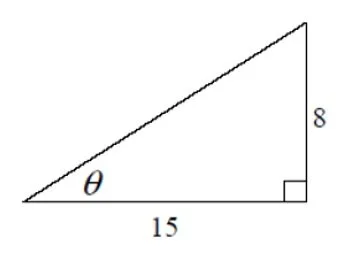
Find the value of the six trigonometric functions for the angle \(\theta\).
-
The hypotenuse is $$h=\sqrt{15^{2}+8^{2}}=17$$So$$\sin\theta = \frac{8}{17}\\ \operatorname{cosec}\theta = \frac{17}{8}\\ \cos\theta = \frac{15}{17}\\ \sec\theta = \frac{17}{15}\\ \tan\theta = \frac{8}{15}\\ \cot\theta = \frac{15}{8}$$
Your Turn
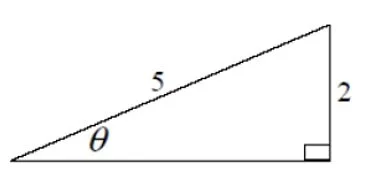
Find the value of the six trigonometric functions for the angle \(\theta\).
-
The adjacent is $$a=\sqrt{5^{2}-2^{2}}=\sqrt{21}$$So$$\sin\theta = \frac{2}{5}\\ \operatorname{cosec}\theta = \frac{5}{2}\\ \cos\theta = \frac{\sqrt{21}}{5}\\ \sec\theta = \frac{5}{\sqrt{21}}\\ \tan\theta = \frac{2}{\sqrt{21}}\\ \cot\theta = \frac{zsqrt{21}}{2}$$
Your Turn
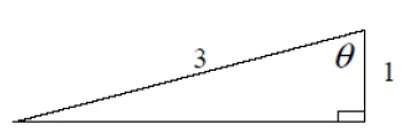
Find the value of the six trigonometric functions for the angle \(\theta\).
-
The opposite is $$o=\sqrt{3^{2}-1^{2}}=\sqrt{8}$$So$$\sin\theta = \frac{\sqrt{8}}{3}\\ \operatorname{cosec}\theta = \frac{3}{\sqrt{8}}\\ \cos\theta = \frac{1}{3}\\ \sec\theta = \frac{3}{1}\\ \tan\theta = \frac{\sqrt{8}}{1}\\ \cot\theta = \frac{1}{\sqrt{8}}$$
Your Turn
Find the exact value of $$\sec\left(\frac{5\pi}{6}\right)$$
Your Turn
Find the exact value of $$\cot\left(-\frac{3\pi}{4}\right)$$
Key Facts
Use this applet to generate a prompt for a Key Fact that you need to know for the course. The idea is that you should KNOW these key facts in order to be able to solve problems.
Taking it Deeper
Conceptual Questions to Consider
Explain why the graphs of \(\sec x\) and \(\cosec x\) do not have an amplitude.
How is the graph of \(y=\sec x\) related to the graph of \(y=\cosec x\)?
Common Mistakes / Misconceptions
Confusing which of the reciprocal trig functions pairs with each base trig function. Remember it is the THIRD letter of the reciprocal trig function that matches the FIRST letter of the base trig function.
Another common error is to mistake the reciprocal function for the inverse function due to the notation. \(\sin^{-1}x\) is the inverse of \(\sin x\). \(\cosec x\) is the reciprocal which is \(\frac{1}{\sin x}=\left(\sin x\right)^{-1}\).
Connecting This to Other Skills
The definitions of the reciprocal functions are linked to the definitions of the trigonometric functions by the Unit Circle (3.5).
The reciprocal trig functions will appear in Trigonometric Identities (3.12) as a short hand notation.
In Differentiating Trig Functions (4.12) and Integral Calculus (Unit 5) we will see how the reciprocal trigonometric functions are related to these ideas.
Self-Reflection
What was the most challenging part of this skill for you?
What are you still unsure about that you need to review?