
Unit 3 - Trigonometry
Required Prior Knowledge
Questions
a) Determine the value of \(\cos 26^{\circ} \)
b) Solve the equation$$\frac{x}{3}=\frac{4}{5}$$
c) Solve the equation$$\frac{3}{x}=\frac{4}{5}$$
d) If \(\sin x=0.4\), determine the value of \(x\).
Solutions
Get Ready
Questions
Shown is a right-angled triangle.
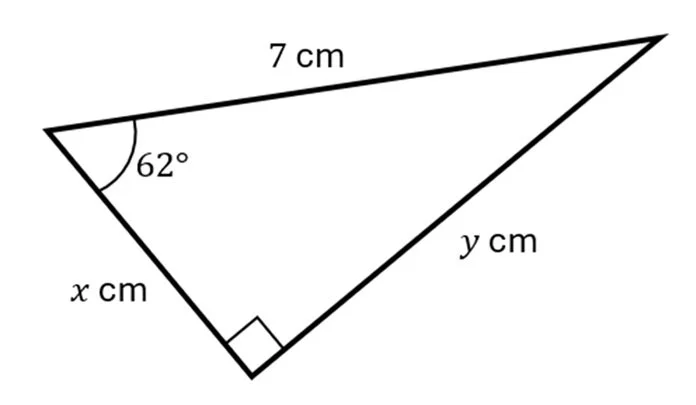
Determine the length \(x\).
Hence, determine the length \(y\).
What would happen to the lengths \(x\) and \(y\) if the angle marked was to increase? Decrease?
Solutions
Notes
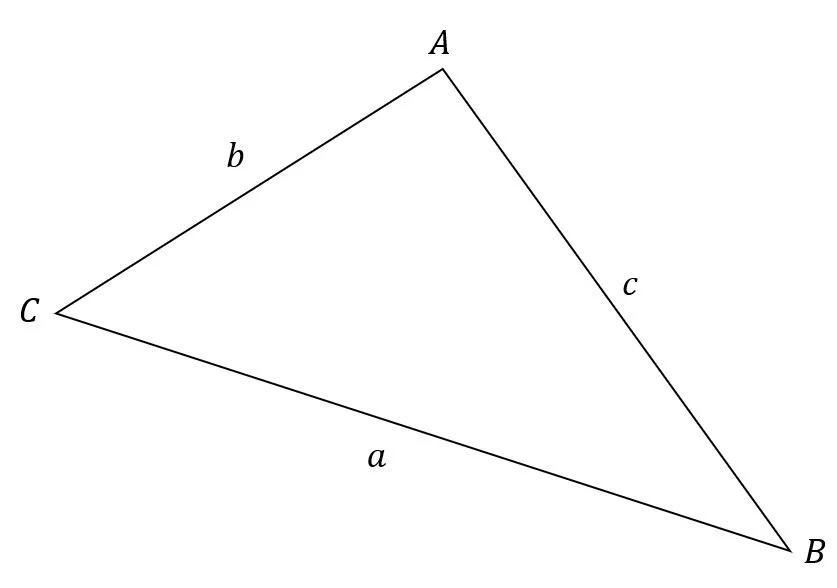
For triangles that are NOT right-angled, we label the sides with lowercase letters and the vertices with UPPERCASE LETTERS.
We always label sides and opposite vertices with the same letter.
For example,
Your Turn
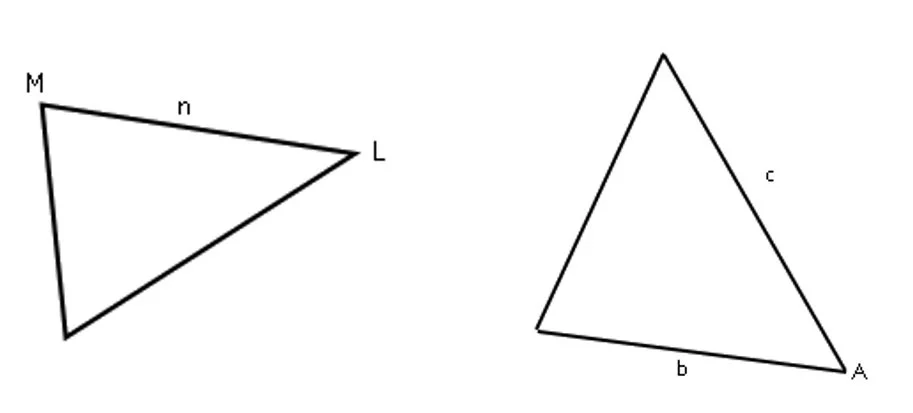
Complete the labelling of these triangles.
Notes
One of the angles in a triangle that is not right-angled can be greater than \(90^{\circ}\).
The \(\sin \), \(\cos \) and \(\tan \) functions can deal with angles of any size, including greater than \(90^{\circ}\).
Your Turn
Use your calculator to evaluate each of these:
| \(\sin 30^{\circ}\) |
\(0.500\)
?
|
\(\cos 30^{\circ}\) |
\(0.866\)
?
|
\(\tan 30^{\circ}\) |
\(0.577\)
?
|
| \(\sin 150^{\circ}\) |
\(0.500\)
?
|
\(\cos 150^{\circ}\) |
\(-0.866\)
?
|
\(\tan 150^{\circ}\) |
\(-0.577\)
?
|
| \(\sin 140^{\circ}\) |
\(0.643\)
?
|
\(\cos 140^{\circ}\) |
\(-0.766\)
?
|
\(\tan 140^{\circ}\) |
\(-0.839\)
?
|
| \(\sin 40^{\circ}\) |
\(0.643\)
?
|
\(\cos 40^{\circ}\) |
\(0.766\)
?
|
\(\tan 40^{\circ}\) |
\(0.839\)
?
|
| \(\sin 220^{\circ}\) |
\(-0.643\)
?
|
\(\cos 220^{\circ}\) |
\(-0.766\)
?
|
\(\tan 220^{\circ}\) |
\(0.839\)
?
|
| \(\sin 320^{\circ}\) |
\(-0.643\)
?
|
\(\cos 320^{\circ}\) |
\(0.766\)
?
|
\(\tan 320^{\circ}\) |
\(-0.839\)
?
|
| \(\sin 400^{\circ}\) |
\(0.643\)
?
|
\(\cos 400^{\circ}\) |
\(0.766\)
?
|
\(\tan 400^{\circ}\) |
\(0.839\)
?
|
| \(\sin (-40^{\circ})\) |
\(-0.643\)
?
|
\(\cos (-40^{\circ})\) |
\(0.766\)
?
|
\(\tan (-40^{\circ})\) |
\(-0.839\)
?
|
| \(\sin (-400^{\circ})\) |
\(-0.643\)
?
|
\(\cos (-400^{\circ})\) |
\(0.766\)
?
|
\(\tan (-400^{\circ})\) |
\(-0.839\)
?
|
Notes
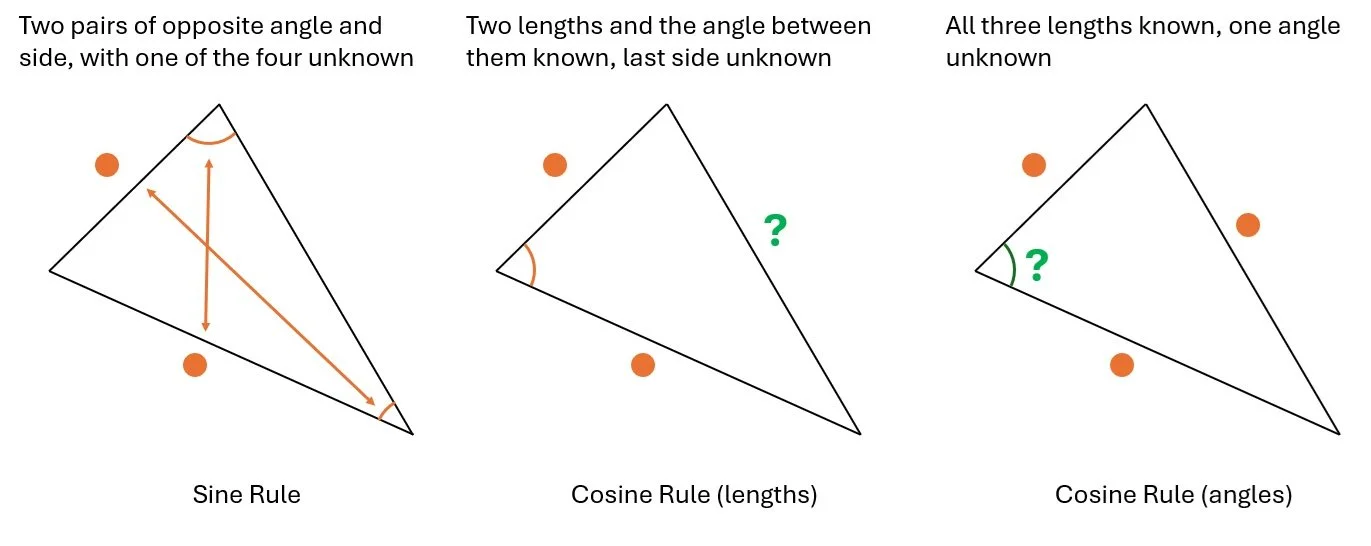
When trying to find the missing lengths or angles in non-right-angled triangles we have to use either:
The Sine Rule
The Cosine Rule
These formulae are given in the formula booklet in the exam, so you need to the able to use them, not memorise them.
There is also a related formula for calculating the area of any triangle when we know an angle in the triangle.
-
$$a^{2}=b^{2}+c^{2}-2bc\cos A$$
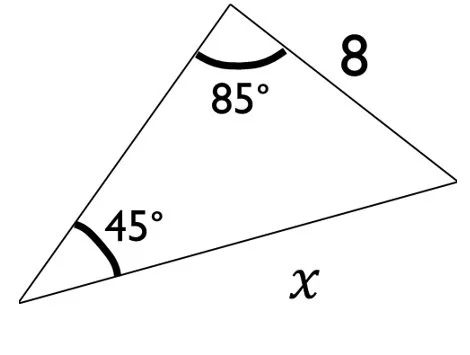
We use this form when we have two lengths and the angle between the two known lengths (SAS). We use it to find the third missing side (opposite the known angle).
-
$$\cos A=\frac{b^{2}+c^{2}-a^{2}}{2bc}$$
This form is a rearrangement of the one above and is used to find an angle when we know all three lengths. We can find any angle, but the angle being found is opposite the side that is being subtracted in the formula.
-
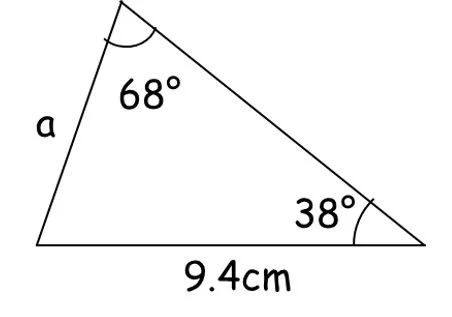
$$\frac{a}{\sin A}=\frac{b}{\sin B}=\frac{c}{\sin C}$$
To use this formula we need to have two pairs of opposite lengths/angles, where we don’t know one of these lengths.
-
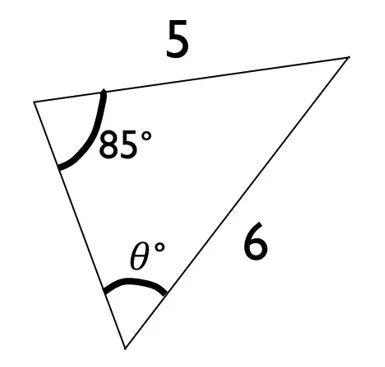
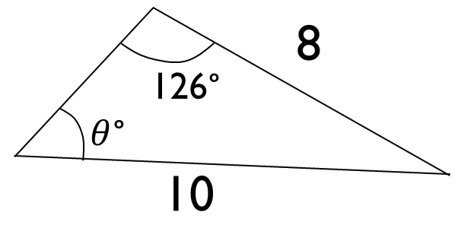
$$\frac{\sin A}{a}=\frac{\sin B}{b}=\frac{\sin C}{c}$$
This is the reciprocal of the formula above, and NOT in the formula booklet.
To use this formula we need to have two pairs of opposite lengths/angles, where we don’t know one of these angles.
-
$$A=\frac{1}{2}bc\sin A$$
To use this formula we need two lengths and the angle between them (SAS), the same requirement as for the Cosine Rule for Lengths.
Proof of Area of Triangle
Proof of Cosine Rule
Proof of Sine Rule
Examples and Your Turns
Example
Find the length of \(x\) in this triangle.
Your Turn
Find the length of \(a\) in this triangle.
Example
Find the angle \(\theta\) in this triangle.
Your Turn
Find the angle \(\theta\) in this triangle.
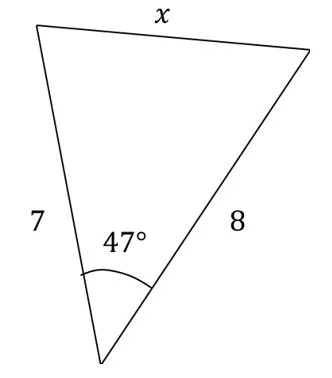
Example
Find the length \(x\) in this triangle.
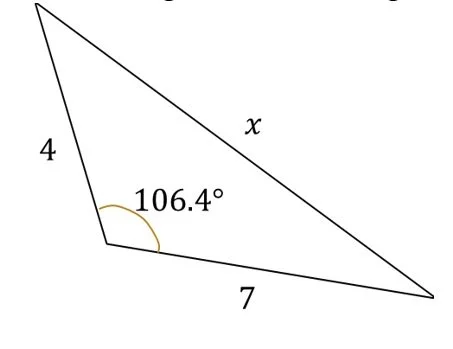
Your Turn
Find the length \(x\) in this triangle.
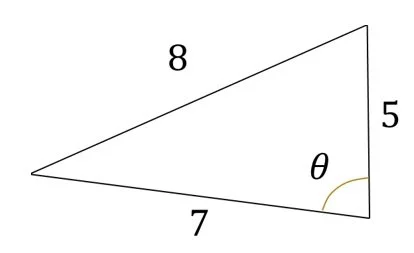
Example
Find the angle \(\theta\) in this triangle.
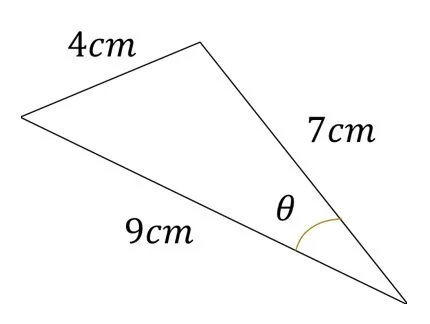
Your Turn
Find the angle \(\theta\) in this triangle.
Example
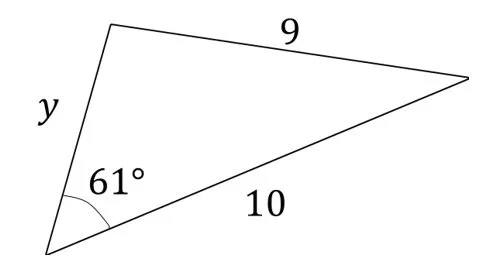
Find the length \(y\) in this triangle.
Your Turn
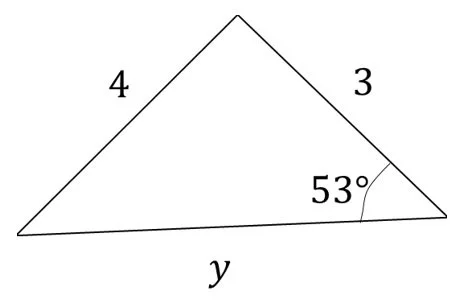
Find the length \(x\) in this triangle.
Example
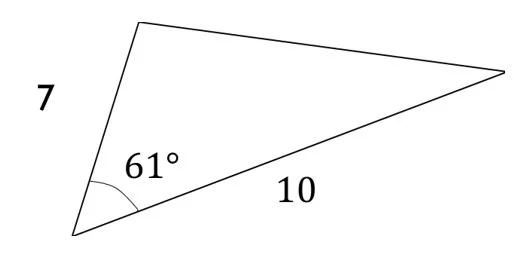
Find the area of this triangle.
Your Turn
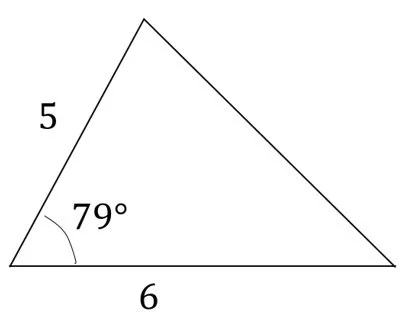
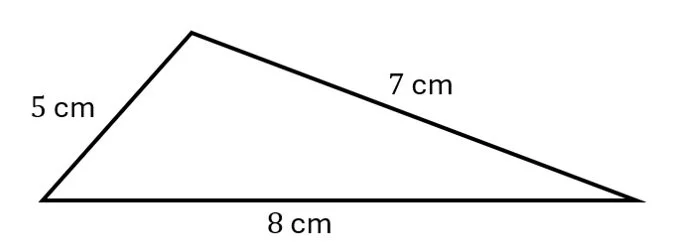
Find the area of this triangle.
Your Turn
Find the area of this triangle.
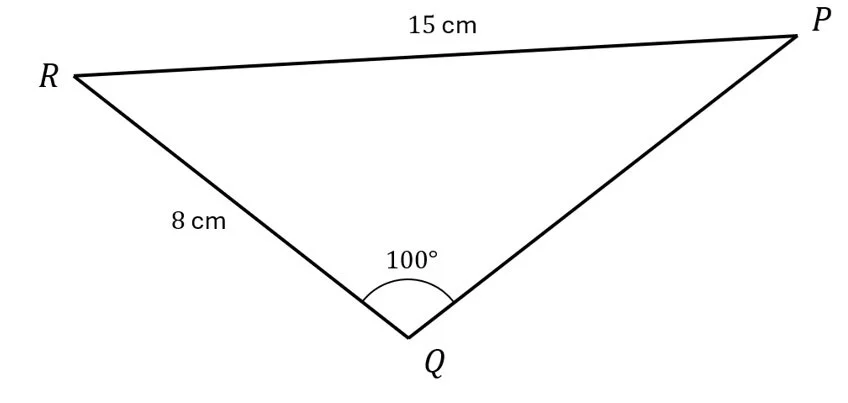
Your Turn
Given that the area of the triangle \(PQR\) shown below is \(58\) cm\(^{2}\), determine the length \(PQ\).
Your Turn
A triangular piece of land has vertices \(A\), \(B\) and \(C\).
The distance from \(A\) to \(B\) is \(50\) m, the distance from \(B\) to \(C\) is \(80\) m, and the angle at \(B\) is \(75^{\circ}\).
A straight fence is to be built from point \(A\) to a point \(D\) on the side \(BC\).
The fence \(AD\) is to be \(60\) m long.
a) Find the length of the side \(AC\).
b) Find the measure of angle \(BAC\).
c) Find the length of the segment \(BD\).
d) Find the area of the triangular piece of land \(ADC\).
Investigation
Draw accurately the triangle \(ABC\) where \(AB=10\) cm, \(BC=6\) cm and angle \(CAB=30^{\circ}\).
Find angle \(ACB\).
What happens in each of these scenarios:
(i) \(BC=5\) cm
(ii) \(BC=3\) cm
(iii) \(BC=12\) cm
Example
Find the size of angle \(C\) in triangle \(ABC\) if \(AC=7\) cm, \(AB=11\) cm and angle \(B\) measures \(25^{\circ}\).
Your Turn
Find the size of angle \(L\) in triangle \(KLM\) if \(LM=16.8\) cm, \(KM=13.5\) cm and angle \(K\) measures \(56^{\circ}\).
Key Facts
Use this applet to generate a prompt for a Key Fact that you need to know for the course. The idea is that you should KNOW these key facts in order to be able to solve problems.
Taking it Deeper
Conceptual Questions to Consider
How is the cosine rule linked to Pythagoras’ Theorem?
Explain why the ambiguous case of the sine rule occurs in certain situations? When does is happen?
Common Mistakes / Misconceptions
The most common mistake is to use the wrong rule. Another common on is to label the triangle incorrectly, and so making the wrong substitution.
Remember to always check for the ambiguous case when using the sine rule.
Connecting This to Other Skills
A good working knowledge of Right Angled Trigonometry (PK6) is assumed here, and sometimes you are better using that to solve problems.
We will build upon this in Applications of Trigonometry (3.2), and also when we introduce Radians (3.4) we can do the same problems in radians. These formulae are also often needed to solve problems involving Arcs and Sectors (3.4).
Self-Reflection
What was the most challenging part of this skill for you?
What are you still unsure about that you need to review?