
Unit 3 - Trigonometry
Required Prior Knowledge
Questions
a) Solve the equation \(4x+5=0\)
b) Solve the equation \(5=8+x\)
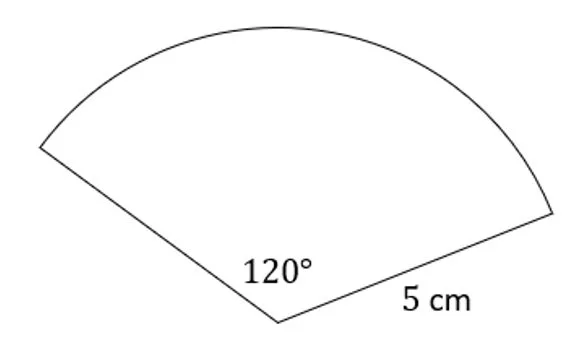
Find the arc length and area of the following sector.
Solutions
Get Ready
Questions
Give some examples of equivalent measurements in different units.
Notes
Radians are a different unit for measuring angles.
Given that$$180^{\circ}=\pi\text{ radians}$$fill in the following blanks
| Degrees | Radians |
|---|---|
| $$360^{\circ}$$ |
$$2\pi$$
?
|
| $$90^{\circ}$$ |
$$\frac{\pi}{2}$$
?
|
|
$$270^{\circ}$$
?
|
$$\frac{3\pi}{2}$$ |
|
$$45^{\circ}$$
?
|
$$\frac{\pi}{4}$$ |
| $$60^{\circ}$$ |
$$\frac{\pi}{3}$$
?
|
| $$30^{\circ}$$ |
$$\frac{\pi}{6}$$
?
|
| $$150^{\circ}$$ |
$$\frac{5\pi}{6}$$
?
|
|
$$36^{\circ}$$
?
|
$$\frac{\pi}{5}$$ |
|
$$15^{\circ}$$
?
|
$$\frac{\pi}{12}$$ |
| $$240^{\circ}$$ |
$$\frac{4\pi}{3}$$
?
|
|
$$450^{\circ}$$
?
|
$$\frac{5\pi}{2}$$ |
|
$$72^{\circ}$$
?
|
$$\frac{2\pi}{5}$$ |
When an arc of a circle is equal to the radius, the angle subtended is \(1\) radian.
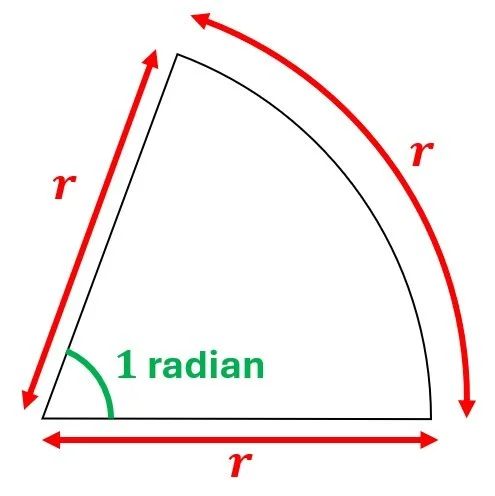
Normally we do not use a unit when angles are written in radians, but if we want to be really clear we can use \(^{c}\).
From this point on in the course, the default angle unit is radians, unless the question specifies it is in degrees.
\(1\) radian is slightly less than \(60^{\circ}\).$$1^{c}\approx 57.3^{\circ}$$The key conversion is $$\pi\text{ radians}=180^{\circ}$$You need to know the following conversions and what each radian value means by heart:
| Radian | Degree |
|---|---|
| $$2\pi$$ | $$360^{\circ}$$ |
| $$\pi$$ | $$180^{\circ}$$ |
| $$\frac{\pi}{2}$$ | $$90^{\circ}$$ |
| $$\frac{\pi}{4}$$ | $$45^{\circ}$$ |
| $$\frac{\pi}{6}$$ | $$30^{\circ}$$ |
| $$\frac{\pi}{3}$$ | $$60^{\circ}$$ |
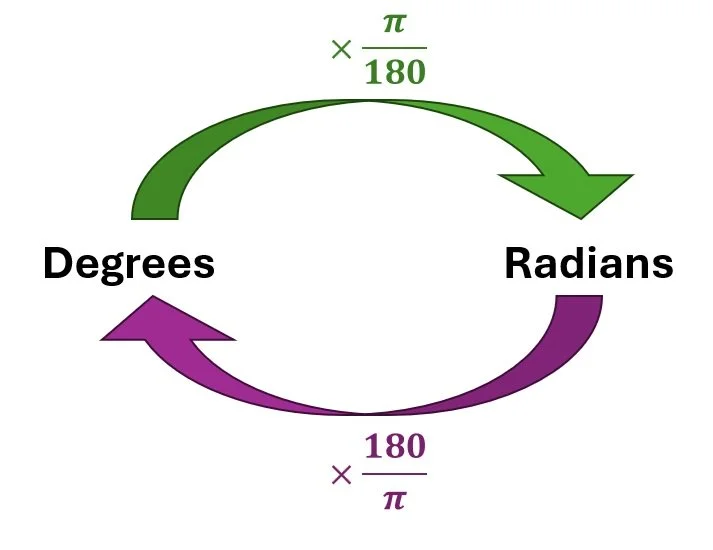
We can convert any value using
Examples and Your Turns
Example
a) Convert \(45^{\circ}\) to radians.
b) Convert \(0.638\) radians to degrees.
c) Convert \(126.5^{\circ}\) to radians.
d) Convert \(\frac{5\pi}{6}\) radians to degrees.
Your Turn
a) Convert \(135^{\circ}\) to radians.
b) Convert \(\frac{6\pi}{5}\) radians to degrees.
c) Convert \(213^{\circ}\) to radians.
d) Convert \(1.7\) radians to degrees.
Notes
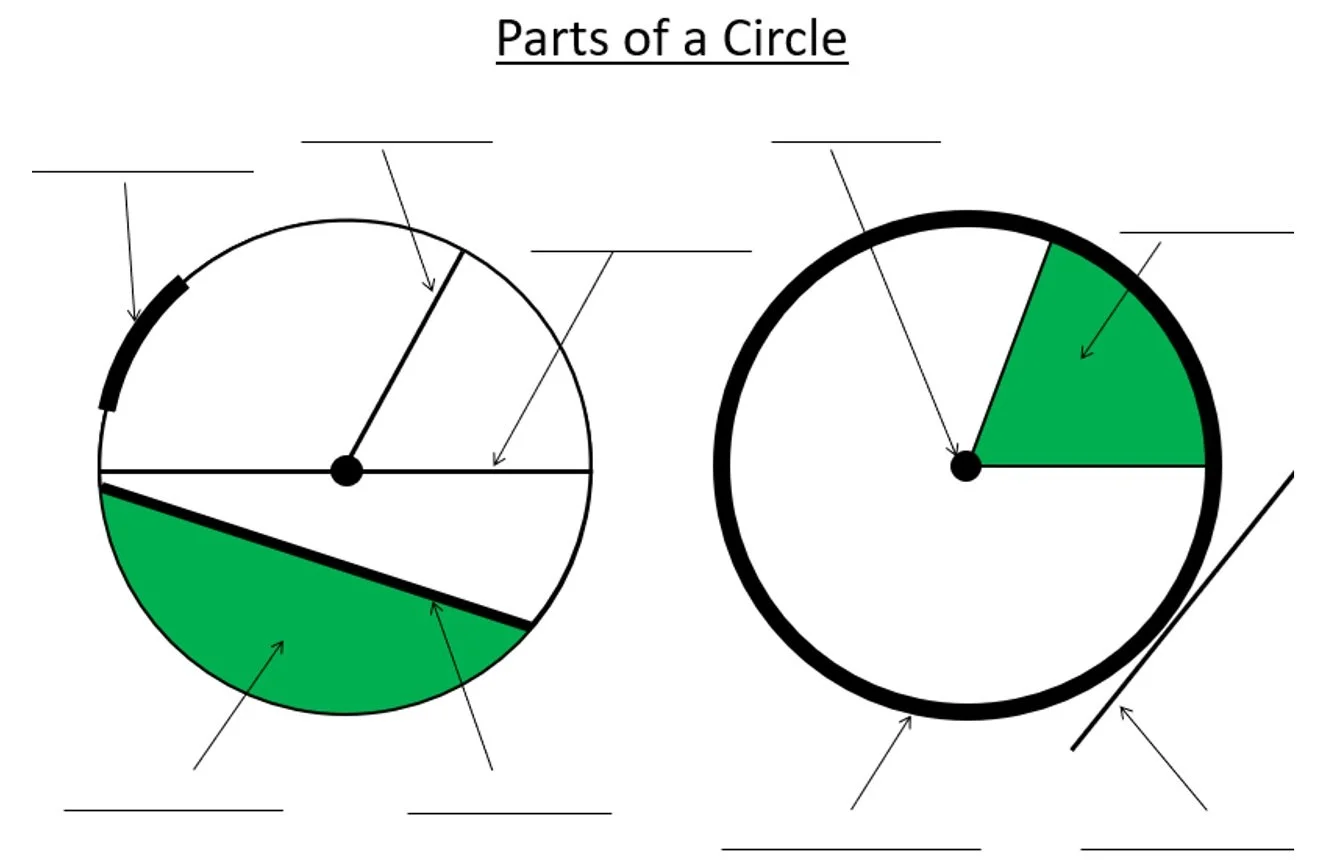
Label the parts of the following circles.
For a sector with the angle given in degrees:
Arc Length \(=\frac{\theta}{360}\times2\pi r\)
Area of Sector \(=\frac{\theta}{360}\times\pi r^{2}\)
However, as we will mostly be dealing in radians, we have these versions too:
Arc Length \(=\theta r\)
Area of Sector \(=\frac{1}{2}\theta r^{2}\)
Examples and Your Turns
Example
A sector has radius \(12\) cm and angle \(3\) radians. Find the arc length and area of the sector.
Your Turn
A sector has radius \(8.7\) cm and angle \(\frac{\pi}{5}\) radians. Find the arc length and area of the sector.
Your Turn
A sector of a circle has an area of \(24\pi\) cm\(^{2}\) and a radius of \(6\) cm. Find the angle of the sector in radians.
Your Turn
An arc of a circle is \( 12.5\) cm long. If the radius is \(5\) cm, find the central angle of the arc in radians.
Your Turn
A sector has a perimeter of \(25\) cm and a radius of \(8\) cm. Find the area of the sector.
Your Turn (No Calculator)
The area of a sector of a circle is \(18\) cm\(^{2}\). The radius of the circle is \(6\) cm.
Find the perimeter of the sector.
Your Turn
The diagram below shows a circle with center \(O\) and radius \(5\) cm.
The points \(A\) and \(B\) are on the circumference, and the arc length \(AB\) is \(7.5\) cm.
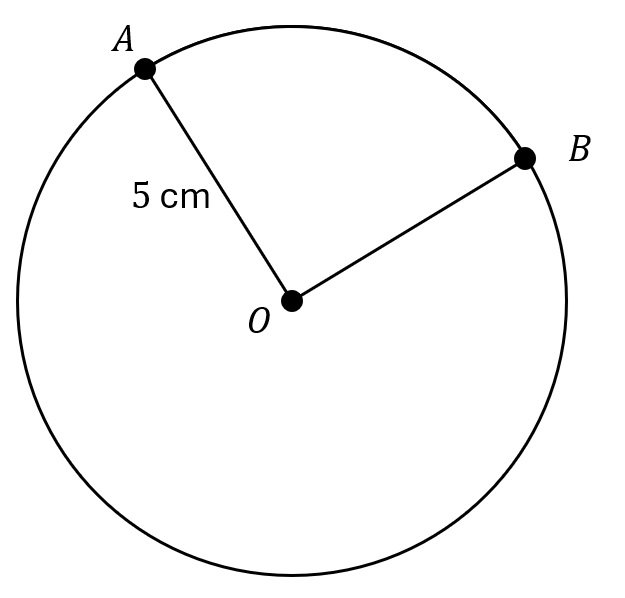
a) Find the angle \(AOB\) in radians.
b) Find the area of the sector \(OAB\).
Point \(C\) is on the circumference such that the length \(AC\) is \(4.35\) cm.
A shaded region is formed by the sector \(OAB\) and the triangle \(OAC\).
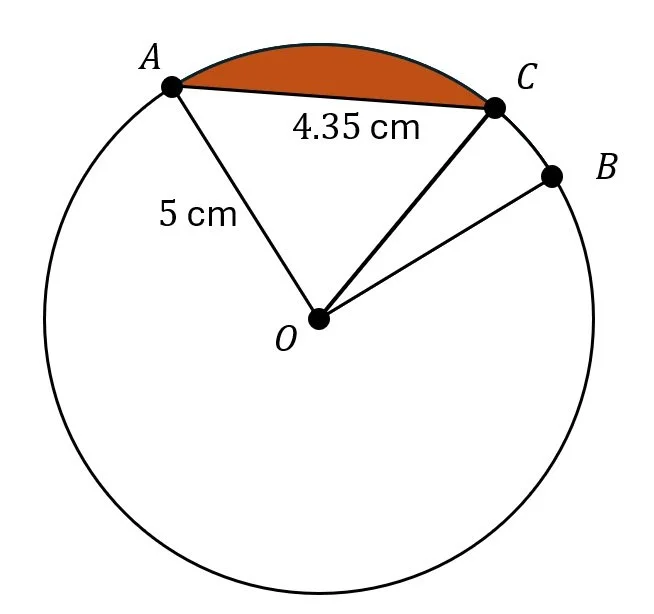
c) Find the area of the shaded region.
Key Facts
Use this applet to generate a prompt for a Key Fact that you need to know for the course. The idea is that you should KNOW these key facts in order to be able to solve problems.
Taking it Deeper
Conceptual Questions to Consider
Why are radians considered the more “natural” unit for measuring angles?
How can we derive the formulae for arc length and area of sectors in radians?
Why do we multiply by \(\frac{\pi}{180}\) to convert from degrees to radians?
Common Mistakes / Misconceptions
When calculating the perimeter of a sector, don’t forget the two radii.
Connecting This to Other Skills
We will use radians throughout the rest of the trigonometry unit, particularly in the Unit Circle (3.5) and Exact Values (3.6).
Radians are also essential to Differentiation with Trig Functions (4.12) and Integrating Trig Functions (5.1, 5.4, 5.6).
We will also need radians in Polar Form (10.2) and other topics in Complex Numbers.
Self-Reflection
What was the most challenging part of this skill for you?
What are you still unsure about that you need to review?