
Unit 3 - Trigonometry
Required Prior Knowledge
Questions (No Calculator
Match each equation to the corresponding solutions.
| A | \(\sin x = \frac{1}{2}\) |
| B | \(\cos x = -\frac{\sqrt{2}}{2}\) |
| C | \(\tan x = -1\) |
| D | \(\sin x = -\frac{1}{2}\) |
| E | \(\tan x = \frac{1}{\sqrt{3}}\) |
| F | \(\cos x = 1\) |
| G | \(\sin x = 0\) |
| H | \(\cos x = -1\) |
| I | \(\tan x = \sqrt{3}\) |
| J | \(\sin x = -\frac{\sqrt{3}}{2}\) |
| 1. | \(0^{\circ}, 180^{\circ}, 360^{\circ}\) |
| 2. | \(\frac{\pi}{3}, \frac{4\pi}{3}\) |
| 3. | \(150^{\circ}, 330^{\circ}\) |
| 4. | \(30^{\circ}, 150^{\circ}\) |
| 5. | \(\frac{7\pi}{6}, \frac{11\pi}{6}\) |
| 6. | \(0, 2\pi\) |
| 7. | \(135^{\circ}, 225^{\circ}\) |
| 8. | \(\frac{\pi}{6}, \frac{7\pi}{6}\) |
| 9. | \(135^{\circ}, 315^{\circ}\) |
| 10. | \(180^{\circ}\) |
Solutions
Get Ready
Questions
Sketch the graph of \(y=\sin x\) on the domain \(-360^{\circ}\le x\le 720^{\circ}\).
How many solutions are the to the equation \(\sin x =0.5\) in this interval?
Solutions
Examples and Your Turns
Your Turn (Calculator)
Solve each of the following equations in the given intervals
-
$$x_{1}=40.5^{\circ}\\x_{2}=180^{\circ}-40.5^{\circ}=139.5^{\circ}\\x_{3}=40.5^{\circ}-360^{\circ}=-319.5^{\circ}\\x_{4}=139.5^{\circ}-360^{\circ}=-220.5^{\circ}$$
-
Description text goes here
-
Description text goes here
Notes
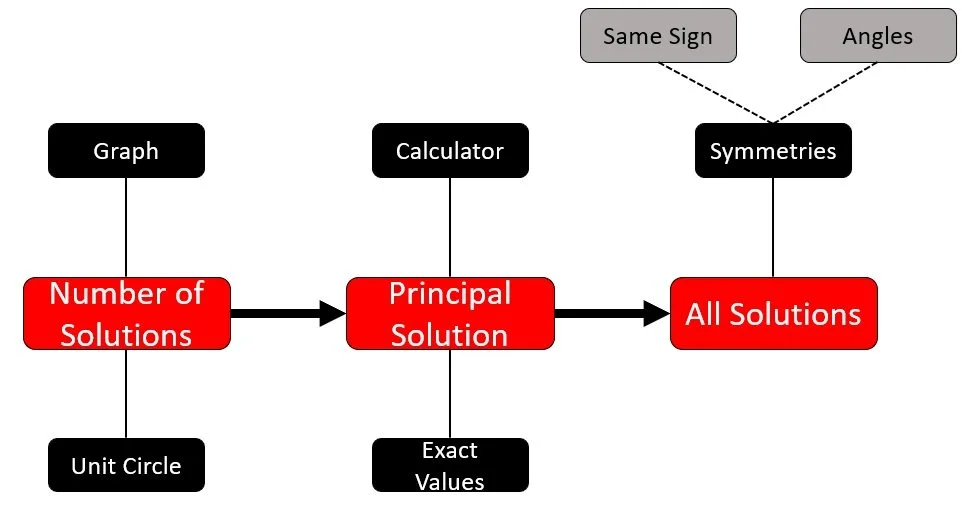
Examples and Your Turns
Example (No Calculator)
Solve \(2\sin x -1=0\) for \(0\le x\le 4\pi\).
Your Turn (No Calculator)
Solve \(3\tan x +\sqrt{3}=0\) for \(0\le x\le 4\pi\).
Example (No Calculator)
Solve \(\cos^{2}x=\frac{1}{2}\) for \(-2\pi\le x\le 2\pi\).
Your Turn (No Calculator)
Solve \(4\sin^{2}x - 3=0\) for \(-\pi\le x\le \pi\).
Practice
Consider the equation$$\sin x=0.4$$Give an appropriate domain for the equation so that it has:
a) 1 solution and another and another
b) 2 solutions and another and another
c) 3 solutions and another and another
d) 4 solutions and another and another
Can you always find a suitable domain for any number of solutions?
Now repeat the activity for \(\sin x=-0.4\). What do you notice?
What about if you used the cosine or tangent functions instead?
Notes
When we have a transformation of the angle inside the trigonometric function, the best approach is to substitute this for a new variable, remembering to also substitute the domain.
Example (No Calculator)
Solve \(\sin\left(x-\frac{\pi}{6}\right)=-\frac{1}{2}\) for \(0\le x\le 3\pi\).
Your Turn (No Calculator)
Solve \(\sin\left(2x\right)=-\frac{1}{2}\) for \(0\le x\le 3\pi\).
Your Turn (No Calculator)
Solve \(\cos\left(\frac{1}{3}x\right)=-\frac{\sqrt{2}}{2}\) for \(-3\pi\le x\le 3\pi\).
Your Turn (No Calculator)
Solve \(\cos\left(x+\frac{\pi}{3}\right)=-\frac{\sqrt{2}}{2}\) for \(-3\pi\le x\le 3\pi\).
Your Turn (No Calculator)
Solve \(\sqrt{2}\cos\left(x-\frac{3\pi}{4}\right)+1=0\) for \(0\le x\le 6\pi\).
Your Turn (No Calculator)
Solve \(3\tan\left(\frac{1}{2}\theta-30^{\circ}\right)=\sqrt{3}\) for \(0^{\circ}\le \theta\le 720^{\circ}\).
Notes
Often we need to use some trigonometric identities to manipulate a trigonometric equation into the ‘basic’ form in order to be able to solve it.
Examples and Your Turns
Example (No Calculator)
Solve \(\sqrt{3}\sin x=\cos x\) for \(0^{\circ}\le x \le 360^{\circ}\).
Your Turn (Calculator)
Solve \(\sin x-2\cos x=0\) for \(0\le x \le 2\pi\).
Example (Calculator)
Solve \(3\sin x \cos x + \sin x - 9\cos x -3=0\) for \(0\le x \le 2\pi\).
Your Turn (Calculator)
Solve \(3\sin x \cos x = 2\sin x \) for \(-\pi\le x \le \pi\).
Your Turn (Calculator)
Solve \(3\sin^{2}x - 4\sin x +1=0\) for \(0\le x \le 2\pi\).
Your Turn (Calculator)
Solve \(\tan^{2}x + \tan x -2 =0\) for \(0^{\circ}\le x \le 360^{\circ}\).
Your Turn (No Calculator)
Solve \(2\sin^{2}x + \sin x=0\) for \(0\le x \le 2\pi\).
Your Turn (No Calculator)
Solve \(2\cos^{2}x + \cos x -1 =0\) for \(0\le x \le 2\pi\).
Your Turn (No Calculator)
Solve \(2\cos^{2}x + 3\sin x-3=0\) for \(0\le x \le 2\pi\).
Your Turn (No Calculator)
Solve \(\sin 2x + \sin x =0\) for \(-\pi\le x \le \pi\).
Your Turn (No Calculator)
Solve \(\cos 2x + \sin x=0\) for \(-\pi\le x \le \pi\).
Your Turn (No Calculator)
Solve \(\cos 2x + 3\sin x -2=0\) for \(0^{\circ}\le x \le 720^{\circ}\).
Notes
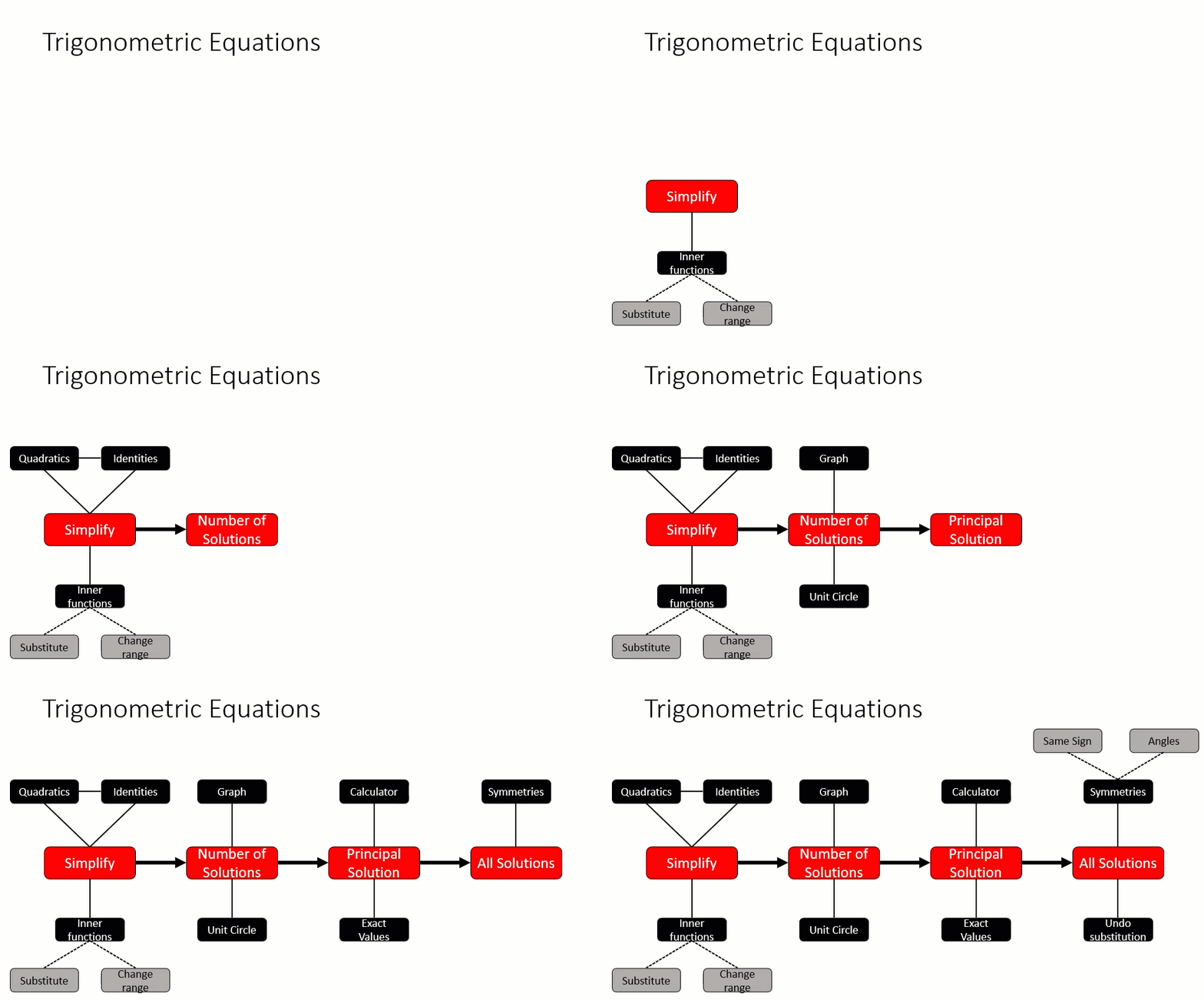
Key Facts
Use this applet to generate a prompt for a Key Fact that you need to know for the course. The idea is that you should KNOW these key facts in order to be able to solve problems.
Taking it Deeper
Conceptual Questions to Consider
How does the number of solutions to a trigonometric equation relate to the domain of the equation?
Explain the process when solving a trigonometric equation with a transformation of the angle inside the function.
Common Mistakes / Misconceptions
Not finding all the solutions for the given domain is the most common mistake. Take careful note of the domain in any question, and ensure you find ALL solutions.
This is often caused by forgetting to change the domain when making a substitution to solve equations like \(\sin\left(x+\frac{\pi}{6}\right)=0.5\).
Dividing through by a common factor is not an appropriate way to solve equations like \(\sin x \cos x = \cos x\) as you lose some of the solutions. Instead you should rearrange and factorise.
Making mistakes using identities to simplify the equation. Be careful and use the formula booklet to make sure you are not remembering the identity wrong.
Connecting This to Other Skills
This build directly on Solving Simple Trigonometric Equations (3.8), which requires knowledge of the Unit Circle (3.5) and Exact Values (3.6), as well as being comfortable working with Radians (3.4).
In many of these we are also using Trigonometric Identities (3.12) or Double Angle Formulae (3.14). We need to use the Inverse Trigonometric Functions (3.15) to find the principal angle.
We also used the ideas of Quadratic Equations (PK3) and More Quadratic Equations (2.14).
When we get to differential calculus, and Stationary Points (4.14) we might have to solve trigonometric equations to find the solutions.
Self-Reflection
What was the most challenging part of this skill for you?
What are you still unsure about that you need to review?