
Unit 2 - Functions
Required Prior Knowledge
Questions
Rearrange each of these formula to make \(x\) the subject.
a) \(y=5x-7 \)
b) \(a=\frac{x+2}{b}\)
c) \(r=px+qx\)
d) \(y=2e^{3x}\)
Solutions
Get Ready
Questions
Let \(f\left(x\right)=x^{2}+4\) and \(g\left(x\right)=\sqrt{x-4}\). Find
a) \(f\circ g\left(13\right)\)
b) \(g\circ f\left(13\right)\)
c) \(f\circ g\left(x\right)\)
d) \(g\circ f\left(x\right)\)
What do you notice?
Solutions
Notes
The identity function is \(I\left(x\right)=x\).
The identity function is the function that returns the input as the output for all \(x\).
Two functions are inverses if their composition results in the identity function.
That is, \(f\) and \(g\) are inverse functions if and only if$$f\circ g\left(x\right)=g\circ f\left(x\right)=x\text{ for all }x$$
We use the notation \(f^{-1}\) to denote the inverse function of \(f\).
Note that the notation \(f^{-1}\left(x\right)\) does NOT mean the reciprocal of \(f\left(x\right)\).
That is$$f^{-1}\left(x\right)\ne \frac{1}{f\left(x\right)}$$
We can visualise an inverse function on a function machine
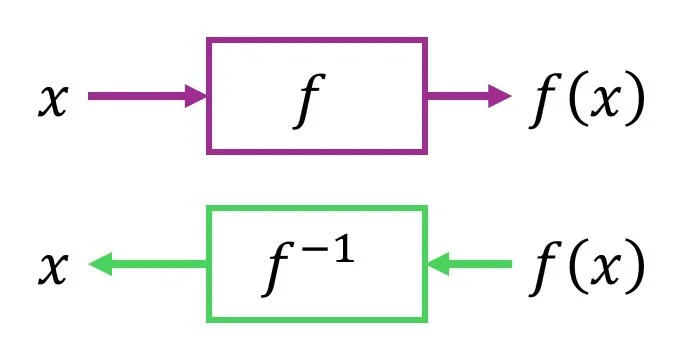
To algebraically find the inverse function we follow these steps:
Replace \(f\left(x\right)\) with \(y\).
Swap \(x\) and \(y\).
Rearrange this equation to make \(y\) the subject.
Replace \(y\) with \(f^{-1}\left(x\right)\).
Examples and Your Turns
Example
Find the inverse function of$$f\left(x\right)=\frac{1+x}{3-x},\quad x\ne 3$$
Your Turn
Find the inverse function of$$g\left(x\right)=\frac{1}{x-2}+3,\quad x\ne 2$$
Your Turn
Consider the function \(f\left(x\right)=x^{2}+6x+4\) for \(x\ge -3\).
a) Find \(f\left(x\right)\) in the form \(\left(x+a\right)^{2}+b\) where \(a,b\in\mathbb{Z}\).
b) Hence find \(f^{-1}\left(x\right)\).
Your Turn
Find the inverse function of \(g\left(x\right)=2+\ln x\) for \(x>0\).
Your Turn
Given that \(h\left(x\right)=e^{x-2}+1\), determine \(h^{-1}\left(x\right)\).
Your Turn
Let \(f\left(x\right)=\sqrt{x+k}\) for \(x\ge k\).
Given that \(f^{-1}\left(3\right)=5\), find the value of \(k\).
Notes
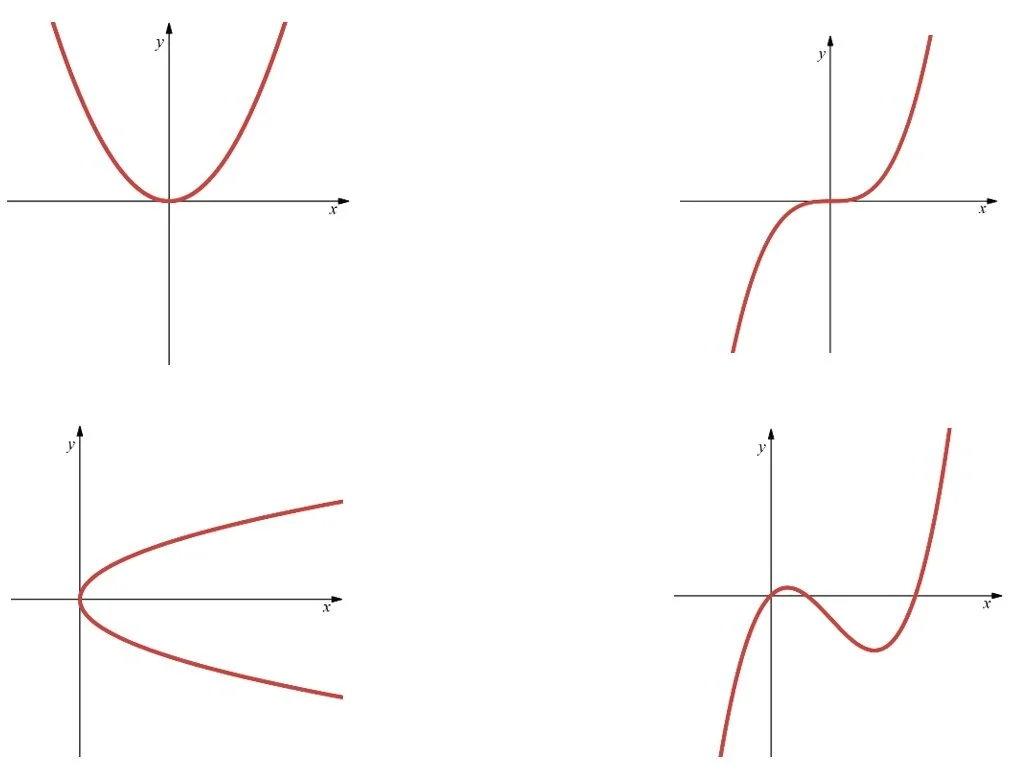
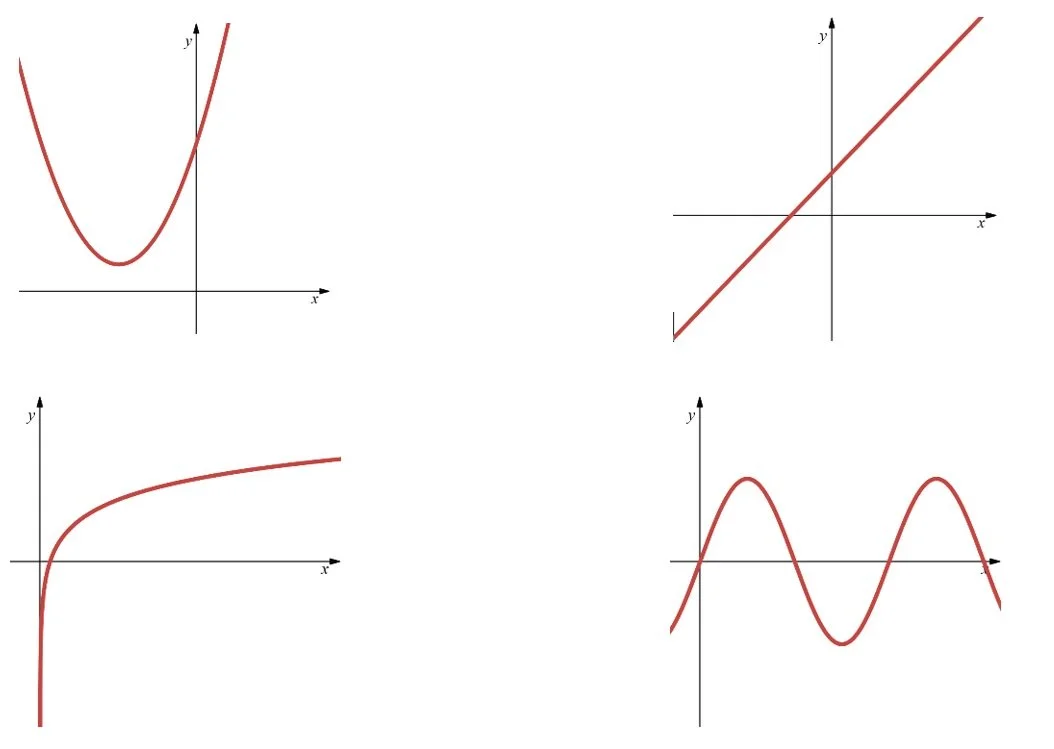
A function only has an inverse if it is one-to-one.
That is, it passes both the vertical line test (to be a function) and the horizontal line test (to have an inverse).
Why must a function be one-to-one to have an inverse function?
-
If the original function was many-to-one, then the inverse would be one-to-many, which is not a function.
The domain of \(f^{-1}\left(x\right)\) is the range of \(f\left(x\right)\).
The range of \(f^{-1}\left(x\right)\) is the domain of \(f\left(x\right)\).
The graph of \(y=f^{-1}\left(x\right)\) is a reflection of the graph of \(y=f\left(x\right)\) in the line \(y=x\).
If the point \(\left(a,b\right)\) is on the graph of \(y=f\left(x\right)\), then the point \(\left(b,a\right)\) is on the graph of \(f^{-1}\left(x\right)\).
If \(f\left(a\right)=b\), then we know that \(f^{-1}\left(b\right)=a\).
A function is self-inverse if \(f^{-1}\left(x\right)=f\left(x\right)\).
Can you explain why the graph of \(y=f^{-1}\left(x\right)\) is a reflection of \)y=f\left(x\right)\) in the line \(y=x\)?
Examples and Your Turns
Example
Which of these relations have inverses, and why?
Your Turn
Which of these relations have inverses, and why?
Example
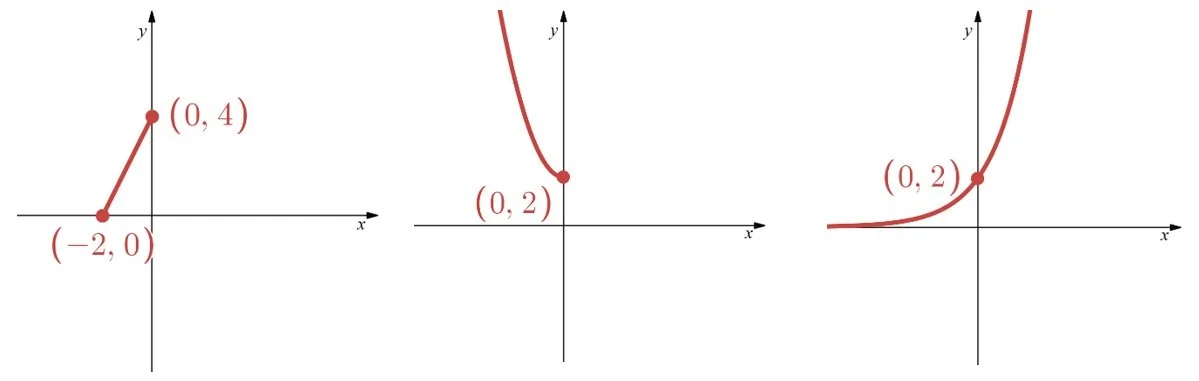
Sketch the inverse functions for the following. State the domain and range of both the function and the inverse function.
Your Turn
Sketch the inverse functions for the following. State the domain and range of both the function and the inverse function.
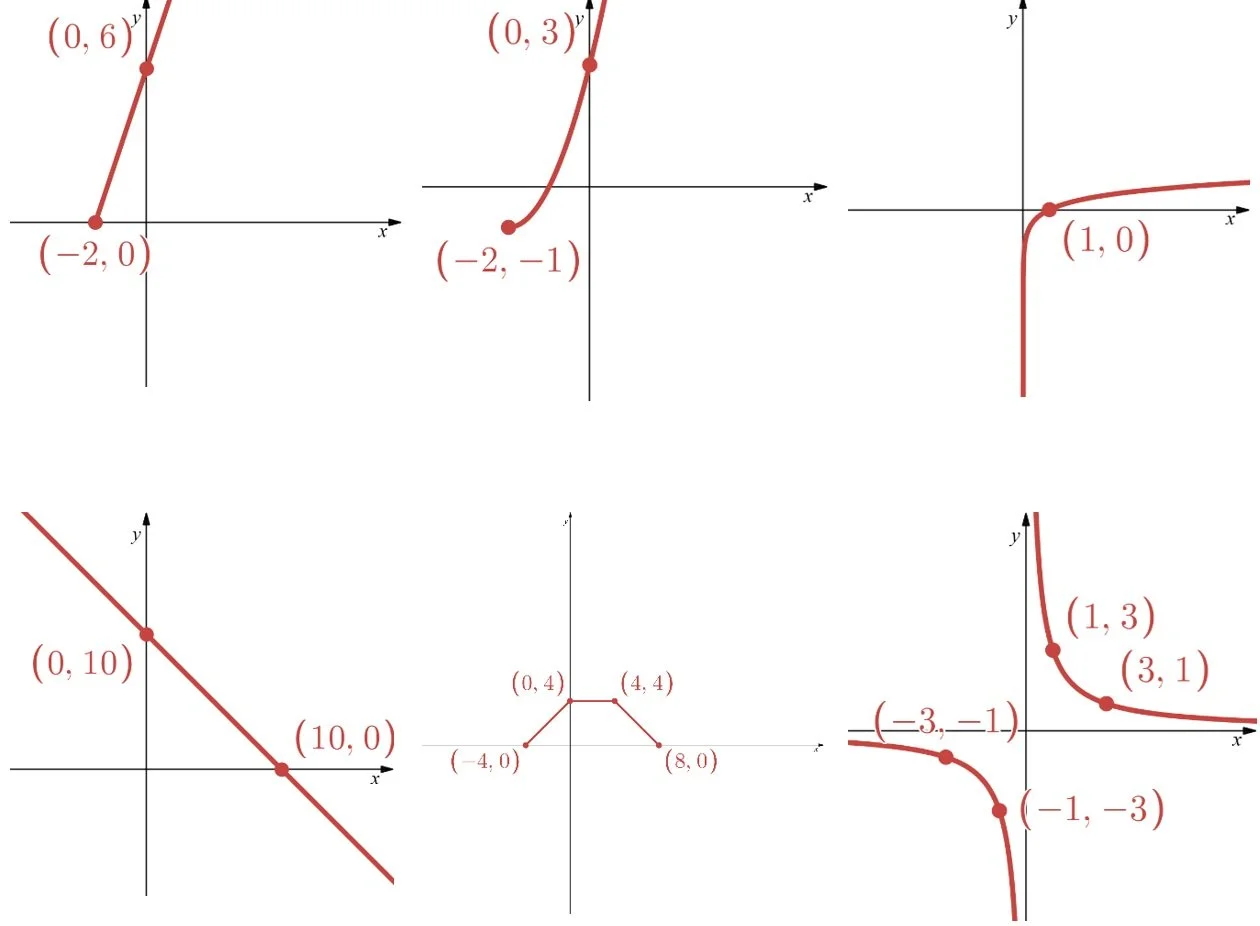
Your Turn
The domain of \(h\left(x\right)\) is \(\left\{x:-1<x\le 7\right\}\). State the range of \(h^{-1}\left(x\right)\).
Your Turn
Given that \(f\left(4\right)=28\), state the value of \(f^{-1}\left(28\right)\).
Your Turn
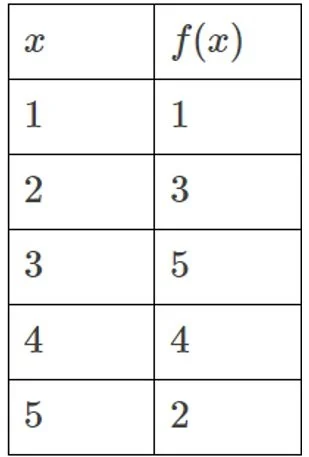
The table shows the values of function \(g\) for \(1\le x\le 5\), \(x\in\mathbb{Z}\).
Find the value of \(a\) such that \(f^{-1}\left(a\right)=5\).
Your Turn
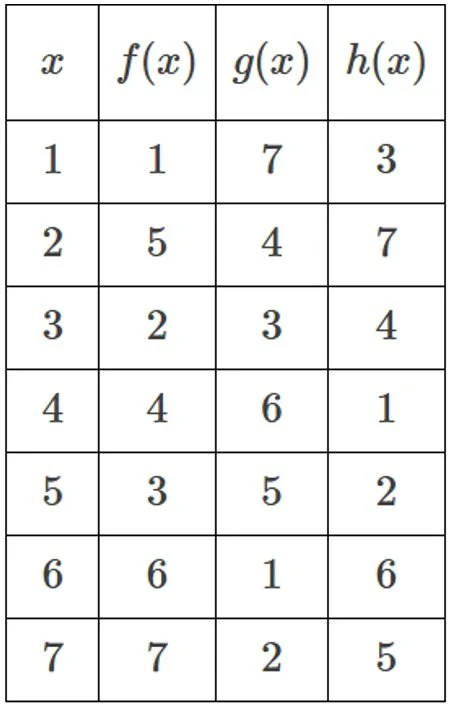
The table shows the values of the functions \(f\), \(g\) and \(h\) for \(1\le x\le 7\), \(x\in\mathbb{Z}\).
a) Find \(f\circ h\left(3\right)\)
b) Find \(g^{-1}\left(6\right)\)
c) Find \(f^{-1}\circ g^{-1}\left(7\right)\)
d) Determine the possible values of \(a\) if \(f\left(a\right)=h^{-1}\left(a\right)\).
Your Turn
Give some examples of self-inverse functions.
Your Turn
By letting \(f^{-1}\circ g^{-1}\left(a\right)=b\), or otherwise, prove that$$f^{-1}\circ g^{-1}\left(x\right)=\left(g\circ f\right)^{-1}\left(x\right)$$
Key Facts
Use this applet to generate a prompt for a Key Fact that you need to know for the course. The idea is that you should KNOW these key facts in order to be able to solve problems.
Taking it Deeper
Conceptual Questions to Consider
Why does a function need to be one-to-one for it to have an inverse?
How can we restrict domains to ensure a function has an inverse? Consider \(y=x^{2}\).
Explain why the graph of the inverse function is a reflection in the line \(y=x\).
Common Mistakes / Misconceptions
Confusing \(f^{-1}\left(x\right)\) with \(\left(f\left(x\right)\right)^{-1}=\frac{1}{f\left(x\right)}\). The inverse is not the same thing as the reciprocal.
Forgetting that a function needs to be one-to-one to have an inverse, and hence that the domain might need to be restricted.
Connecting This to Other Skills
This skill builds upon the foundational ideas of what a function is (2.2). Knowledge of domains and range (2.6) and composite functions (2.12) is essential.
To find inverses of exponential functions (2.8), you need a good working knowledge of logarithms (1.1).
We will encounter the inverse trigonometric functions (3.15) later in the course.
When we look at finding areas of curves to the y-axis (5.12), we often need to find the inverse function.
Self-Reflection
What was the most challenging part of this skill for you?
What are you still unsure about that you need to review?