
Unit 3 - Trigonometry
Required Prior Knowledge
Questions
Point\(A\left(2,3\right)\) and \(B\left(7,1\right)\) lie on the Cartesian plane. Find:
a) The distance \(AB\)
b) The midpoint of the line segment \(AB\)
c) The gradient of the line segment \(AB\)
d) The equation of the perpendicular bisector of \(AB\) in the form \(ax+by=d\).
Solutions
Get Ready
Questions
Imagine you are in a large, empty room. How would you describe the location of a fly buzzing in the air? You can't just use its distance from a single wall or its height from the floor. What three pieces of information would you need to precisely locate it?
Notes
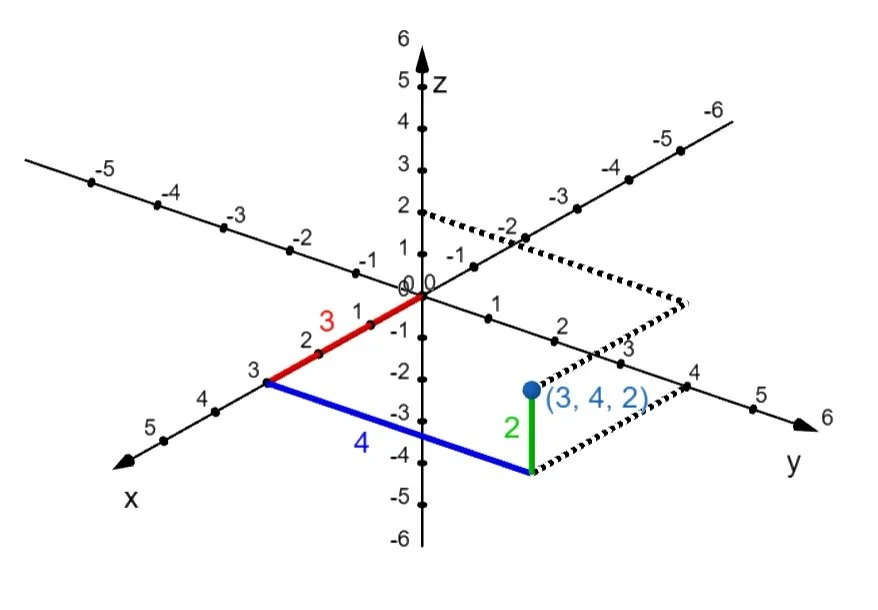
In 3D geometry there are 3 mutually perpendicular axes.
Any point in space can then be specified by an ordered triple \(\left(x,y,z\right)\).
The point \(\left(3,4,2\right)\) is located \(3\) along the \(x\)-axis (out of the page), \(4\) along the \(y\)-axis (left/right in the page) and \(2\) along the \(z)-axis (up/down in the page).
What is the distance of the line connecting \(O\left(0,0,0\right)\) to \(A\left(3,4,2\right)\)?
What is the midpoint of the line \(OA\)?
In general, for the points \(A\left(x_{1},y_{1},z_{1}\right)\) and \(B\left(x_{2},y_{2},z_{2}\right)\):
The distance $$AB=\sqrt{\left(x_{2}-x_{1}\right)^{2}+\left(y_{2}-y_{1}\right)^{2}+\left(z_{2}-z_{1}\right)^{2}}$$
The midpoint of \(AB\) is$$\left(\frac{x_{1}+x_{2}}{2},\frac{y_{1}+y_{2}}{2},\frac{z_{1}+z_{2}}{2}\right)$$
Examples and Your Turns
Example
Consider the points \(A\left(4,-3,1\right)\) and \(B\left(-2,4,-1\right)\). Find:
a) The distance \(AB\)
b) The midpoint of \(AB\)
Your Turn
Consider the points \(A\left(7,-2,1\right)\) and \(B\left(-3,-4,2\right)\). Find:
a) The distance \(AB\)
b) The midpoint of \(AB\)
Your Turn
A point \(P\) is the midpoint of the line segment connecting \(Q\left(1,4,10\right)\) and \(R\left(x,y,z\right)\). If \(P\) is at \(\left(-2,3,5\right)\), find the coordinates of \(R\).
Notes
We can define 3D shapes by giving coordinates of the vertices of the solid.
We can calculate lengths of edges and then find the volume and surface area.
Your Turn
A square-based pyramid has base coordinates \(O\left(0,0,0\right)\), \(A\left(4,0,0\right)\), \(B\left(4,4,0\right)\) and \(C\left(0,4,0\right)\). The apex of the pyramid is \(D\left(2,2,5\right)\).
a) Verify the apex lies directly above the centre of the base.
b) Find the volume of the pyramid.
c) Suppose \(M\) is the midpoint of the edge \(BC\).
(i) Find the coordinates of \(M\)
(ii) Find the exact length of \(MD\)
(iii) Hence find the surface area of the pyramid
Notes
We can also apply the trigonometry results to shapes formed by given coordinates.
Your Turn
The cuboid \(OABCDEFG\) has three vertices \(A\left(5,0,0\right)\), \(C\left(0,4,0\right)\) and \(D\left(0,0,3\right)\).
Point \(E\) lies directly above \(A\).
Find the angle between the line segment \(EC\) and the base plane \(OABC\).
Key Facts
Use this applet to generate a prompt for a Key Fact that you need to know for the course. The idea is that you should KNOW these key facts in order to be able to solve problems.
Taking it Deeper
Conceptual Questions to Consider
How is the distance formula in 3D connected to the Pythagorean Theorem?
Explain why the midpoint formula works.
Common Mistakes / Misconceptions
The most common mistakes here are numerical errors, particularly involving negative numbers. Take care.
Connecting This to Other Skills
This builds on basic ideas in 2D, and will be vitally important in Vectors (9.1).
Self-Reflection
What was the most challenging part of this skill for you?
What are you still unsure about that you need to review?