
Unit 3 - Trigonometry
Required Prior Knowledge
Questions
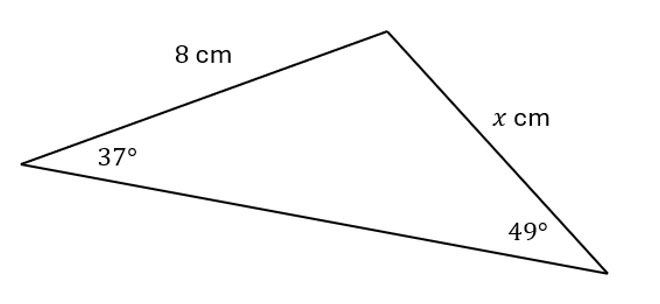
Find the value of \(x\) in the following triangle.
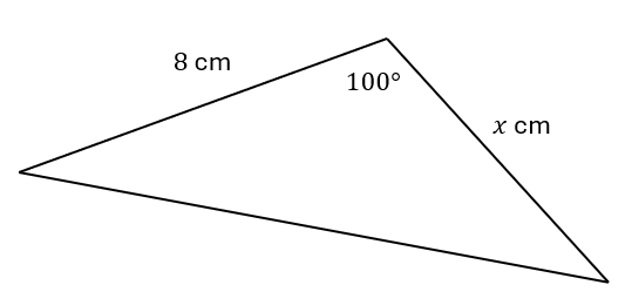
The area of the following triangle is \(40\) cm\(^{2}\). Determine the value of \(x\).
Solutions
Get Ready
Questions
Think of some different real world scenarios where we might need to measure triangles.
Notes
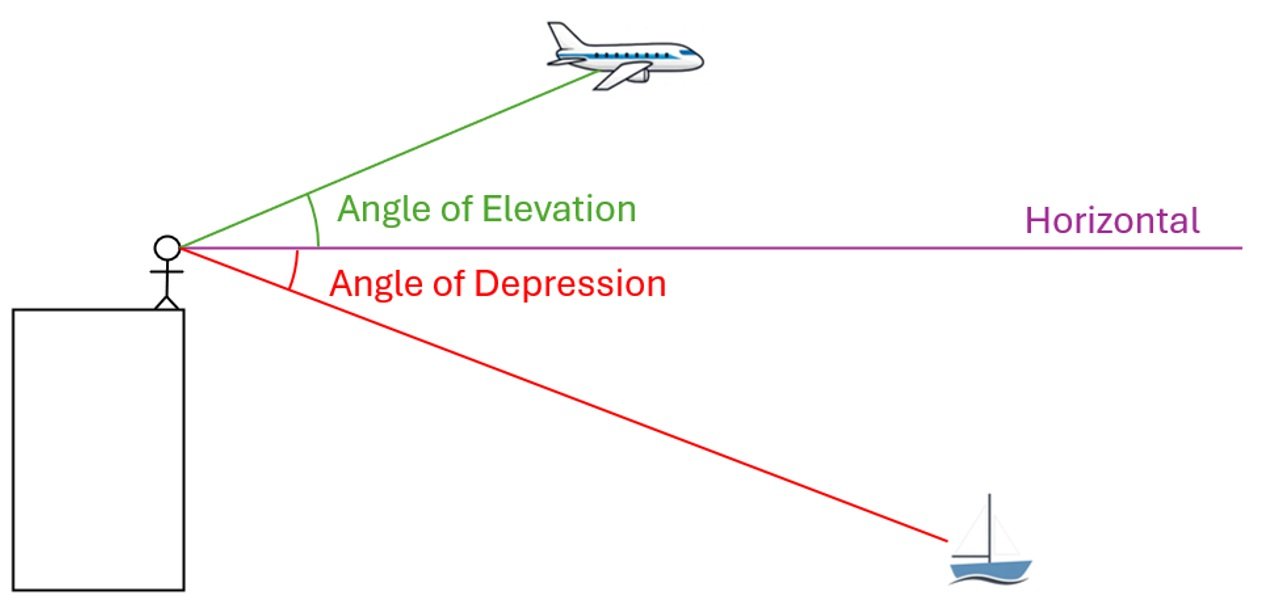
Angles of elevation and angles of depression are always measured to the horizontal.
Examples and Your Turns
Example
A man standing \(20\) m from the base of a vertical tree, looks to the top of the tree. He measures the angle of elevation as \(40^{\circ}\). Determine the height of the tree.
Your Turn
From the top of a \(50\) m lighthouse, the angle of depression to a boat is \(25^{\circ}\). How far is the boat from the lighthouse?
Notes
Bearings are measured clockwise from North.
Bearings are always written with 3 digits, even if this means it needs a zero at the front.
Examples and Your Turns
Example
Draw a diagram to represent this situation.
Town B is at a bearing of \(048^{\circ}\) from Town A.
What is the bearing of Town A from Town B?
Your Turn
When Samantha goes jogging, she finishes \(2\) km south and \(3\) km west of where she started. Find Samantha’s bearing from her starting point.
Your Turn
A ship sails \(5\) km on a bearing of \(120^{\circ}\) from point \(A\) to point \(B\). It then sails \(8\) km on a bearing of \(230^{\circ}\) from \(B\) to point \(C\).
a) Find the distance of \(C\) from \(A\).
b) Find the bearing of \(C\) from \(A\).
Your Turn
An airplane flies \(150\) km on a bearing of \(030^{\circ}\), and then \(200\) km on a bearing of \(080^{\circ}\).
How far is the airplane from its starting point?
Notes
The angle between a line and a plane is the angle formed at the intersection of the line with the plane.
Your Turn
Shown below is a cuboid.
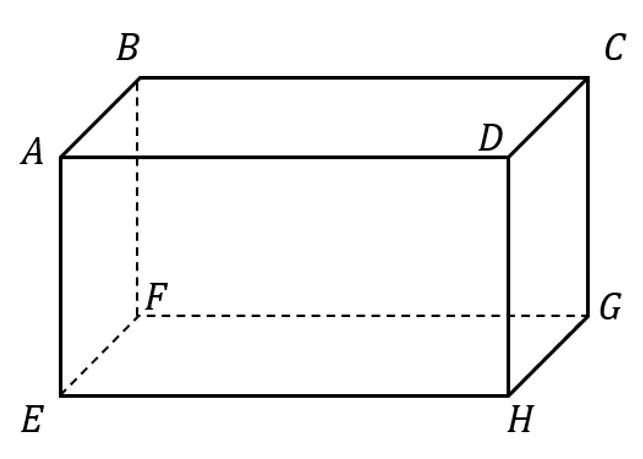
If \(AB=2\) cm, \(AE=6\) cm and \(AD=5\) cm, find the following:
(a) angle \(CEG\)
(b) length \(DF\)
If \(M\) is the midpoint of \(EH\), find
(c) angle \(BMC\).
Key Facts
Use this applet to generate a prompt for a Key Fact that you need to know for the course. The idea is that you should KNOW these key facts in order to be able to solve problems.
Taking it Deeper
Conceptual Questions to Consider
Why are diagrams with clear North lines important when solving problems with bearings?
What is the relationship between the angle of elevation to an object, and the angle of depression from the same object?
How could you use the angle of elevation to measure the height of a tree?
Common Mistakes / Misconceptions
Bearings - not measuring from the North line, or measuring anti-clockwise.
Angles of depression - using the angle inside the triangle, not the angle to the horizontal.
Connecting This to Other Skills
This skill uses the ideas of Right Angled Trigonometry (PK6) and the Sine and Cosine Rule (3.1).
When we come to Vectors (9.1) we will use the ideas of trigonometry again.
Self-Reflection
What was the most challenging part of this skill for you?
What are you still unsure about that you need to review?