
Unit 3 - Trigonometry
Required Prior Knowledge
Questions
Calculate
a) \(\pi - \frac{5\pi}{8}= \)
b) \(\pi + \frac{5\pi}{8}= \)
c) \(2\pi - \frac{3\pi}{5}\)
d) \(\pi + \frac{3\pi}{5}\)
e) \(\pi - \frac{7\pi}{6}\)
f) \(2\pi - \frac{7\pi}{6}\)
Solutions
Get Ready
Questions
Think about the minute hand on a clock.
a) When the hand points at \(30\) minutes, what angle has the hand travelled through from \(0\)?
b) When the hand has travelled through an angle of \(60^{\circ}\), where is the hand pointing?
c) Think about how we describe where the hand is in two different ways: using an angle or using the location it is pointing at.
Notes
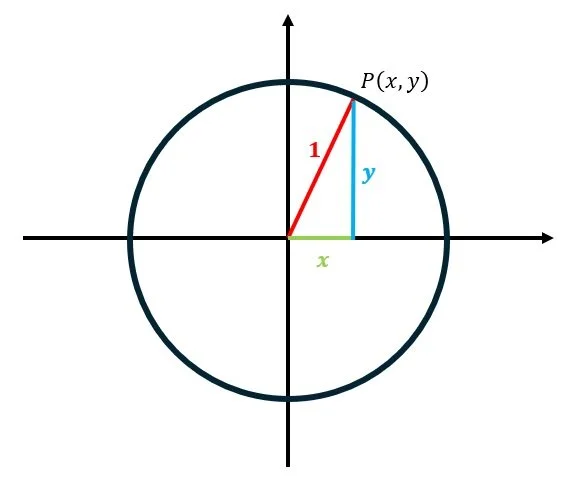
The unit circle is a circle with centre \(\left(0,0\right)\) and radius \(1\).
For any point \(P\left(x,y\right)\) on the unit circle$$x^{2}+y^{2}=1$$Can you explain why?
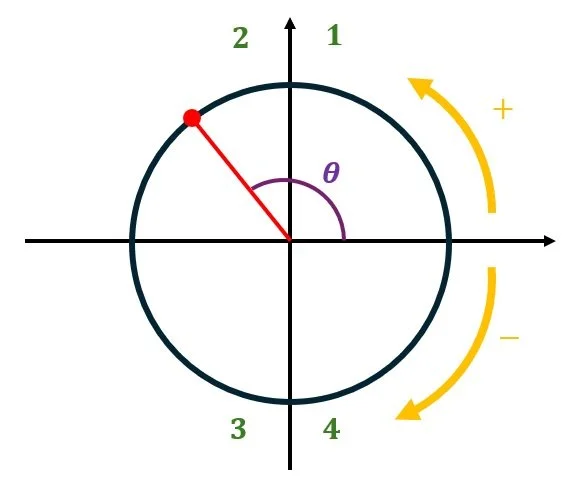
Another way to describe the point \(P\) is to use an angle \(\theta\).
\(\theta\) is always measured from \(\left(1,0\right)\)
anticlockwise is the positive direction
clockwise is the negative direction
The quadrants are labelled as we reach them in the positive direction.
Your Turn
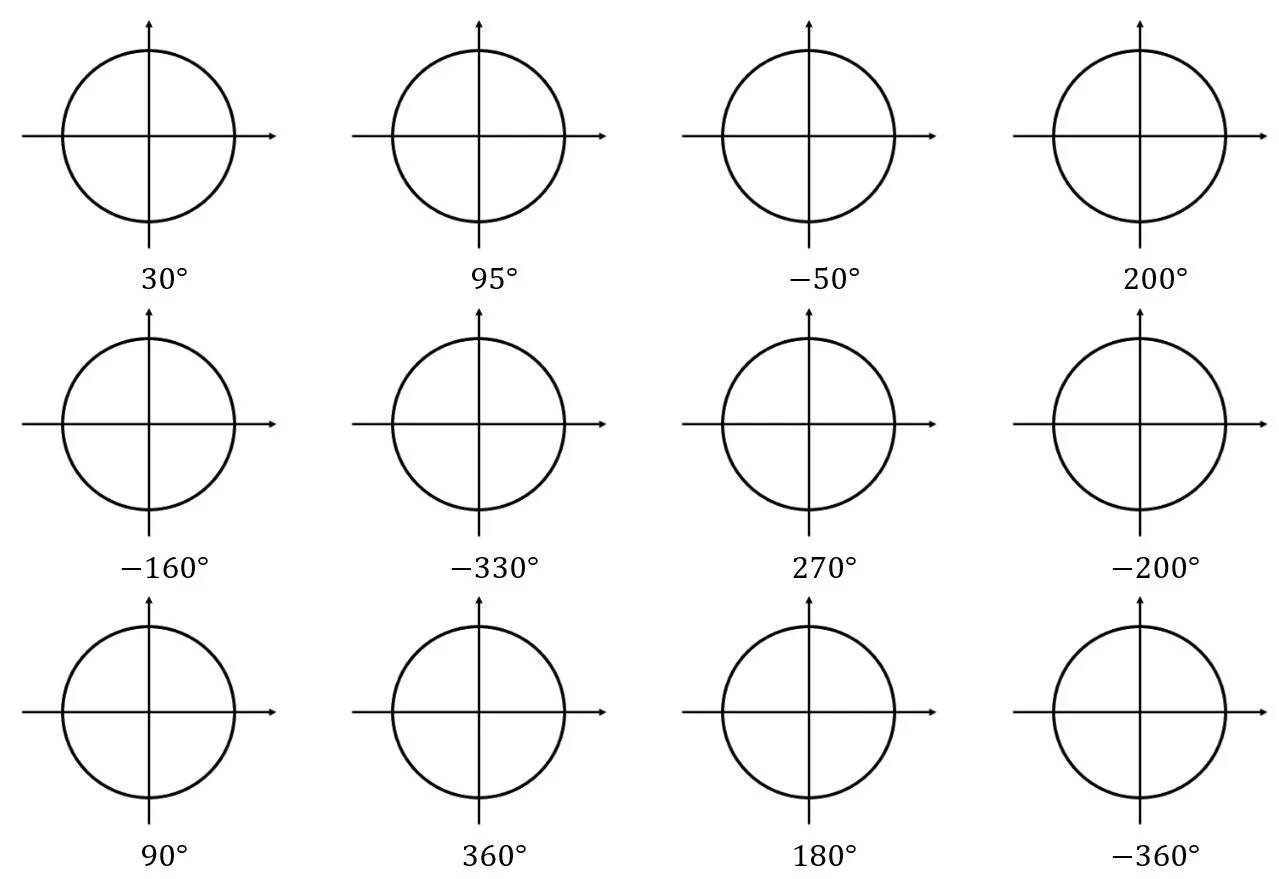
For each diagram below, draw the given angle.
Notes
Consider a point \(P\left(x,y\right)\) on the unit circle in the first quadrant.
Then we can draw a right-angled triangle from the origin to \(P\).
From this, and using trigonometry, we can see that$$\cos \theta=\frac{x}{1}=x$$Therefore \(\cos \theta\) tells us the \(x\) coordinate of \(P\).
We also have that$$\sin \theta=\frac{y}{1}=y$$Therefore \(\sin \theta\) tells us the \(y\) coordinate of \(P\).
So \(P\) has coordinates \(\left(\cos \theta ,\sin \theta\right)\).
We also have that$$\tan \theta=\frac{y}{x}$$Therefore \(\tan \theta\) tells us the gradient of the radius to \(P\).
Your Turn
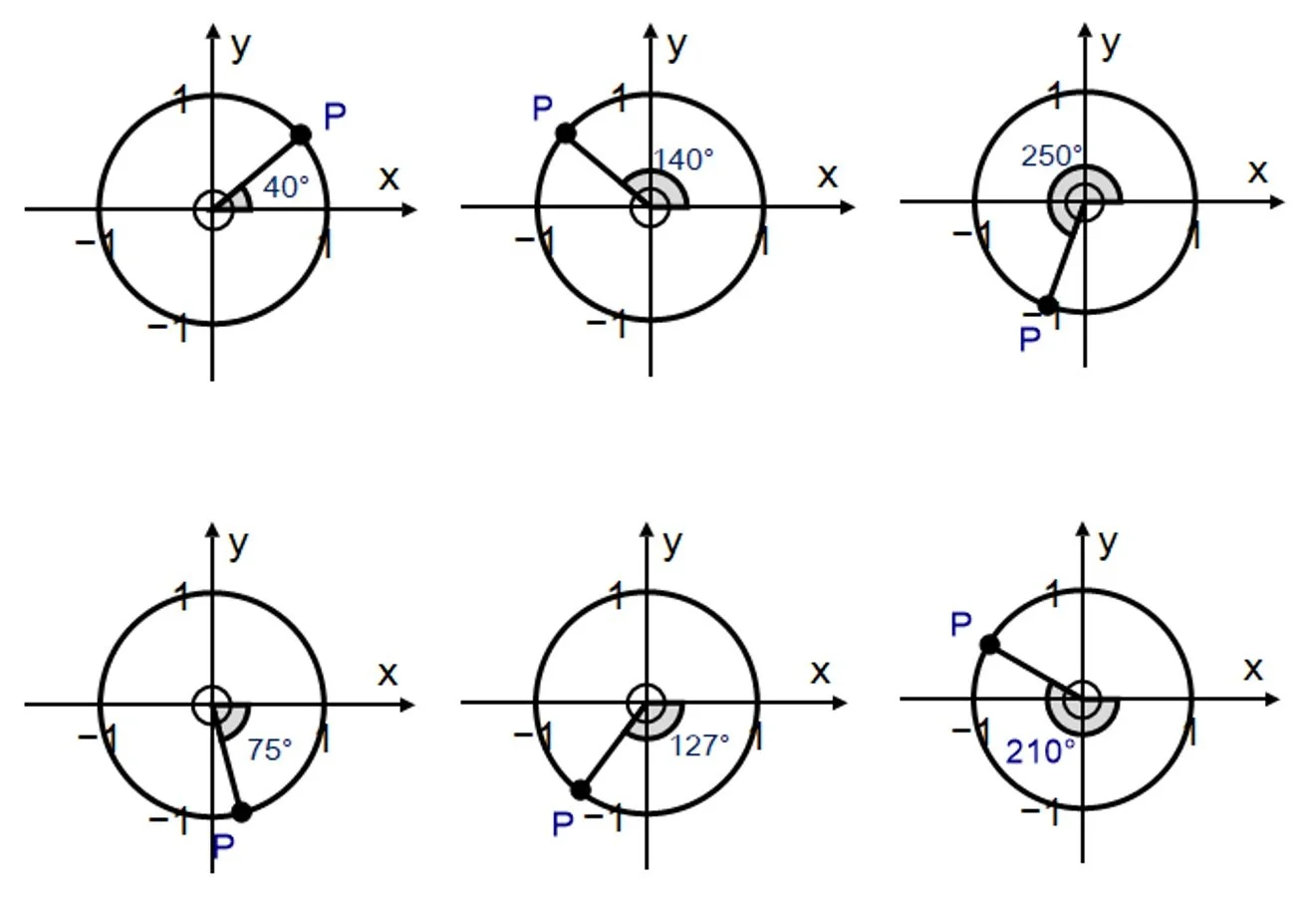
For each diagram, use your calculator to find the coordinates of the point \(P\).
Notes
Two angles are complementary if they sum to \(90^{\circ}\).
Two angles are supplementary if they sum to \(180^{\circ}\).
Two angles are explementary if they sum to \(360^{\circ}\).
Your Turn
Complete the table using your calculator to work out values.
What patterns do you spot?
| Angle Properties | Angle | Complement (\(90^{\circ} - \theta\)) | Supplement (\(180^{\circ} - \theta\)) | Explement (\(360^{\circ} - \theta\)) | |||||||||||||||
|---|---|---|---|---|---|---|---|---|---|---|---|---|---|---|---|---|---|---|---|
|
|
|
|
|
|||||||||||||||
|
|
|
|
|
|||||||||||||||
|
|
|
|
|
|||||||||||||||
|
|
|
|
|
|||||||||||||||
|
|
|
|
|
|||||||||||||||
|
|
|
|
|
|||||||||||||||
|
|
|
|
|
|||||||||||||||
|
|
|
|
|
|||||||||||||||
|
|
|
|
|
Notes
The cosine of the complement of an angle is equal to the sine of the angle.
That is$$\cos \left(90^{\circ}-\theta\right)=\sin \theta$$and$$\sin \left(90^{\circ}-\theta\right)=\cos \theta$$
The cosine of the supplement of an angle is equal to the negative cosine of the angle.
That is$$\cos \left(180^{\circ}-\theta\right)=-\cos \theta$$
The sine of the supplement of an angle is equal to the sine of the angle.
That is$$\sin \left(180^{\circ}-\theta\right)=\sin \theta$$
The cosine of the explement of an angle is equal to the cosine of the angle.
That is$$\cos \left(360^{\circ}-\theta\right)=\cos \theta$$
The sine of the explement of an angle is equal to the negative sine of the angle.
That is$$\sin \left(360^{\circ}-\theta\right)=-\sin \theta$$
We can see all this information in the unit circle, as explained in the video below.
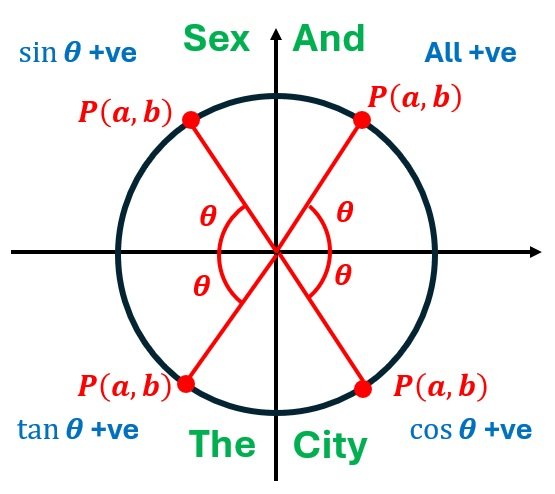
We can determine the sign of a given trigonometric ratio depending on which quadrant it is in.
Consider the point \(P\left(a,b\right)\) on the unit circle, with angle \(\theta\).
In quadrant 1:$$\begin{matrix}a>0&\implies&\cos \theta >0\\b>0&\implies&\sin \theta >0\\\frac{b}{a}>0&\implies&\tan \theta >0\end{matrix}$$
In quadrant 2:$$\begin{matrix}a<0&\implies&\cos \theta <0\\b>0&\implies&\sin \theta >0\\\frac{b}{a}<0&\implies&\tan \theta <0\end{matrix}$$
In quadrant 3:$$\begin{matrix}a<0&\implies&\cos \theta <0\\b<0&\implies&\sin \theta <0\\\frac{b}{a}>0&\implies&\tan \theta >0\end{matrix}$$
In quadrant 4:$$\begin{matrix}a>0&\implies&\cos \theta >0\\b<0&\implies&\sin \theta <0\\\frac{b}{a}<0&\implies&\tan \theta <0\end{matrix}$$
We can use the mnemonic Sex And The City to remember in which quadrant each trig function is positive, or think back to the sign of the coordinates.
Your Turn
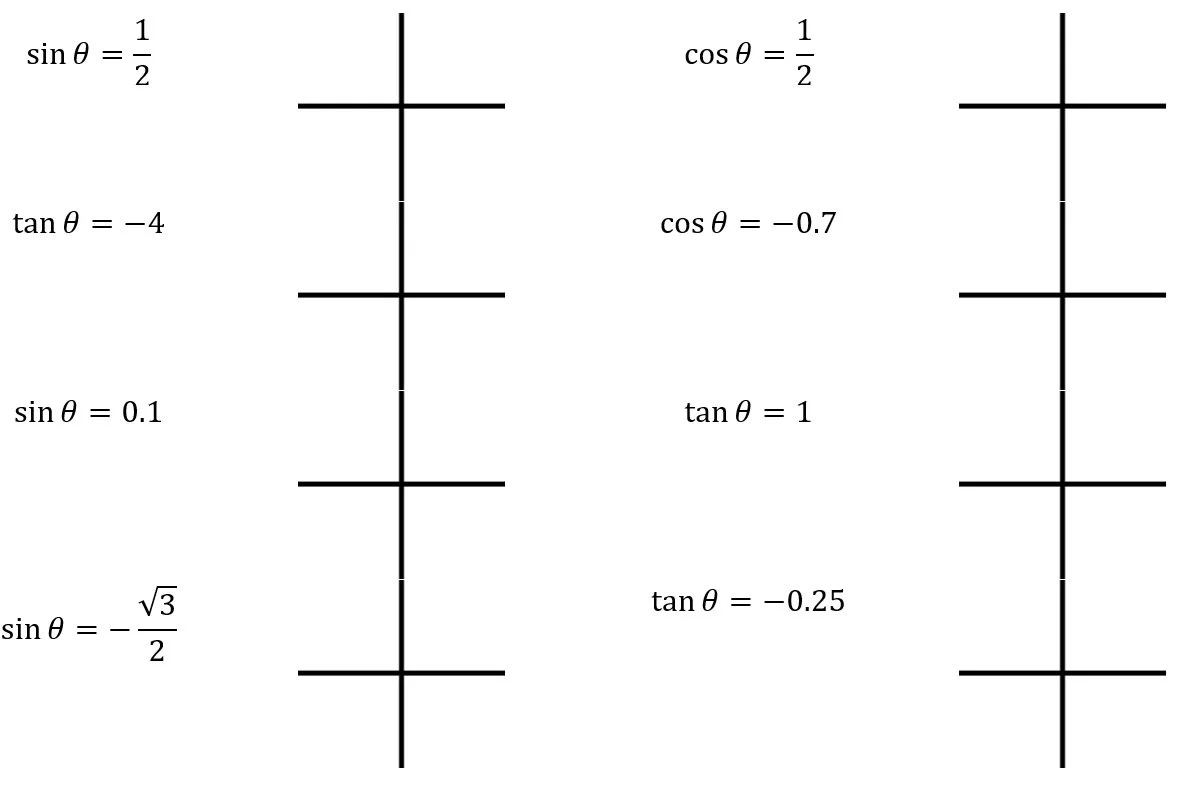
For each question, decide which quadrants the solution angle could be in.
Your Turn
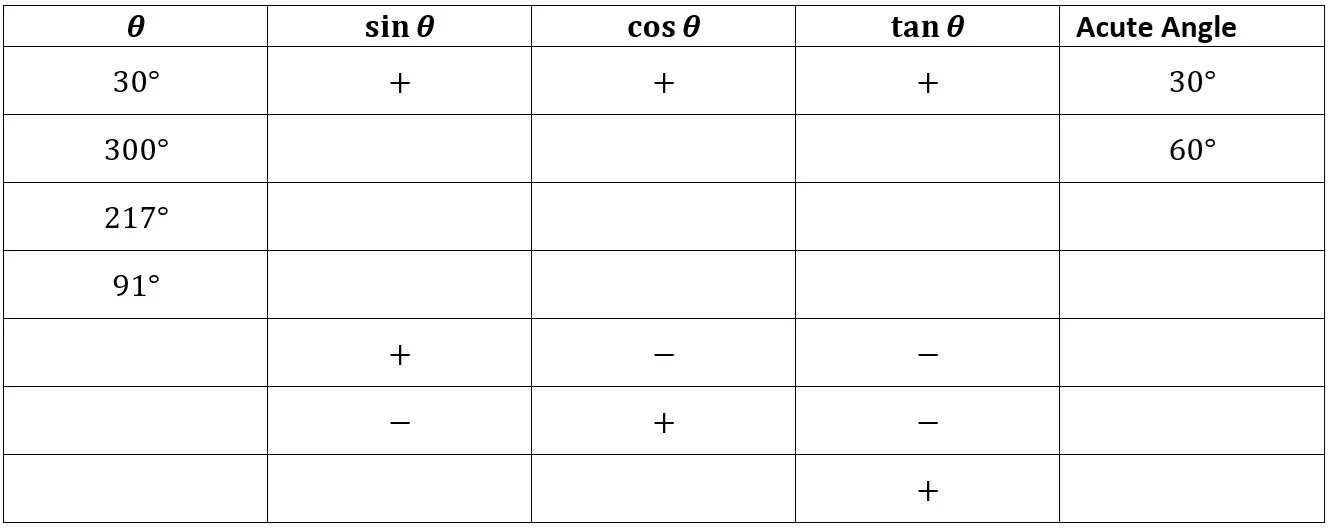
For each row, fill in the gaps.
Your Turn
By using the unit circle, determine equivalent trigonometric ratios for each of these.
$$\begin{matrix}\sin\left(\frac{\pi}{2}-\theta\right)=&\qquad&\cos\left(\frac{\pi}{2}-\theta\right)=&\qquad&\tan\left(\frac{\pi}{2}-\theta\right)=\\ \sin\left(\pi-\theta\right)=&\qquad&\cos\left(\pi-\theta\right)=&\qquad&\tan\left(\pi-\theta\right)=\\ \sin\left(\pi+\theta\right)=&\qquad&\cos\left(\pi+\theta\right)=&\qquad&\tan\left(\pi+\theta\right)=\\ \sin\left(2\pi-\theta\right)=&\qquad&\cos\left(2\pi-\theta\right)=&\qquad&\tan\left(2\pi-\theta\right)=\\ \sin\left(2\pi+\theta\right)=&\qquad&\cos\left(2\pi+\theta\right)=&\qquad&\tan\left(2\pi+\theta\right)=\end{matrix}$$
Example
Write each of these angles in terms of acute angles.
a) \(\sin 156^{\circ}\)
b) \(\tan 140^{\circ}\)
c) \(\cos 320^{\circ}\)
d) \(\cos \left(\frac{5\pi}{8}\right)\)
Your Turn
Write each of these angles in terms of acute angles.
a) \(\sin 144^{\circ}\)
b) \(\cos 210^{\circ}\)
c) \(\sin -170^{\circ}\)
d) \(\cos 400^{\circ}\)
e) \(\tan 230^{\circ}\)
f) \(\tan -525^{\circ}\)
g) \(\sin \left(\frac{7\pi}{8}\right)\)
h) \(\cos \left(\frac{9\pi}{5}\right)\)
i) \(\sin \left(\frac{43\pi}{15}\right)\)
j) \(\cos -\left(\frac{7\pi}{6}\right)\)
k) \(\tan \left(\frac{7\pi}{3}\right)\)
l) \(\tan \left(\frac{19\pi}{4}\right)\)
Your Turn
Give some examples of trigonometric statements that are equal in value and negatives of the given ratios.
Some examples are given, but there are many more possible answers.
| Function | Equal | Negative |
|---|---|---|
| \(\sin 50^{\circ}\) |
?
|
?
|
| \(\cos \frac{3\pi}{7}\) |
?
|
?
|
| \(\tan 85^{\circ}\) |
?
|
?
|
| \(\sin (-\frac{\pi}{2})\) |
?
|
?
|
| \(\cos 164^{\circ}\) |
?
|
?
|
| \(\tan \frac{13\pi}{8}\) |
?
|
?
|
Your Turn
(a) Find \(\sin(x + 360^{\circ})\) given \(\sin x = 0.8\)
Since the period of sine is \(360^{\circ}\):
$$ \sin(x + 360^{\circ}) = \sin x = 0.8 $$(b) Find \(\cos(x - 4\pi)\) given \(\cos x = -0.2\)
Since the period of cosine is \(2\pi\), and \(4\pi = 2\pi(2)\):
$$\cos(x - 4\pi) = \cos x = -0.2 $$(c) Find \(\tan(x + 540^{\circ})\) given \(\tan x = 1.5\)
Since the period of tangent is \(180^{\circ}\), and \(540^{\circ} = 180^{\circ}(3)\):
$$ \tan(x + 540^{\circ}) = \tan x = 1.5 $$(d) Find \(\sin(x + 540^{\circ})\) given \(\sin x = -0.7\)
The period of sine is \(360^{\circ}\). We rewrite \(540^{\circ}\) as \(360^{\circ} + 180^{\circ}\):
$$ \begin{align}\sin(x + 540^{\circ}) &= \sin(x + 360^{\circ} + 180^{\circ}) \\&= \sin(x + 180^{\circ}) \\&= -(\sin x) \\&= 0.7 \end{align}$$(e) Find \(\tan(x - 6\pi)\) given \(\tan x = -3\)
Since the period of tangent is \(\pi\), and \(6\pi = \pi(6)\):
$$ \tan(x - 6\pi) = \tan x = -3 $$Your Turn
Each row has two expressions that are equal, and one odd one out. Determine the odd one out, and write an expression that matches with it.
| Expression 1 | Expression 2 | Expression 3 | Solution (Click to Reveal) |
|---|---|---|---|
\(\sin 30^{\circ}\) |
\(\sin 150^{\circ}\) |
\(\sin 210^{\circ}\) |
Values: \(\frac{1}{2}, \frac{1}{2}, -\frac{1}{2}\)
Odd One Out: \(\sin 210^{\circ} = -\frac{1}{2}\)
Matching Expression: e.g. \(\sin 330^{\circ}=-\frac{1}{2}\)
?
|
\(\cos \frac{\pi}{3}\) |
\(\cos \frac{5\pi}{3}\) |
\(\cos \frac{2\pi}{3}\) |
Values: \(\frac{1}{2}, \frac{1}{2}, -\frac{1}{2}\)
Odd One Out: \(\cos \frac{2\pi}{3} = -\frac{1}{2}\)
Matching Expression: e.g. \(\cos \frac{4\pi}{3}=-\frac{1}{2}\)
?
|
\(\tan \frac{3\pi}{4}\) |
\(\tan \frac{7\pi}{4}\) |
\(\tan \frac{5\pi}{4}\) |
Values: \(-1, -1, 1\)
Odd One Out: \(\tan \frac{5\pi}{4} = 1\)
Matching Expression: e.g. \(\tan \frac{\pi}{4}=1\)
?
|
\(\sin -45^{\circ}\) |
\(\sin 225^{\circ}\) |
\(\sin 135^{\circ}\) |
Values: \(-\frac{\sqrt{2}}{2}, -\frac{\sqrt{2}}{2}, \frac{\sqrt{2}}{2}\)
Odd One Out: \(\sin 135^{\circ} = \frac{\sqrt{2}}{2}\)
Matching Expression: e.g., \(\cos 45^{\circ}=\frac{\sqrt{2}}{2}\)
?
|
\(\cos 300^{\circ}\) |
\(\cos 60^{\circ}\) |
\(\cos 330^{\circ}\) |
Values: \(\frac{1}{2}, \frac{1}{2}, \frac{\sqrt{3}}{2}\)
Odd One Out: \(\cos 330^{\circ} = \frac{\sqrt{3}}{2}\)
Matching Expression: e.g., \(\sin 60^{\circ}=\frac{\sqrt{3}}{2}\)
?
|
\(\sin \frac{7\pi}{6}\) |
\(\sin \frac{11\pi}{6}\) |
\(\sin \frac{\pi}{6}\) |
Values: \(-\frac{1}{2}, -\frac{1}{2}, \frac{1}{2}\)
Odd One Out: \(\sin \frac{\pi}{6} = \frac{1}{2}\)
Matching Expression: e.g. \(\cos \frac{\pi}{3}=\frac{1}{2}\)
?
|
\(\sin 240^{\circ}\) |
\(\cos 210^{\circ}\) |
\(\cos 30^{\circ}\) |
Values: \(-\frac{\sqrt{3}}{2}, -\frac{\sqrt{3}}{2}, \frac{\sqrt{3}}{2}\)
Odd One Out: \(\cos 30^{\circ} = \frac{\sqrt{3}}{2}\)
Matching Expression: e.g. \(\sin 60^{\circ}=\frac{\sqrt{3}}{2}\)
?
|
\(\sin \frac{3\pi}{4}\) |
\(\cos \frac{3\pi}{4}\) |
\(\cos \frac{\pi}{4}\) |
Values: \(\frac{\sqrt{2}}{2}, -\frac{\sqrt{2}}{2}, \frac{\sqrt{2}}{2}\)
Odd One Out: \(\cos \frac{3\pi}{4} = -\frac{\sqrt{2}}{2}\)
Matching Expression: e.g., \(\cos \frac{5\pi}{4}=-\frac{\sqrt{2}}{2}\)
?
|
\(\sin 495^{\circ}\) |
\(\sin 135^{\circ}\) |
\(\sin -45^{\circ}\) |
Values: \(\frac{\sqrt{2}}{2}, \frac{\sqrt{2}}{2}, -\frac{\sqrt{2}}{2}\)
Odd One Out: \(\sin -45^{\circ} = -\frac{\sqrt{2}}{2}\)
Matching Expression: e.g. \(\cos 135^{\circ}=-\frac{\sqrt{2}}{2}\)
?
|
\(\cos \frac{7\pi}{6}\) |
\(\sin \frac{5\pi}{3}\) |
\(\sin \frac{4\pi}{3}\) |
Values: \(-\frac{\sqrt{3}}{2}, -\frac{\sqrt{3}}{2}, -\frac{\sqrt{3}}{2}\)
Odd One Out: NONE (All values are \(-\frac{\sqrt{3}}{2}\))
?
|
Your Turn
Put the following in ascending order. Check your answers with your calculator.
| Smallest Value | Middle Value | Largest Value | Check |
|---|---|---|---|
|
|||
|
|||
|
|||
|
|||
|
|||
|
|||
Notes
From the unit circle we also have that$$\cos\left(-\theta\right)=\cos\theta\\\sin\left(-\theta\right)=-\sin\theta\\\tan\left(-\theta\right)=-\tan\theta$$This means that \(\cos \) is an even function, whereas \(\sin \) and \(\tan \) are odd functions.
Your Turn
Simplify
a) \(2\sin\left(-\theta\right)+3\sin\theta\)
b) \(2\cos\theta +\cos\left(-\theta\right)\)
c) \(3\sin\left(\frac{\pi}{2}-\theta\right)+2\cos\theta\)
Notes
When working with trigonometric functions in your calculator, you need to be careful to be in degrees or radians mode depending on the question.
Your Turn
Use your calculator to find each of these values:
| Function | Value | Function | Value | Function | Value |
|---|---|---|---|---|---|
| \(\cos 25^{\circ}\) |
\(0.9063\)
?
|
\(\sin \frac{\pi}{12}\) |
\(0.2588\)
?
|
\(\tan 715^{\circ}\) |
\(-1.1918\)
?
|
| \(\sin (-47^{\circ})\) |
\(-0.7314\)
?
|
\(\cos 3\) |
\(-0.9900\)
?
|
\(\tan \frac{20\pi}{3}\) |
\(1.7321\)
?
|
| \(\tan 58^{\circ}\) |
\(1.6003\)
?
|
\(\sin 12\) |
\(-0.5366\)
?
|
\(\cos \frac{8\pi}{15}\) |
\(-0.1045\)
?
|
Your Turn
Given that \(\cos 68^{\circ}=0.375\), find the values, if possible, of:
\(\cos (-68^{\circ})\)
Using the Even Identity: \(\cos(-\theta) = \cos \theta\)
\( = 0.375 \)
\(\cos 248^{\circ}\)
Rewrite as: \(\cos(180^{\circ} + 68^{\circ})\). This is in Quadrant III, where cosine is negative.
\( = -0.375 \)
\(\cos 22^{\circ}\)
Using the Complementary Identity: \(\cos 22^{\circ} = \sin 68^{\circ}\) which we cannot calculate.
\(\cos 428^{\circ}\)
Using the Periodicity Identity ($360^{\circ}$ period):
\(\cos 428^{\circ} = \cos(428^{\circ} - 360^{\circ}) = \cos 68^{\circ}\)
\( = 0.375 \)
\(\cos 112^{\circ}\)
Rewrite as: \(\cos(180^{\circ} - 68^{\circ})\). This is in Quadrant II, where cosine is negative.
\( = -0.375 \)
\(\cos 292^{\circ}\)
Rewrite as: \(\cos(360^{\circ} - 68^{\circ})\). This is in Quadrant IV, where cosine is positive.
\( = 0.375 \)
\(\sin 68^{\circ}\)
This is not possible.
\(\sin 22^{\circ}\)
Use the Complementary Identity: \(\sin 22^{\circ} = \sin(90^{\circ} - 68^{\circ}) = \cos 68^{\circ}\)
\( = 0.375 \)
Key Facts
Use this applet to generate a prompt for a Key Fact that you need to know for the course. The idea is that you should KNOW these key facts in order to be able to solve problems.
Taking it Deeper
Conceptual Questions to Consider
What would change to the definitions of the trigonometric functions if instead of a unit circle, we used a circle with radius \(2\)?
Explain why the trigonometric functions are periodic? What does periodic mean?
Explain how the unit circle can be used to determine whether a given trigonometric value is positive or negative?
What is the relation between sine and cosine, and how does this lead to the name ‘cosine’?
Common Mistakes / Misconceptions
Switching \(\cos \) and \(\sin \) as the values for \(x\) and \(y\).
A common mistake is to use the acute angle to the \(y\) axis. It is always the acute angle to the \(x\) axis.
Numerical mistakes with the fractions of \(\pi\) when working with radians are a common issue.
Connecting This to Other Skills
In Exact Values (3.6) we will build upon these ideas and use them to solve questions where we know the values of the trig function.
When Using Pythagoras (3.7) with trigonometry, we will use the definition of the unit circle to see an important identity and how it can be used to calculate trigonometric values.
A big part of this unit is Solving Simple Trigonometric Equations (3.8) and Solving Trigonometric Equations (3.16), where the idea of periodicity is essential to finding ALL possible solutions to the equations.
The unit circle underpins all work we do in trigonometry, and is an absolutely essential concept to understand for the whole topic.
Self-Reflection
What was the most challenging part of this skill for you?
What are you still unsure about that you need to review?