
Unit 2 - Functions
Required Prior Knowledge
Questions
Draw a number line to represent the following inequalities.
a) \(x\lt 2 \)
b) \(x\ge -1\)
c) \(-2\lt x\le 4\)
d) \(x\le -2\text{ and } x\gt 4\)
Define each of these number sets and state the symbol used to represent them.
a) The natural numbers
b) The integers
c) The positive integers
d) The rational numbers
e) The real numbers
Solutions
Get Ready
Questions
Consider this relation$$\left\{\left(1,2\right),\left(2,3\right),\left(3,4\right),\left(3,3\right)\right\}$$
a) What is the domain of the relation?
b) What is the range of the relation?
c) Is the relation a function?
Solutions
Notes
Most functions that we deal with will have an infinite number of elements in their domain and range and so we have to be able to describe them using set notation, instead of listing the elements.
Do you know how to read the following as a sentence? Remember that Mathematical notation is just a language to say things, and you need to be able to read it.$$\left\{x:x\gt 6,x\in \mathbb{R}\right\}$$
-
The set of all values of \(x\) such that \(x\) is greater than \(6\) and \(x\) is a real number.
Breaking this down into the parts that make up the whole sentence:
\(\left\{\right\}\) - the set of
\(x\) - all \(x\) values
\(:\) - such that (sometimes the symbol \(|\) is used)
\(x\gt 6\) - \(x\) is greater than \(6\)
\(,\) - and
\(x\in\mathbb{R}\) - \(x\) is a real number (technically \(x\) belongs to the set of all real numbers)
Often this is abbreviated to just \(x\gt 6,x\in\mathbb{R}\) or even just \(x\gt 6\).
If no number set is defined, the default is the real numbers \(\mathbb{R}\). If a function is only defined for integers values \(\mathbb{Z}\), then this will be stated explicitly.
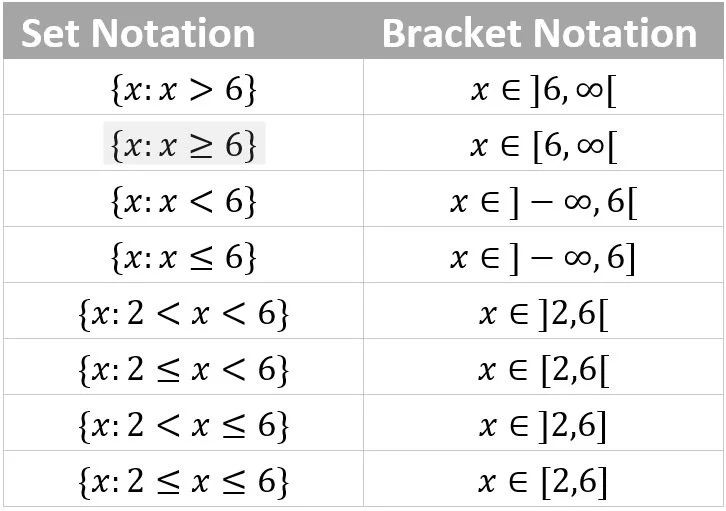
This is the notation used by the IB, but you might see other notations for defining sets in textbooks or other sources, called bracket notation.
In bracket notation the symbols [ and ] are used, and end points are listed a bit like a coordinate. If the bracket ‘closes’ towards the number, it includes the value. If the bracket ‘closes’ away from the number, it is not included.
Some examples are given below.
Your Turn
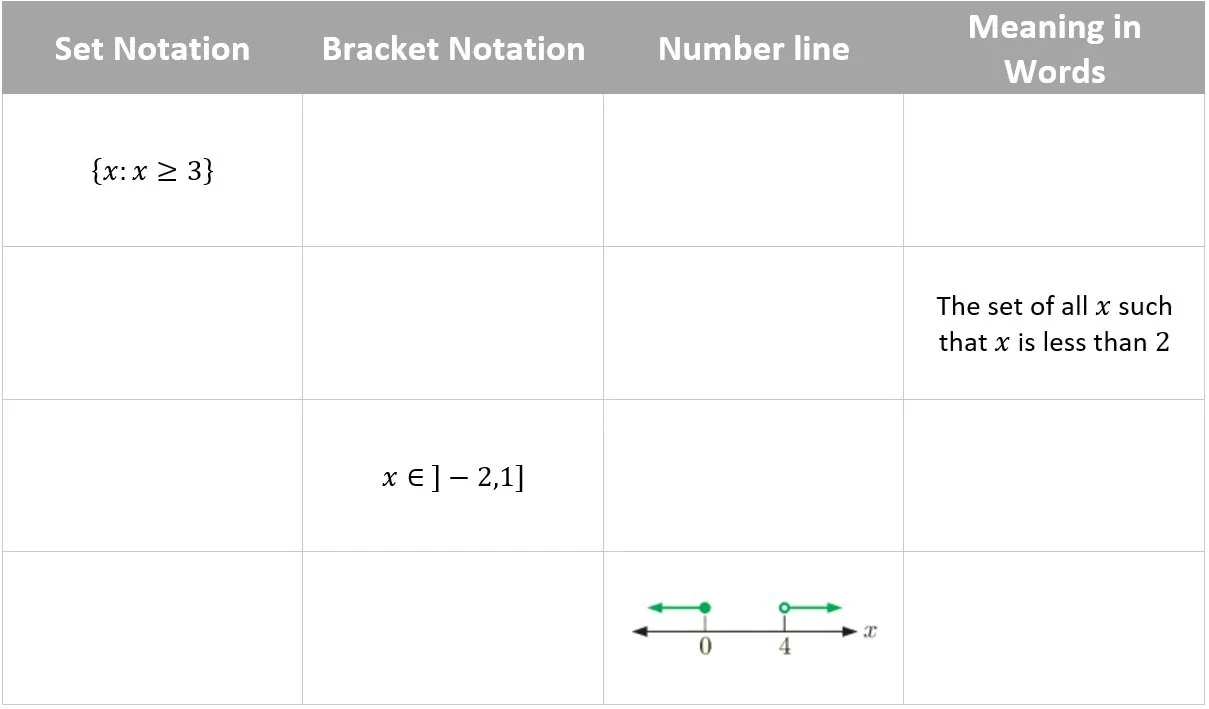
Complete the missing parts of the table below.
Example
State the domain and range of the function shown below.
Your Turn
State the domain and range of the function shown below.
Your Turn
Determine if this graph shows a function, state the domain and range, and give the coordinates of the local minimum.
-
It is a function as it passes the vertical line test.
The domain is \(\left\{x:x\in\mathbb{R}\right\}\).
The range is \(\left\{y:y\ge -1\right\}\).
Local minimum: \(\left(-2,-1\right)\).
Your Turn
Determine if this graph shows a function, state the domain and range, and give the coordinates of the local minimum.
-
It is a function as it passes the vertical line test.
The domain is \(\left\{x:x\in\mathbb{R}\right\}\).
The range is \(\left\{y:y\ge -1\right\}\).
Local minimum: \(\left(-4,-1\right)\).
Your Turn
Determine if this graph shows a function, state the domain and range, and give the coordinates of the local maximum.
-
It is a function as it passes the vertical line test.
The domain is \(\left\{x:x\in\mathbb{R}\right\}\).
The range is \(\left\{y:y\le 9\right\}\).
Local minimum: \(\left(1,9\right)\).
Your Turn
Determine if this graph shows a function, state the domain and range, and give the coordinates of the roots.
-
It is a function as it passes the vertical line test.
The domain is \(\left\{x:x\in\mathbb{R}\right\}\).
The range is \(\left\{y:y\le 6.25\right\}\).
Roots: \(\left(-4,0\right)\) and \(\left(1,0\right)\).
Your Turn
Determine if this graph shows a function, state the domain and range.
-
It is a function as it passes the vertical line test.
The domain is \(\left\{x:x\in\mathbb{R}\right\}\).
The range is \(\left\{y:y\in\mathbb{R}\right\}\).
Your Turn
Determine if this graph shows a function, state the domain and range.
-
It is a function as it passes the vertical line test.
The domain is \(\left\{x:-2\lex\le 2\right\}\).
The range is \(\left\{y:-4\le y\le 0\right\}\).
Your Turn
Determine if this graph shows a function, state the domain and range, and state the equations of any asymptotes.
-
It is a function as it passes the vertical line test.
The domain is \(\left\{x:x\in\mathbb{R}\right\}\).
The range is \(\left\{y:y\gt -2\right\}\).
Horizontal Asymptote: \(y=-2\).
Your Turn
Determine if this graph shows a function, state the domain and range, and state the equations of any asymptotes.
-
It is a function as it passes the vertical line test.
The domain is \(\left\{x:x\ne -1\right\}\).
The range is \(\left\{y:y\ne -3\right\}\).
Vertical Asymptote: \(x=-1\).
Horizontal Asymptote: \(y=-3\).
Your Turn
Determine if this graph shows a function, state the domain and range, and state the equations of any asymptotes.
-
It is a function as it passes the vertical line test.
The domain is \(\left\{x:x\ne -1, x\ne 1\right\}\).
The range is \(\left\{y:y\in\mathbb{R}\right\}\).
Vertical Asymptotes: \(x=-1\) and \(x=1\).
Horizontal Asymptote: \(y=0\).
Your Turn
Determine if this graph shows a function, state the domain and range, and state the equations of any asymptotes.
-
It is a function as it passes the vertical line test.
The domain is \(\left\{x:x\ne -1\right\}\).
The range is \(\left\{y:y\le -2, y\ge 2\right\}\).
Vertical Asymptote: \(x=-1\).
Your Turn
Determine if this graph shows a function, state the domain and range.
-
It is a function as it passes the vertical line test.
The domain is \(\left\{x:x\in\mathbb{R}\right\}\).
The range is \(\left\{y:-1\le y\le 1\right\}\).
Your Turn
Determine if this graph shows a function, state the domain and range.
-
It is a function as it passes the vertical line test.
The domain is \(\left\{x:x\ne -270, x\ne -90, x\ne 90, x\ne 270, …\right\}\).
The range is \(\left\{y:y\in\mathbb{R}\right\}\).
Your Turn
Determine if this graph shows a function, state the domain and range.
-
It is a function as it passes the vertical line test.
The domain is \(\left\{x:x\ne -360, x\ne -180, x\ne 0, x\ne 180, x\ne 360, …\right\}\).
The range is \(\left\{y:y\le -1, y\ge 1\right\}\).
Your Turn
Determine if this graph shows a function, state the domain and range.
-
It is NOT a function as it fails the vertical line test.
The domain is \(\left\{x:-4\le x\le 4\right\}\).
The range is \(\left\{y:-4\le y\le 4\right\}\).
Your Turn
Determine if this graph shows a function, state the domain and range.
-
It is a function as it passes the vertical line test.
The domain is \(\left\{x:x\in\mathbb{R}\right\}\).
The range is \(\left\{y:y\ge -1\right\}\).
Your Turn
Determine if this graph shows a function, state the domain and range.
-
It is a function as it passes the vertical line test.
The domain is \(\left\{x:x\gt -1\right\}\).
The range is \(\left\{y:y\le 0.63629\right\}\).
Your Turn
Determine if this graph shows a function, state the domain and range.
-
It is a function as it passes the vertical line test.
The domain is \(\left\{x:x\ne 3\right\}\).
The range is \(\left\{y:y\le 5, y\ge 13\right\}\).
Your Turn
Determine if this graph shows a function, state the domain and range.
-
It is a function as it passes the vertical line test.
The domain is \(\left\{x:x\ne -1, x\ne 1\right\}\).
The range is \(\left\{y:y\le 5, y\ge 9\right\}\).
Your Turn
Determine if this graph shows a function, state the domain and range.
-
It is a function as it passes the vertical line test.
The domain is \(\left\{x:x\in\mathbb{R}\right\}\).
The range is \(\left\{y:y\ge -6\right\}\).
Your Turn
Determine if this graph shows a function, state the domain and range, and state the equations of any asymptotes.
-
It is a function as it passes the vertical line test.
The domain is \(\left\{x:x\ge 0\right\}\).
The range is \(\left\{y:-1\lt y\le 0.3\right\}\).
Horizontal Asymptote: \(y=-1\).
Notes
To fully describe any function we need both a domain and a rule that connects each element of the domain to an element in the range.
If a domain is not specified, we use the natural domain, which is the largest possible domain for which all elements have an image.
For the function \(f\left(x\right)=\sqrt{x}\) the natural domain is
-
$$\left\{x:x\ge 0,x\in\mathbb{R}\right\}$$This is because we cannot take square roots of negative numbers (when dealing with functions of real numbers, as we see in this course!)
The same is true for fourth roots or sixth roots, or any even root.
For the function \(\left(x\right)=\frac{1}{x}\) the natural domain is
-
$$\left\{x:x\ne 0,x\in\mathbb{R}\right\}$$This is because we cannot divide by \(0\).
The same is true for any function with the variable in the denominator of a fraction.
Examples and Your Turns
Example
State the natural domain and range for the function$$f\left(x\right)=\sqrt{4-x}$$
-
Since the inside of a square root can’t be less than \(0\), we set \(4-x\ge 0\) to find the natural domain.
The domain is \(\left\{x:x\le 4\right\}\).
The range is \(\left\{y:y\ge 0\right\}\).
Your Turn
State the natural domain and range for the function$$f\left(x\right)=\sqrt{x-5}$$
-
Since the inside of a square root can’t be less than \(0\), we set \(x-5\ge 0\) to find the natural domain.
The domain is \(\left\{x:x\ge 5\right\}\).
The range is \(\left\{y:y\ge 0\right\}\).
Example
State the natural domain and range for the function$$f\left(x\right)=\frac{1}{4-x}$$
-
Since the denominator can’t be equal to \(0\), we set \(4-x=0\) to find the natural domain.
The domain is \(\left\{x:x\ne 4\right\}\).
The range is \(\left\{y:y\ne 0\right\}\).
Your Turn
State the natural domain and range for the function$$f\left(x\right)=\frac{1}{x-5}$$
-
Since the denominator can’t be equal to \(0\), we set \(x-5=0\) to find the natural domain.
The domain is \(\left\{x:x\ne 5\right\}\).
The range is \(\left\{y:y\ne 0\right\}\).
Example
State the natural domain and range for the function$$f\left(x\right)=\frac{1}{\sqrt{4-x}}$$
-
Since the inside of a square root can’t be less than \(0\), and the denominator can’t be equal to \(0\), we set \(4-x\gt 0\) to find the natural domain.
The domain is \(\left\{x:x\lt 4\right\}\).
The range is \(\left\{y:y\gt 0\right\}\).
Your Turn
State the natural domain and range for the function$$f\left(x\right)=\frac{1}{\sqrt{x-5}}$$
-
Since the inside of a square root can’t be less than \(0\), and the denominator can’t be equal to \(0\), we set \(x-5\gt 0\) to find the natural domain.
The domain is \(\left\{x:x\gt 5\right\}\).
The range is \(\left\{y:y\gt 0\right\}\).
Your Turn
Find the domain and range of the function$$f\left(x\right)=\ln \left(x-5\right)$$
-
Since the inside of a logarithm must be greater than \(0\), we set \(x-5\gt 0\) to find the natural domain.
The domain is \(\left\{x:x\gt 5\right\}\).
The range is \(\left\{y:y\in\mathbb{R}\right\}\).
Your Turn
Find the domain and range of the function$$f\left(x\right)=\frac{x+1}{x-3}$$
-
Since the denominator can’t be equal to \(0\), we set \(x-3= 0\) to find the natural domain.
The domain is \(\left\{x:x\ne 3\right\}\).
The range is \(\left\{y:y\ne 1\right\}\).
Your Turn
Find the natural domain for the function$$f\left(x\right)=\frac{1}{x-2}+\sqrt{x+3}$$
-
Since the denominator can’t be equal to \(0\), we set \(x-2=0\) for the first part of the function.
Since the inside of a square root can’t be less than \(0\), we set \(x+3\ge 0\) for the second part of the function.
The domain is \(\left\{x:x\ne 2, x\ge -3\right\}\).
Your Turn
Give an example of a function with domain \(\left\{x:x\ne 3,x\in\mathbb{R}\right\}\).
And another.
And another.
Give an example of a function with domain \(\left\{x:x\ge 5,x\in\mathbb{R}\right\}\).
And another.
And another.
Give an example of a function with domain \(\left\{x:x\lt 5,x\in\mathbb{R}\right\}\).
And another.
And another.
Key Facts
Use this applet to generate a prompt for a Key Fact that you need to know for the course. The idea is that you should KNOW these key facts in order to be able to solve problems.
Taking it Deeper
Conceptual Questions to Consider
Why do we need to have a domain given for a function?
Is it possible for the domain of a function to be the empty set?
Explain how the domain and range relate to the graph of a function.
Common Mistakes / Misconceptions
Not considering the restrictions to a domain or assuming it is always the real numbers.
Using \(\lt\) and \(\le\) interchangeably.
Connecting This to Other Skills
This skill build upon ideas from 2.2, 2.3 and 2.4.
When we move on to look at Composite Functions (2.12) and Inverse Functions (2.13) the idea of domain and range will be really important.
When we study Stationary Points (4.14) we will find analytic ways to determine the range without graphical calculators.
Self-Reflection
What was the most challenging part of this skill for you?
What are you still unsure about that you need to review?