
Unit 3 - Trigonometry
Required Prior Knowledge
Questions
Complete the table, giving the smallest possible angle that satisfies$$ \begin{array}{|c|c|c|c|c|c|c|c|c|} \hline \textbf{Degrees} & 0^\circ & & & & & 270^\circ & & \\ \hline \textbf{sin } \boldsymbol{\theta} & & 1 & & & & & & -\frac{1}{2} \\ \hline \textbf{cos } \boldsymbol{\theta} & & & & \frac{\sqrt{2}}{2} & & & & \\ \hline \textbf{tan } \boldsymbol{\theta} & & & & & \sqrt{3} & & & \\ \hline \textbf{Radians} & & & 2\pi & & & & \frac{\pi}{6} & \\ \hline \end{array} $$
Solutions
Get Ready
Questions
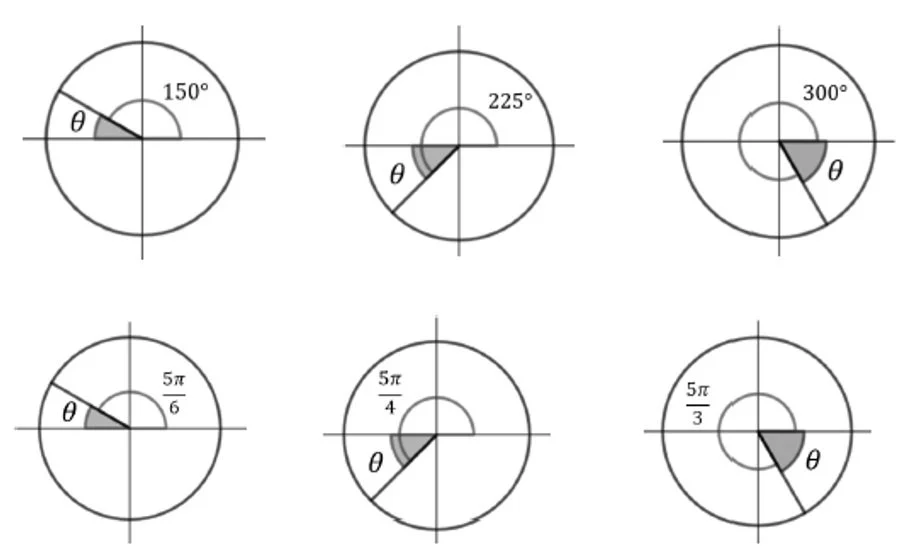
Determine the angle \(\theta\) in each of these diagrams
If \(\sin 147^{\circ}=0.5446\) then find the value of
a) \(\sin 33^{\circ}\)
b) \(\sin 213^{\circ}\)
c) \(\sin 327^{\circ}\)
If \(\cos 275^{\circ}=0.0872\) then give three equations you can state from this result.
Solutions
Examples and Your Turns
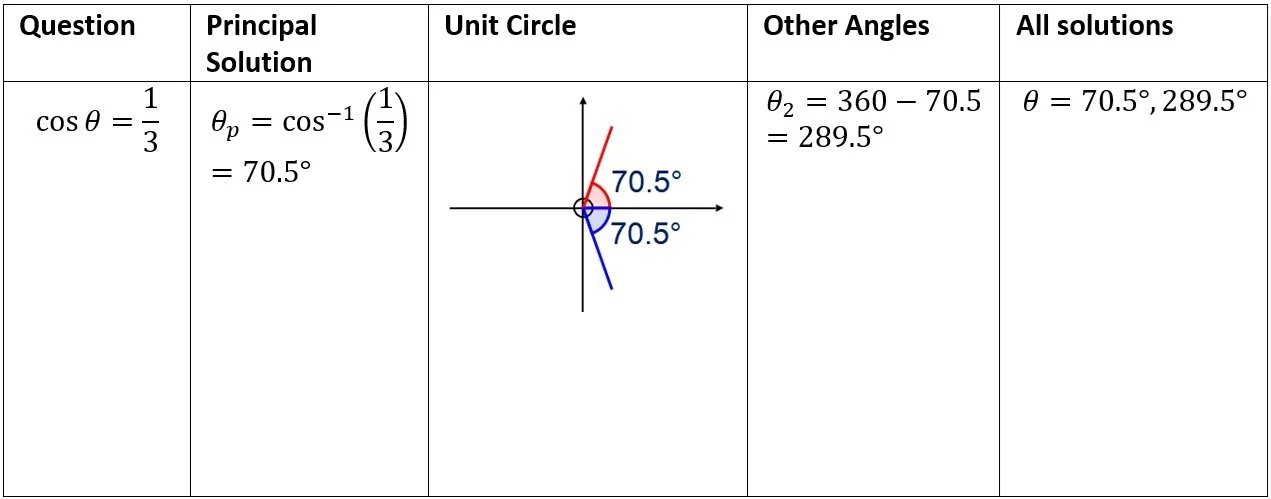
Example
Find the two angles \(\theta\) on the unit circle, with \(0^{\circ}\le\theta\le 360^{\circ}\)
Your Turn
Complete the table in the below worksheet.
Your Turn
Complete the table in the below worksheet.
Your Turn
Without using a calculator, solve the following equations for \(\theta\), where \(0\le\theta\le 2\pi\).
a) \(\sin\theta = -\frac{1}{2}\)
b) \(\cos\theta = \frac{1}{\sqrt{2}}\)
c) \(\tan\theta = \sqrt{3}\)
d) \(\sin\theta = -1\)
e) \(\cos\theta = 1\)
f) \(\tan\theta = 0\)
Notes
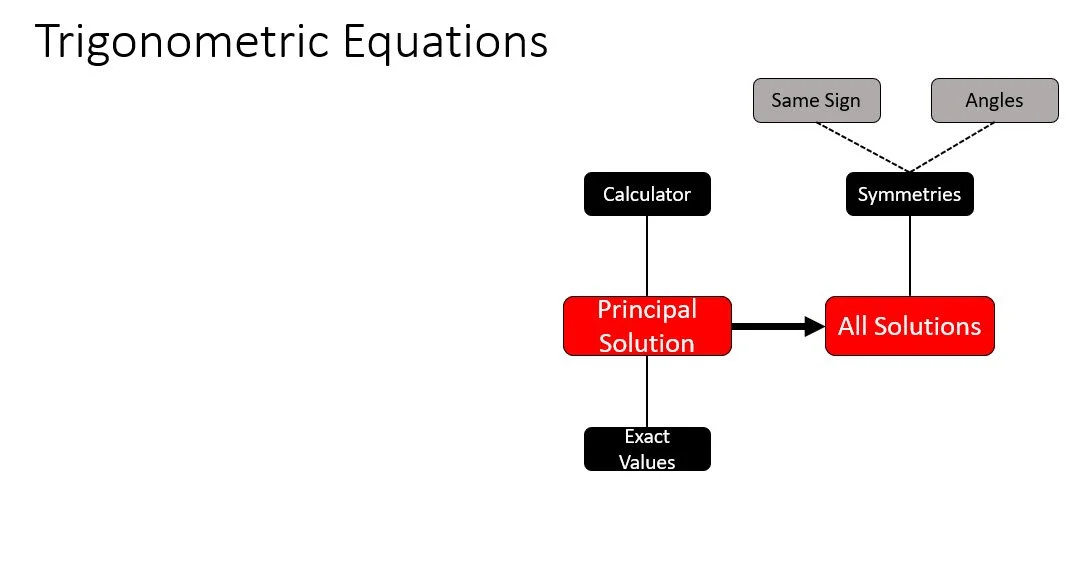
In order to solve a simple trigonometric equation you must:
find the principal solution (using either your calculator or known exact values);
determine the other quadrants where the angle has the same sign (using the unit circle or the graph);
use symmetry to determine the values of the other angle.
This can be summarised in this diagram.
Multiple Choice
1. Solve the equation \(\sin \theta = \frac{1}{2}\) for \(0^\circ \le \theta \le 360^\circ\)
2. Solve the equation \(\cos \theta = \frac{\sqrt{2}}{2}\) for \(0^\circ \le \theta \le 360^\circ\)
3. Solve the equation \(\tan \theta = -1\) for \(0^\circ \le \theta \le 360^\circ\)
4. Solve the equation \(\cos \theta = -\frac{\sqrt{3}}{2}\) for \(0^\circ \le \theta \le 360^\circ\)
5. Solve the equation \(\sin \theta = 0.8\) for \(0^\circ \le \theta \le 360^\circ\)
Spot the Error
**1. Solve \(\sin x = 0.5\) for \(0^\circ \le x \le 360^\circ\)**
Principal value \(x_p = \sin^{-1} 0.5 = 30^\circ\).
Second solution \(x_2 = 180^\circ + 30^\circ = 210^\circ\).
Final answer \(x = 30^\circ, 210^\circ\).
**2. Solve \(\cos x = -0.8\) for \(0 \le x < 2\pi\)**
Principal value \(x_p = \cos^{-1} -0.8 \approx 2.498\).
Second solution \(x_2 = 2\pi - 2.498 \approx 3.785\).
Final answer \(x = 2.498, 3.785\).
**3. Solve \(\tan x = 1\) for \(0^\circ \le x \le 360^\circ\)**
Principal value \(x_p = \tan^{-1} 1 = 45^\circ\).
Second solution \(x_2 = 360^\circ - 45^\circ = 315^\circ\).
Final answer \(x = 45^\circ, 315^\circ\).
**4. Solve \(\sin x = -0.2\) for \(0 \le x < 2\pi\)**
Related acute angle: \(\sin^{-1} 0.2 \approx 0.201\)
Since sine is negative, the solutions are in quadrants 3 and 4.
Quadrant 3 solution: \(\pi + 0.201 = 3.343\)
Quadrant 4 solution: \(2\pi - 0.201 = 6.082\)
Final answer \(x = 3.343, 6.082\).
**5. Solve \(\cos x = \frac{\sqrt{3}}{2}\) for \(0^\circ \le x \le 360^\circ\)**
Principal value \(x_p = \cos^{-1} \frac{\sqrt{3}}{2} = 30^\circ\).
Second solution \(x_2 = 360^\circ - 30^\circ = 330^\circ\).
Final answer \(x = 30^\circ, 330^\circ\).
**6. Solve \(\sin x = -1\) for \(0 \le x < 2\pi\)**
Final answer \(x = 270^\circ\).
**7. Solve \(\sin x = 0.75\) for \(0 \le x < 2\pi\)**
Principal value \(x_p = \sin^{-1} 0.75 = 0.848\)
Second solution \(x_2 = \pi - 0.848 = 2.294\)
Final answer \(x = 0.848, 2.294\).
**8. Solve \(\cos x = 0.5\) for \(0 \le x < 2\pi\)**
Principal value \(x_p = \cos^{-1} 0.5 = \frac{\pi}{3}\)
Second solution \(x_2 = \pi - \frac{\pi}{3} = \frac{2\pi}{3}\)
Final answer \(x = \frac{\pi}{3}, \frac{2\pi}{3}\).
Your Turn
Make up some of your own Spot the Error and Multiple Choice questions.
Make sure the wrong answers are believable at first glance.
Your Turn
Give a trigonometric equation that can be solved without a calculator, where
1. The two solutions are less than \(90^{\circ}\) apart.
2. The two solutions are in quadrants \(2\) and \(4\).
3. The two solutions are in quadrants \(3\) and \(4), and are more than \(\frac{\pi}{2}\) apart.
Key Facts
Use this applet to generate a prompt for a Key Fact that you need to know for the course. The idea is that you should KNOW these key facts in order to be able to solve problems.
Taking it Deeper
Conceptual Questions to Consider
Why does your calculator only give one solution for \(\theta=\sin^{-1}\left(a\right)\)?
How would the solutions change if the domain was \(-\pi\le\theta\le\pi\)?
Which method do you prefer for finding the second solution: unit circle or trigonometric graph? Explain why.
Common Mistakes / Misconceptions
Don’t forget to find all the solutions in the given domain. For a simple trigonometric function with domain \(0^{\circ}\le\theta\le 360^{\circ}\) there are always two solutions.
Using the wrong quadrant for the second solution because you have misapplied the unit circle.
Missing the unit needed for the angle in a particular question. The only indication as to whether you should use degrees or radians is usually in how the domain is given.
Connecting This to Other Skills
This skill builds on the ideas of the Unit Circle and Periodicity (3.5), but also incorporates Radians (3.4) and Exact Values (3.6).
Looking forward, when Modelling with Trig functions (3.10) you will often have to solve a trigonometric equation.
In Trigonometric Equations (3.16) we will build further upon these ideas, and see how trig equations can be made more difficult in various ways.
Self-Reflection
What was the most challenging part of this skill for you?
What are you still unsure about that you need to review?