
Unit 0 - Required Prior Knowledge
Required Prior Knowledge
Questions
Solve the following equations
1) \(2x+3=21 \)
2) \(3-2x=21\)
3) \(\frac{x}{2}+3=21\)
4) \(3+2x=21\)
5) \(2x+4=21\)
6) \(3x+3=21\)
7) \(2x-3=21\)
8) \(2x+23=21\)
9) \(6x+3=21\)
10) \(\left(x+1\right)^{2}=2x^{2}-5x+11\)
11) \(5-4x^{2}=3\left(2x+1\right)+2\)
Solutions
Get Ready
Questions
Find the sum and difference of each pair of equations. What do you notice?
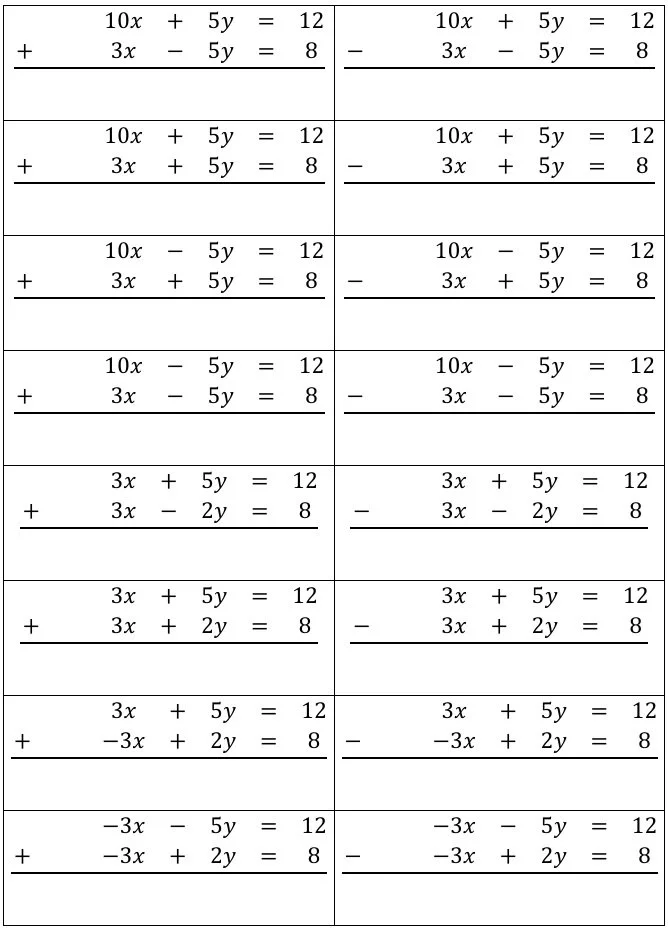
Solutions
Notes
To solve a pair of linear simultaneous equations we can use the method of elimination.
The steps are:
Scale both equations so that the coefficient of one of the variables is equal in both equations
Add or subtract the equations so this variable is eliminated
We are left with an equation in a single variable that is easy to solve
Substitute our known variable into one of the original equations
Solve the resulting linear equation
Check you answer by substituting BOTH solutions into the second original equation (this does not need to be written down, and can be done in your head)
Write down the final solution stating the value of both variables.
Examples and Your Turns
Example
Solve the simultaneous equations$$\begin{matrix}4x&+&3y&=&23\\2x&+&3y&=&19\end{matrix}$$
Your Turn
Solve the simultaneous equations$$\begin{matrix}3x&+&4y&=&14\\x&+&4y&=&18\end{matrix}$$
Example
Solve the simultaneous equations$$\begin{matrix}4x&-&3y&=&23\\2x&+&3y&=&19\end{matrix}$$
Your Turn
Solve the simultaneous equations$$\begin{matrix}3x&+&4y&=&14\\x&-&4y&=&18\end{matrix}$$
Example
Solve the simultaneous equations$$\begin{matrix}2x&-&5y&=&16\\2x&+&3y&=&0\end{matrix}$$
Your Turn
Solve the simultaneous equations$$\begin{matrix}x&+&7y&=&10\\x&-&4y&=&-12\end{matrix}$$
Example
Solve the simultaneous equations$$\begin{matrix}5x&+&2y&=&11\\3x&-&4y&=&4\end{matrix}$$
Your Turn
Solve the simultaneous equations$$\begin{matrix}2x&+&3y&=&5\\5x&-&2y&=&-16\end{matrix}$$
Notes
When you have simultaneous equations where one is non-linear, you have to use substitution.
Note this method also works for two linear equations if you prefer it.
The steps are:
Rearrange the linear equation so it is in terms of one variable
Substitute this into the non-linear equation, eliminating one of the variables
Solve the resulting equation in one variable (usually a quadratic equation) which may have multiple solutions
Substitute the known value(s) into the linear equation to find the solutions for the second variable
Check your answers by substituting them into the second equation (this does not need to be written down)
Write out the final solutions clearly, pairing up the connected solutions for each variable.
Examples and Your Turns
Example
Solve$$y+x=3\\x^{2}-xy=14$$
Your Turn
Solve$$2x+3y=2\\4x^{2}+y^{2}=4$$
Your Turn
Solve$$x+y=3\\x^{2}+y^{2}=5$$
Your Turn
Solve$$y-x=4\\2x^{2}+xy=-1$$
Your Turn
Solve$$5x^{2}+y=3xy\\2x-y=0$$
Key Facts
Use this applet to generate a prompt for a Key Fact that you need to know for the course. The idea is that you should KNOW these key facts in order to be able to solve problems.