
Unit 4 - Differential Calculus
Required Prior Knowledge
Questions
Expand and differentiate
a) \(f\left(x\right)=\left(x^{2}+3\right)\left(4-3x\right) \)
b) \(y=\sqrt{x}\left(2x+1\right)^{3}\)
Solutions
Get Ready
Questions
Considering the function \(f\left(x\right)=\left(x^{2}-3\right)\left(4-3x\right)\) find the derivative of each of the factors:
\(x^{2}-3\) differentiates to
\(4-3x\) differentiates to
Is \(f’\left(x\right)\) equal to the product of these two derivatives?
Do the same thing for \(y=\sqrt{x}\left(2x+1\right)^{3}\).
Solutions
Notes
We have already seen that it \(y=f\left(x\right)+g\left(x\right)\) then \(\frac{dy}{dx}=f’\left(x\right)+g’\left(x\right)\).
From the Required Prior Knowledge and Get Ready we have seen that if \(y=f\left(x\right)\times g\left(x\right)\) then \(\frac{dy}{dx}\) is NOT \(f’\left(x\right)\times g’\left(x\right)\).
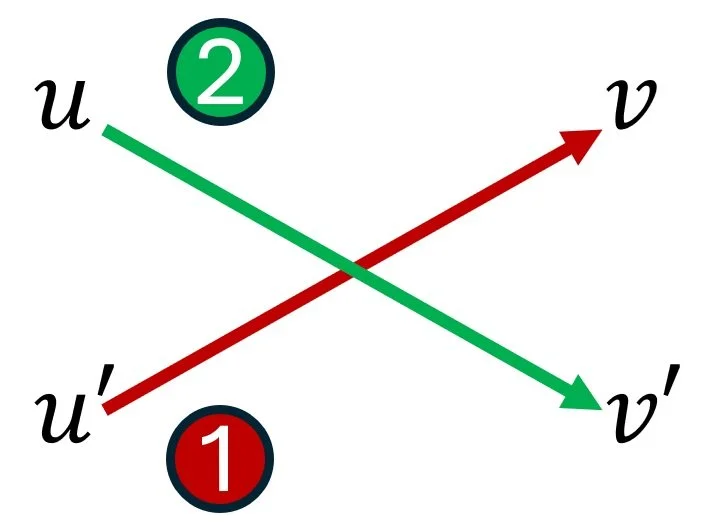
The Product Rule for differentiation states that, if \(f\left(x\right)=u\left(x\right)v\left(x\right)\) then$$f’\left(x\right)=u’\left(x\right)v\left(x\right)+u\left(x\right)v’\left(x\right)$$
This can also be written as, if \(y=uv\), where \(u\) and \(v\) are functions of \(x\), then $$\frac{dy}{dx}=u’v+uv’=\frac{du}{dx}v+u\frac{dv}{dx}$$
We can visualise this by using a ‘cross’ in the following structure:
Proof (HL)
Examples and Your Turns
Example
Find \(f’\left(x\right)\) if \(f\left(x\right)=\left(x^{2}+3\right)\left(4-3x\right)\)
Your Turn
Differentiate \(y=\left(x^{2}+1\right)\left(x^{3}-4\right)\)
Your Turn
Differentiate \(f\left(x\right)=\left(3x+2\right)\left(x^{2}-5x+6\right)\)
Your Turn
Find \(\frac{dy}{dx}\) if \(y=\sqrt{x}\left(2x+1\right)^{3}\).
Your Turn
Find \(\frac{dy}{dx}\) if \(y=\left(x-2\right)^{3}\left(1-x^{2}\right)^{5}\).
Your Turn
Differentiate \(y=\left(x^{3}+4\right)^{-2}\sqrt{x^{2}-2x}\)
Differentiate the function using the Product Rule
Your Turn
Let \(f\left(x\right)=\left(x^{2}-k\right)x^{3}\) where \)k\in\mathbb{R}\).
(a) The graph of \(y=f\left(x\right)\) has gradient \(0\) where \(x=1\). Find \(k\).
(b) Using your value of \(k\) from part (a), find the other coordinates where the function has gradient \(0\).
Key Facts
Use this applet to generate a prompt for a Key Fact that you need to know for the course. The idea is that you should KNOW these key facts in order to be able to solve problems.
Taking it Deeper
Conceptual Questions to Consider
Is it always better to use the product rule? Or are there times when expanding might be easier?
Common Mistakes / Misconceptions
It is common for students to forget to use the product rule, and just try to work out \(u’\times v’\).
Once you learn the Quotient Rule (4.9), it is common to confuse the two. This is for products of two functions, and is an addition.
Whilst not an error, you might be asked to simplify your derivative, and factorising is often the best way to approach this.
Connecting This to Other Skills
Within the product rule you have to Differentiate Polynomials (4.5) and often use the Chain Rule (4.7).
The Quotient Rule (4.9) is very similar to the Product Rule, but for division of two functions.
When learning Implicit Differentiation (4.10), Differentiating Exponentials and Logarithms (4.11) and Differentiating Trig (4.12) we will use the Product Rule with this types of derivatives.
Self-Reflection
What was the most challenging part of this skill for you?
What are you still unsure about that you need to review?