
Unit 4 - Differential Calculus
Required Prior Knowledge
Questions
Find the gradient of the line passing through the points \(\left(3,7\right)\) and \(\left(5,11\right)\).
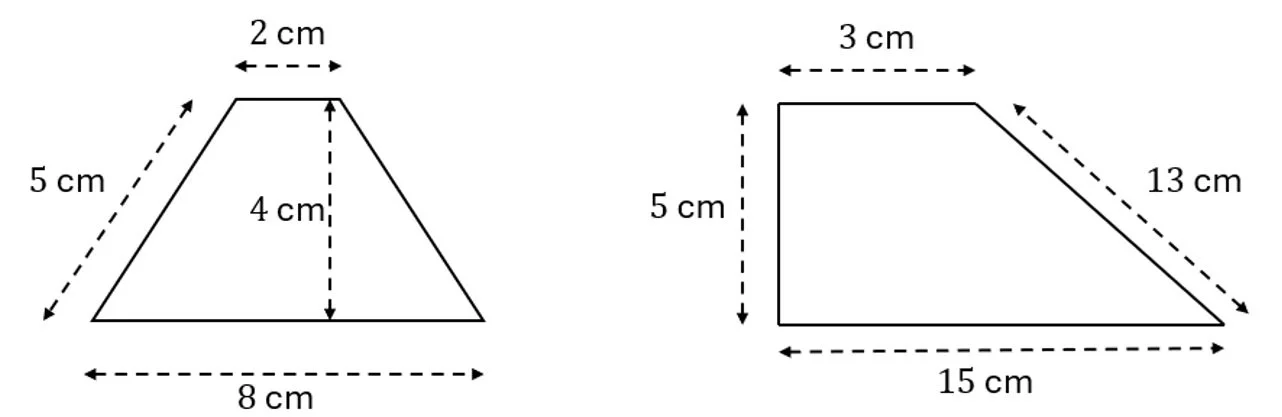
Calculate the area of the trapezia below.
Solutions
Get Ready
Questions
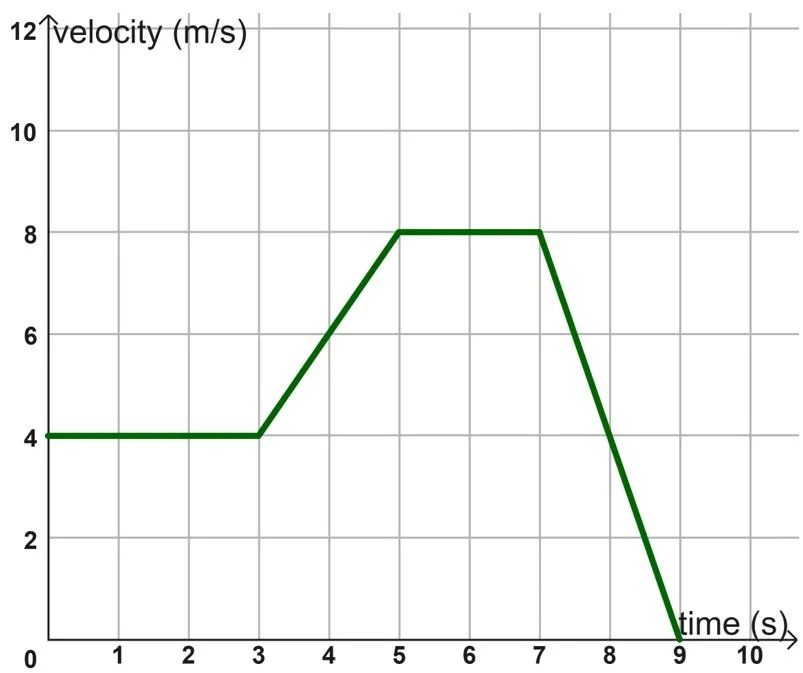
The graph below shows the velocity of a car.
a) What is happening between \(0\)s and \(3\)s?
b) What is the rate of acceleration between \(3\)s and \(5\)s?
c) How far did the car travel on this journey?
Is it realistic that a car travels in this way?
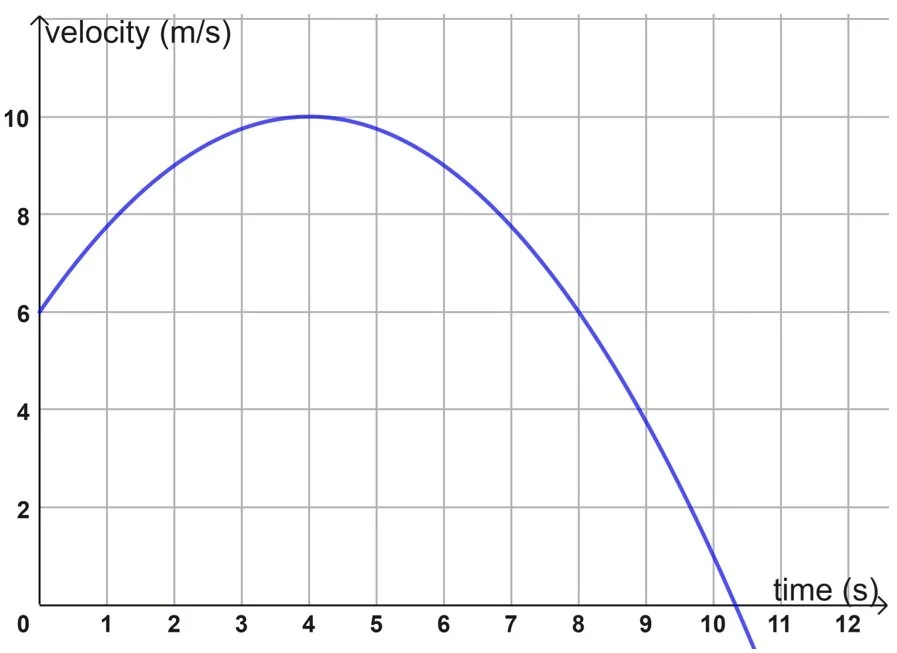
The graph below shows the velocity of a car as it approaches a traffic light.
a) What is happening between \(0\)s and \(4\)s?
b) Estimate the rate of deceleration at \(7\)s.
c)Estimate the total distance the car travelled in this time.
What is different about this second scenario?
Solutions
Notes
The gradient of a curve at a point is defined as the gradient of the tangent to the curve at that point.
We can estimate the gradient of a curve at a point by drawing a tangent to the curve at the point and the finding the gradient of that line.
Move the point \(P\) in the below animation to see the tangent and the calculation for the gradient at that point. You can also change the function \(f\left(x\right)\) to something different to see how it changes.
Your Turns
Your Turn
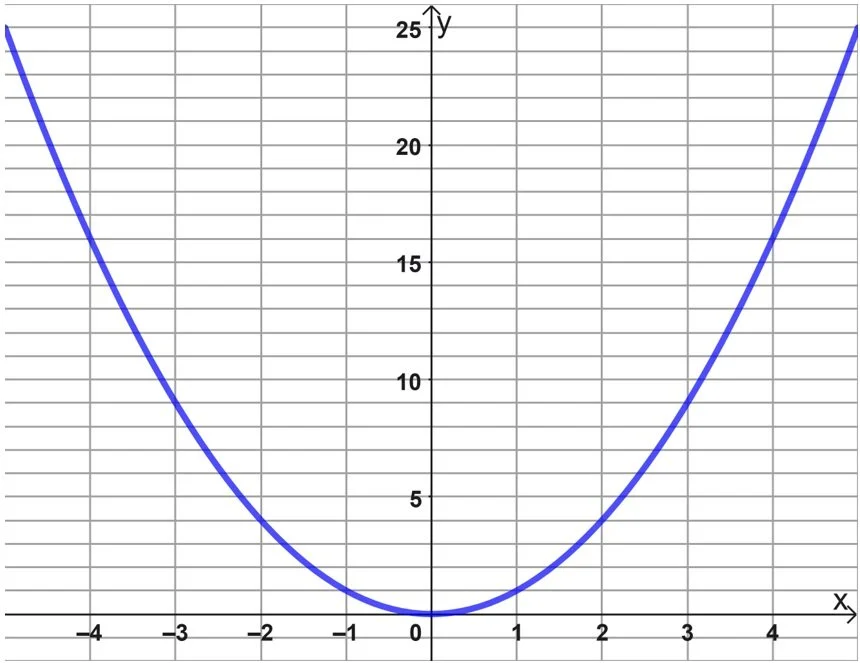
Shown is the graph of \(y=x^{2}\). Estimate the gradient at:
a) \(\left(2,4\right)\)
b) \(\left(-4,16\right)\)
Your Turn
Shown is the graph of \(y=2x^{2}-6x\). Estimate the gradient at:
a) \(\left(3,0\right)\)
b) \(\left(-1,8\right)\)
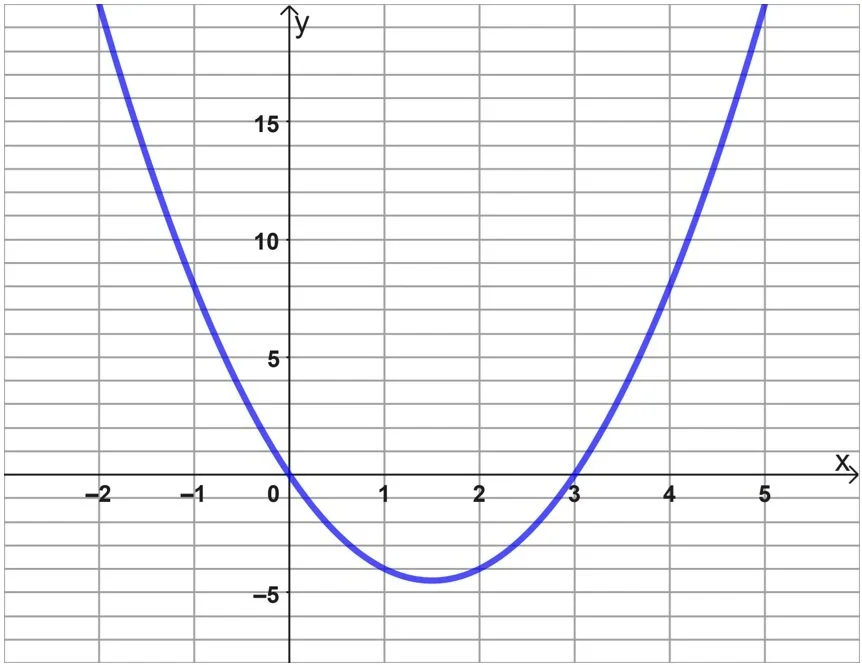
Your Turn
Shown is the graph of \(y=x^{3}-3x^{2}\). Estimate the gradient at:
a) \(\left(-1,-4\right)\)
b) \(\left(3,0\right)\)
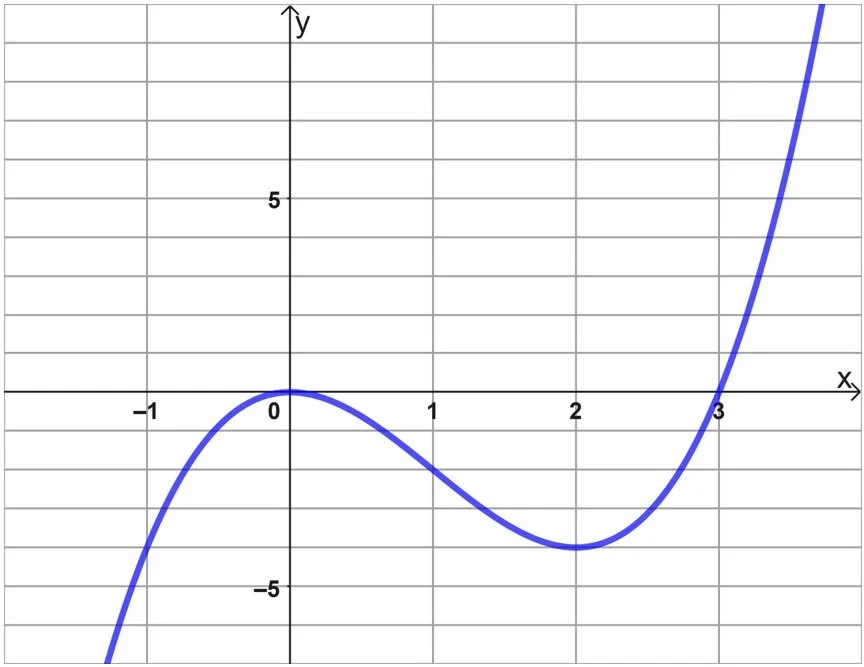
Notes
The area beneath a curve can be estimated by splitting the area into trapeziums (and triangles) and summing the areas of each.
Use the activity below to see the trapezia below a curve that can be used to estimate the area. You can change the original function to see what happens for different curves.
Note that in some cases the trapezia give an under-estimate for the area and in other cases it gives an over-estimate
Your Turn
Shown is the graph of \(y=6x-x^{2}\). Find an estimate for the area below the curve between \(0\le x\le 6\).
State whether this estimate is an underestimate, overestimate or if it is impossible to tell.
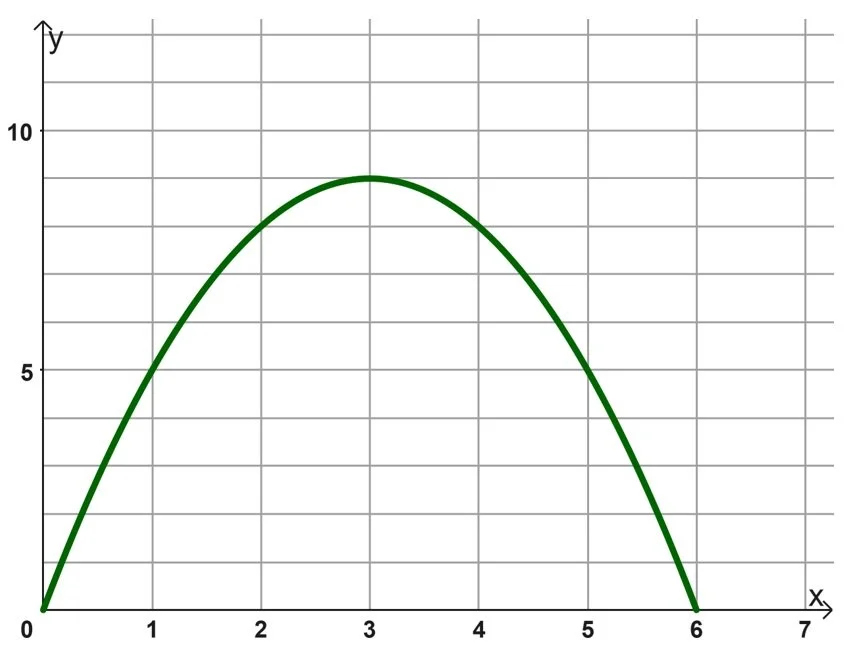
Your Turn
Shown is the graph of \(y=2^{x}\). Find an estimate for the area below the curve between \(0\le x\le 4\).
State whether this estimate is an underestimate, overestimate or if it is impossible to tell.
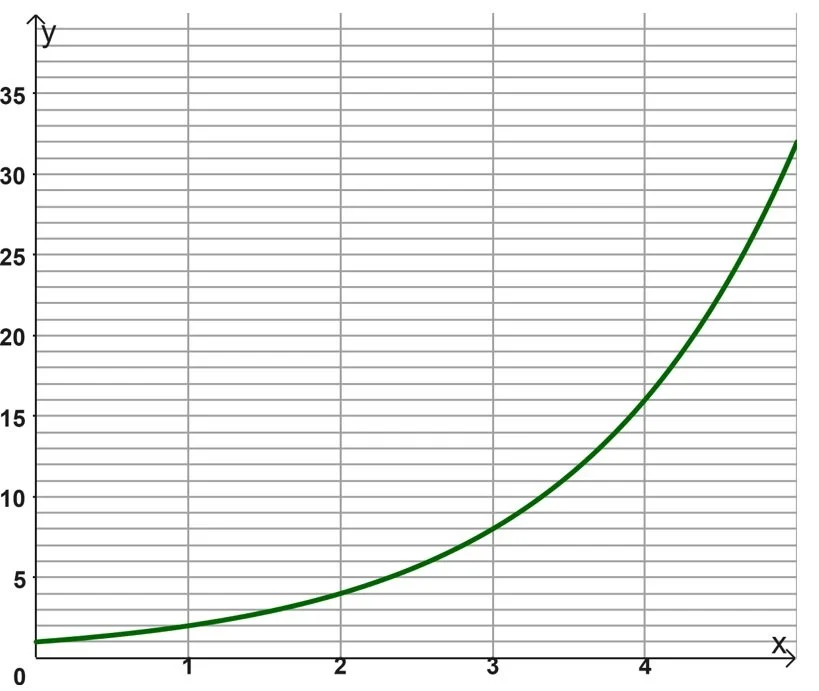
Your Turn
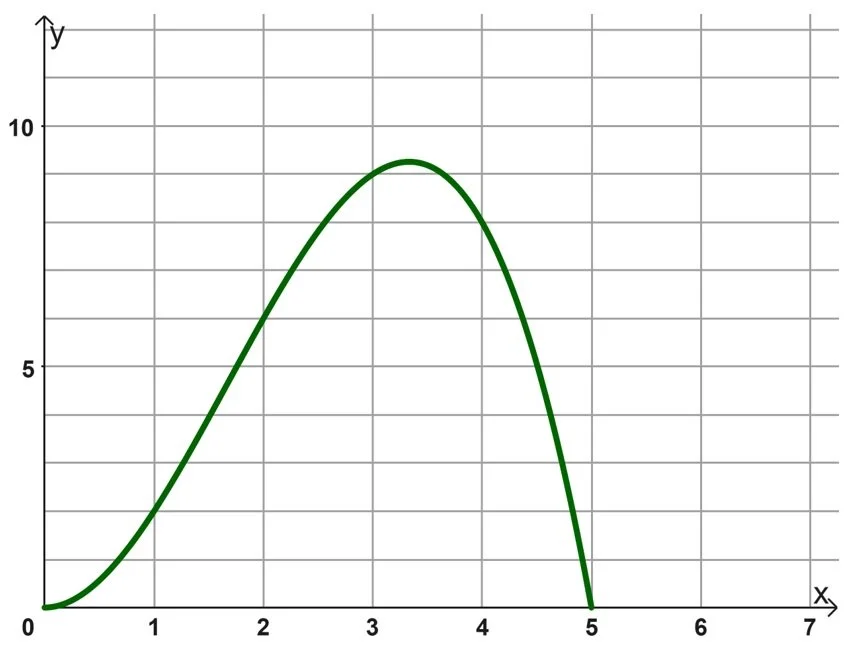
Shown is the graph of \(y=x^{3}-5x^{2}\). Find an estimate for the area below the curve between \(0\le x\le 5\).
State whether this estimate is an underestimate, overestimate or if it is impossible to tell.
Notes - But What IS Calculus???
This idea has been adapted from Infinite Powers by Steven Strogatz.
Consider this problem: how do we calculate the value of \(\pi\)?
Let’s start by considering, what is \(\pi\)?
-
\(\pi\) is the ratio of the circumference to the diameter of a given circle. That is$$\pi=\frac{c}{d}$$
Why is this a constant value no matter the size of the circle?
-
Since all circles are similar shapes, the ratio of two lengths such as the circumference and diameter is constant.
Back to the original problem: how do we calculate the value of \(\pi\)?
Consider the image below of an equilateral triangle inscribed inside a circle.
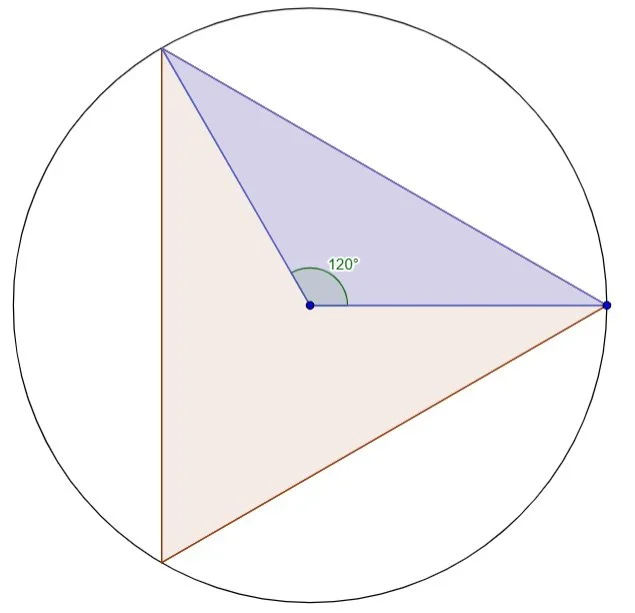
Let’s assume the circle is a unit circle (why does it not matter what the radius is?) and call the length of the side of the triangle \(x\).
Then$$\begin{align}x^{2}&=1^{2}+1^{2}-2\left(1\right)\left(1\right)\cos 120^{\circ}\\&=2\left(1-\cos 120^{\circ}\right)\\&=2\left(1-\left(-\frac{1}{2}\right)\right)\\&=3\end{align}$$So the perimeter, \(P\), of the triangle is$$P=3x=3\sqrt{3}$$Thus the ratio of the perimeter to the diameter of the circle is estimated by$$\frac{P}{d}=\frac{3\sqrt{3}}{2}\approx 2.598$$
How does this help us get to the value of \(\pi\)?
-
Think about what happens as we increase the number of sides on the regular polygon inscribed in the circle.
Your Turn
Consider the square below inscribed in the circle.
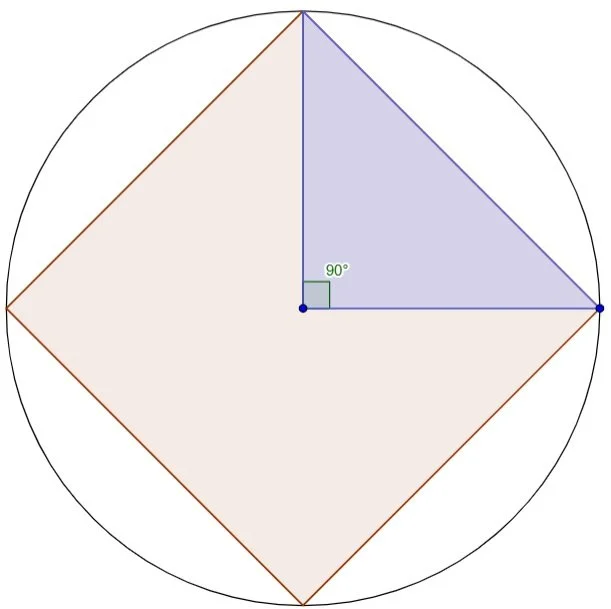
Call the length of the side of the square \(x\).
Then$$\begin{align}x^{2}&=1^{2}+1^{2}-2\left(1\right)\left(1\right)\cos 90^{\circ}\\&=2\left(1-\cos 90^{\circ}\right)\\&=2\left(1-\qquad\right)\\&=\qquad\end{align}$$So the perimeter, \(P\), of the square is$$P=\qquad=\qquad$$Thus the ratio of the perimeter to the diameter of the circle is estimated by$$\frac{P}{d}=\frac{\qquad}{\qquad}\approx \qquad$$
Investigation
Use the applet below to see what happens as the number of sides in the regular polygon increases.
What happens as the number of sides of our inscribed polygon increases?
-
As the number of sides on the inscribed polygon increases, the value of the ratio \(\frac{P}{d}\) gets closer to \(\pi\).
This occurs because the polygon is becoming a better and better approximation to the circle.
Archimedes was able to use this process to approximate the value of \(\pi\). He knew that:$$3+\frac{10}{71}\lt\pi\lt 3+\frac{10}{70}$$
Key Facts
Use this applet to generate a prompt for a Key Fact that you need to know for the course. The idea is that you should KNOW these key facts in order to be able to solve problems.
Taking it Deeper
Conceptual Questions to Consider
If the curve represents your distance travelled over time, explain what the gradient of the tangent at a specific point means? What if the curve represents your velocity at a specific time?
When approximating the area under a curve, why does increasing the number of pieces make the approximation better?
Common Mistakes / Misconceptions
When finding a gradient this way, you must draw a tangent just touching the curve once, not intersecting the curve in two points.
Forgetting whether an approximation for an area is an underestimate or an overestimate.
Connecting This to Other Skills
We need a pretty good understanding of different types of functions (Unit 2) to analyse the graphs.
This skill is the big picture, conceptual idea underpinning all of Differential Calculus (Unit 4) and Integral Calculus (Unit 5).
Self-Reflection
What was the most challenging part of this skill for you?
What are you still unsure about that you need to review?