
Module 3 - Investigation Structure
TL;DR
Finding the general rule is the key step in the investigation.
You just have to write it down; no need to show any working.
Once you have a general rule, you can get some easy marks for Testing and Verifying your general rule.
These are essentially the same skill, but applied slightly differently.
Both Testing and Verifying are about choosing a value of \(n\), substituting this into your general rule, and checking it gives the same answer as you expected by comparing to the table.
The difference is in the value of \(n\) that you choose:
When testing you must choose a value of \(n\) for which you know the correct value. That is, one that you were given in the table, or animation, to begin with. Usually this is a value of \(n\le 4\).
When verifying you must choose a value of \(n\) for which you predicted the correct value. That is, one that you filled in the table in the first step. Usually this is a value of \(n\ge 5\).
Testing is marked against criteria T, always worth 2 marks.
There 1 mark for choosing a correct value of \(n\). The second mark is for correctly substituting this into your general rule and confirming it matches the value given. If it does not match you will not get this point. But if it matches for this value, even if the rule is wrong, you will get this point.
Verifying is marked against criteria V, always worth 3 marks.
There 1 mark for choosing a correct value of \(n\). The second mark is for correctly substituting this into your general rule and calculating the answer. The third mark is for confirming it matches your prediction based on the pattern.
If you use a value of \(n\) from beyond the table, you must also confirm the value by continuing the pattern.
If you get the correct general rule, then these 5 marks should be very easy.
The key to both testing and verifying is being able to substitute values into a formula.
Remember you can use the in built Desmos Calculator to do this, and import your answers directly into the answer box.
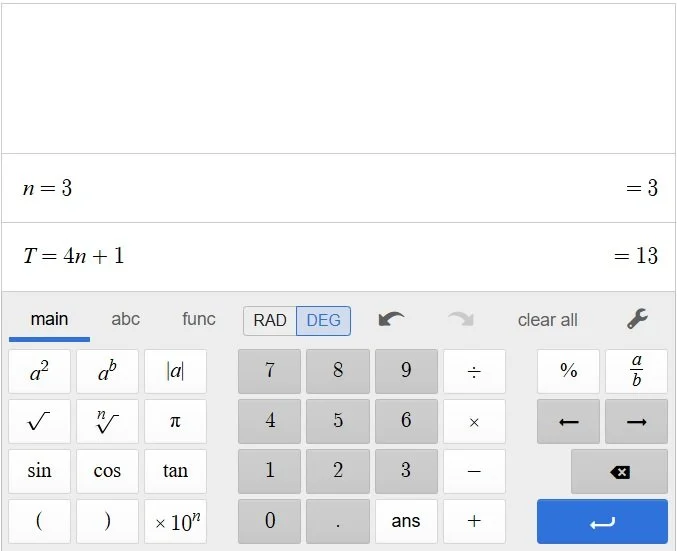
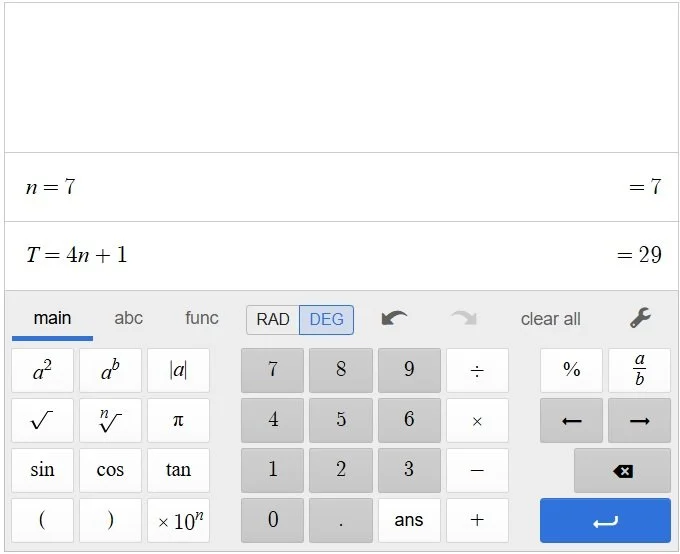
You can type the value of \(n\) into the calculator, then type in the general rule. It will automatically show the answer.
You can then update the value of \(n\) and the answer for the general rule will automatically update.
Example
Test and verify the general rule \(C=7n+5\).
| Stage (\(n\)) | Cubes (\(C\)) |
|---|---|
| 1 | 12 |
| 2 | 19 |
| 3 | 26 |
| 4 | 33 |
| 5 | 40 |
| 6 | 47 |
| 7 | 54 |
-
Test
Using \(n=3\) we get $$C=7(3)+5=26$$This matches the value given in the table.
Verify
Using \(n=6\) we get $$C=7(6)+5=47$$This matches the value I predicted by continuing the pattern in the table.
Example
Test and verify the general rule \(C=-7n+107\).
| Stage (\(n\)) | Count (\(C\)) |
|---|---|
| 1 | 100 |
| 2 | 93 |
| 3 | 86 |
| 4 | 79 |
| 5 | 72 |
| 6 | 65 |
| 7 | 58 |
-
Test
Using \(n=2\) we get $$C=-7(2)+107=93$$This matches the value given in the table.
Verify
Using \(n=5\) we get $$C=-7(5)+107=72$$This matches the value I predicted by continuing the pattern in the table.
Example
Test and verify the general rule \(T=n^{2}+3\).
| Stage (\(n\)) | Tiles (\(T\)) |
|---|---|
| 1 | 4 |
| 2 | 7 |
| 3 | 12 |
| 4 | 19 |
| 5 | 28 |
| 6 | 39 |
| 7 | 52 |
-
Test
Using \(n=4\) we get $$T=(4)^{2}+3=19$$This matches the value given in the table.
Verify
Using \(n=6\) we get $$T=(6)^{2}+3=39$$This matches the value I predicted by continuing the pattern in the table.
Example
Test and verify the general rule \(S=5\times (2)^{n-1}\).
| Stage (\(n\)) | Squares (\(S\)) |
|---|---|
| 1 | 5 |
| 2 | 10 |
| 3 | 20 |
| 4 | 40 |
| 5 | 80 |
| 6 | 160 |
| 7 | 320 |
-
Test
Using \(n=3\) we get $$S=5\times (2)^{3-1}=20$$This matches the value given in the table.
Verify
Using \(n=5\) we get $$S=5\times (2)^{5-1}=80$$This matches the value I predicted by continuing the pattern in the table.
Example
Test and verify the general rule \(P=n^{2}-1\).
| Stage (\(n\)) | Pieces (\(P\)) |
|---|---|
| 1 | 0 |
| 2 | 3 |
| 3 | 8 |
| 4 | 15 |
| 5 | 24 |
| 6 | 35 |
| 7 | 48 |
-
Test
Using \(n=2\) we get $$P=(2)^{2}-1=3$$This matches the value given in the table.
Verify
Using \(n=7\) we get $$P=(7)^{2}-1=48$$This matches the value I predicted by continuing the pattern in the table.
Example
Test and verify the general rule \(C=n^{2}-n+10\).
| Stage (\(n\)) | Circles (\(C\)) |
|---|---|
| 1 | 10 |
| 2 | 12 |
| 3 | 16 |
| 4 | 22 |
| 5 | 30 |
| 6 | 40 |
| 7 | 52 |
-
Test
Using \(n=3\) we get $$C=(3)^{2}-3+10=16$$This matches the value given in the table.
Verify
Using \(n=5\) we get $$C=(5)^{2}-5+10=30$$This matches the value I predicted by continuing the pattern in the table.
Example
Test and verify the general rule \(L=48\times\left(\frac{1}{2}\right)^{n-1}\).
| Stage (\(n\)) | Length (\(L\)) |
|---|---|
| 1 | 48 |
| 2 | 24 |
| 3 | 12 |
| 4 | 6 |
| 5 | 3 |
| 6 | 1.5 |
| 7 | 0.75 |
-
Test
Using \(n=3\) we get $$L=48\times\left(\frac{1}{2}\right)^{3-1}=12$$This matches the value given in the table.
Verify
Using \(n=6\) we get $$L=48\times\left(\frac{1}{2}\right)^{6-1}=1.5$$This matches the value I predicted by continuing the pattern in the table.
Example
Test and verify the general rule \(A=\sqrt{4n+3}\).
| Stage (\(n\)) | Area (\(A\)) |
|---|---|
| 1 | \(\sqrt{7}\) |
| 2 | \(\sqrt{11}\) |
| 3 | \(\sqrt{15}\) |
| 4 | \(\sqrt{19}\) |
| 5 | \(\sqrt{23}\) |
| 6 | \(\sqrt{27}\) |
| 7 | \(\sqrt{31}\) |
-
Test
Using \(n=4\) we get $$A=\sqrt{4(4)+3}=\sqrt{19}$$This matches the value given in the table.
Verify
Using \(n=6\) we get $$A=\sqrt{4(5)+3}=\sqrt{23}$$This matches the value I predicted by continuing the pattern in the table.
The values for \(A\) inside the square root follow a linear pattern. They increase by \(4\) each time.
$$A=\sqrt{4n+3}$$
Example
Test and verify the general rule \(M=\left(2,2n^{2}-3n+6\right)\).
| Stage (\(n\)) | Midpoint (\(M\)) |
|---|---|
| 1 | \(\left(2,5\right)\) |
| 2 | \(\left(2,8\right)\) |
| 3 | \(\left(2,15\right)\) |
| 4 | \(\left(2,26\right)\) |
| 5 | \(\left(2,41\right)\) |
| 6 | \(\left(2,60\right)\) |
| 7 | \(\left(2,83\right)\) |
-
Test
Using \(n=2\) we get $$M=\left(2,2(2)^{2}-3(2)+6\right)=\left(2,8\right)$$This matches the value given in the table.
Verify
Using \(n=7\) we get $$M=\left(2,2(7)^{2}-3(7)+6\right)=\left(2,83\right)$$This matches the value I predicted by continuing the pattern in the table.
Example
Test and verify the general rule \(R=\frac{-2n+17}{3\times 3^{n-1}}\).
| Stage (\(n\)) | Ratio (\(R\)) |
|---|---|
| 1 | \(\frac{15}{3}\) |
| 2 | \(\frac{13}{9}\) |
| 3 | \(\frac{11}{27}\) |
| 4 | \(\frac{9}{81}\) |
| 5 | \(\frac{7}{243}\) |
| 6 | \(\frac{5}{729}\) |
| 7 | \(\frac{3}{2187}\) |
-
Test
Using \(n=4\) we get $$R=\frac{-2(4)+17}{3\times 3^{4-1}}=\frac{9}{81}$$This matches the value given in the table.
Verify
Using \(n=5\) we get $$R=\frac{-2(5)+17}{3\times 3^{5-1}}=\frac{7}{243}$$This matches the value I predicted by continuing the pattern in the table.
Testing and Verifying
| Stage (\(n\)) | Value |
|---|
Note: You can press the Test and Verify button again to get different values for this sequence.